- Animals
- ›Arthropods
- ›Hexapods
- ›Insects
- ›Winged and Once-winged Insects
- ›Ants, Bees, Wasps, and Sawflies
- ›Narrow-waisted Wasps, Ants, and Bees
- ›Ichneumonid and Braconid Wasps
- ›Ichneumonid Wasps
- ›Ctenopelmatinae
- ›Pionini
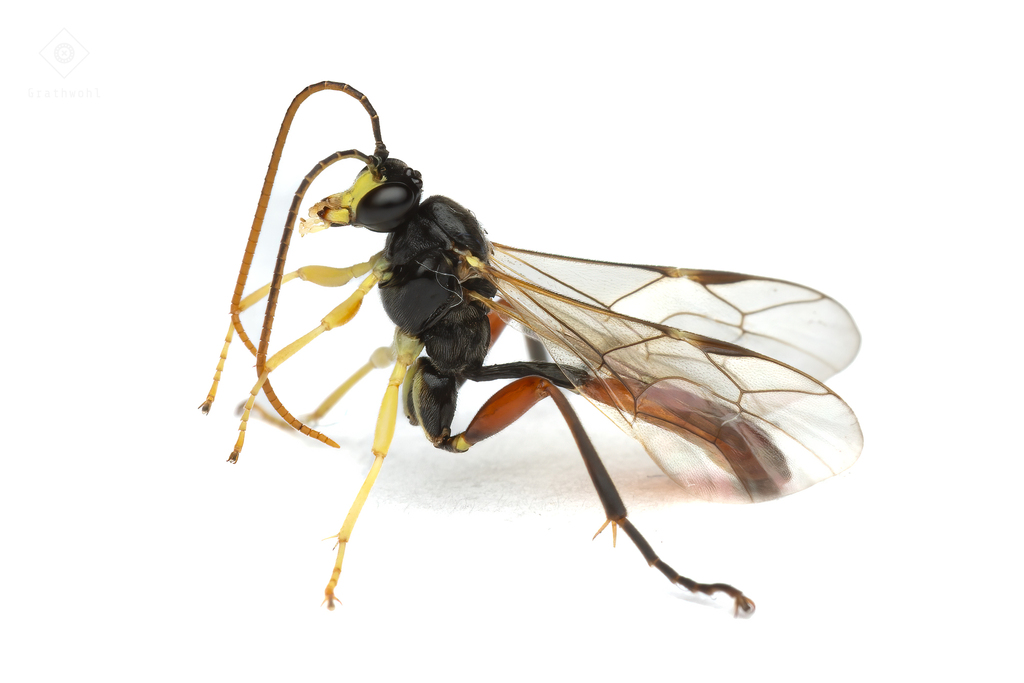
Pion
In particle physics, a pion (/ˈpaɪ.ɒn/, PIE-on) or pi meson, denoted with the Greek letter pi (π), is any of three subatomic particles: π0, π+, and π−. Each pion consists of a quark and an antiquark and is therefore a meson. Pions are the lightest mesons and, more generally, the lightest hadrons. They are unstable, with the charged pions π+ and π− decaying after a mean lifetime of 26.033 nanoseconds (2.6033×10⁻⁸ seconds), and the neutral...
3 branches of this genus, most-observed first
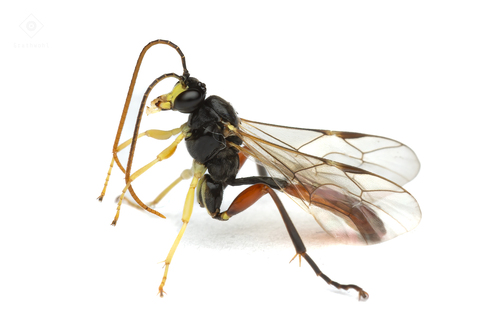
Pion fortipes
speciesPion fortipes
Pion crassipes
speciesPion crassipes
Pion nigripes
speciesPion nigripes
Where it lives
Recorded sightings
—
geo-referenced records in GBIF, from museums, herbaria and field observers.
Drag the globe to turn it. Dots are where records exist, not a range map; darker means more records.
In the old herbals & bestiaries

Phytognomonica
Giambattista della Porta · 1588 · p.162

The Dialogue of Creatures
Anonymous · 1509 · p.39

Ulyssis Aldrovandi ... De animalibus insectis libri septem
Aldrovandi, Ulisse · 1618 · p.240

Experiments on the Generation of Insects
Francesco Redi · 1668 · p.85

Herbarius latinus (with Dutch synonyms)
1486 · p.211

The History of the Holy Grail
1523 · p.163

Physiologia Kircheriana Experimentalis
Athanasius Kircher · 1680 · p.60

Florentine Codex, Vol. 3 (Books 10-12)
Bernardino de Sahagún · 1577 · p.501

Garden of Health (Hortus Sanitatis)
Jacob Meydenbach · 1491 · p.539

Commentaries on the Six Books of Pedanius Dioscorides on Medical Matter
Pietro Andrea Mattioli · 1565 · p.489

History of Animals, Book II: On Oviparous Quadrupeds
Conrad Gessner · 1586 · p.453

Living Images of Plants
Otto Brunfels · 1532 · p.427
In the stacks
Searching the stacks…
Every page naming Pion in the Biodiversity Heritage Library →
This page is assembled live from iNaturalist, GBIF, Wikipedia, the Source Library and the Internet Archive. It is not yet part of the hand-edited codex. iNaturalist taxon 638879.