- Plants
- ›Vascular Plants
- ›flowering plants
- ›Dicots
- ›Sunflowers, Bellflowers, Fanflowers, and Allies
- ›Sunflowers, Daisies, Asters, and Allies
- ›Asteroideae
- ›asters and allies
- ›Asterinae
- ›Aster
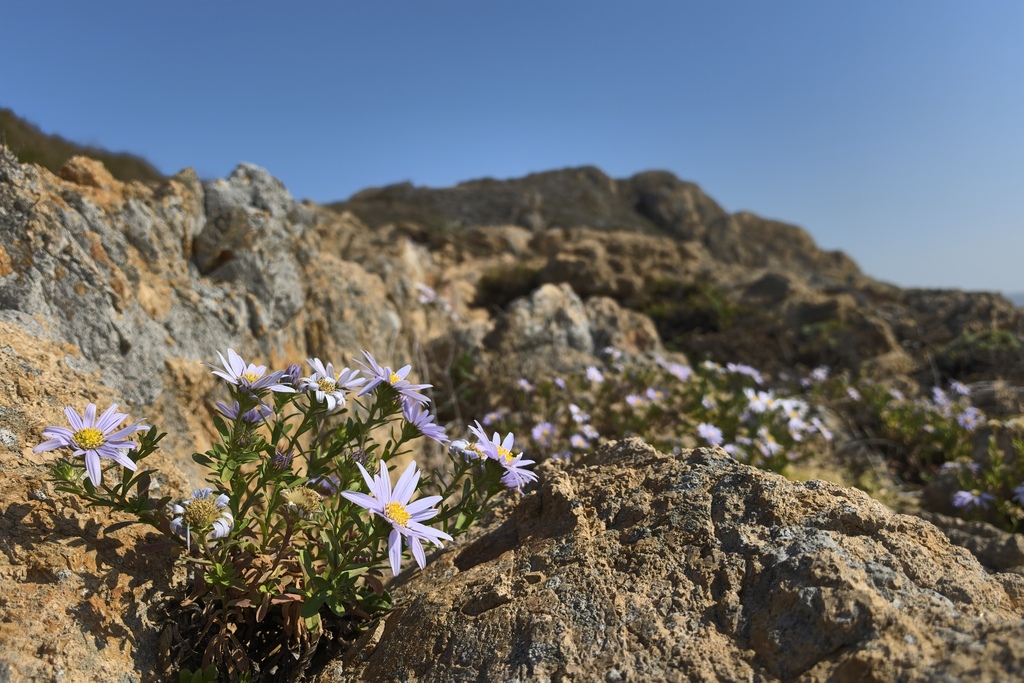
Beach-sand aster
Aster arenarius
Aster arenarius, commonly known as the beach sand aster, is a species of aster endemic to southeast China, Japan, and Korea.
From the article Aster arenarius on Wikipedia (CC BY-SA), quoted section by section
Description
Aster arenarius is a herbaceous biennial or perennial plant, which grows to a height of 15–70 cm (5.9–27.6 in). Stems are branched from the base, with spatulate leaves measuring between 1.5 and 3 cm (0.59 and 1.18 in). Leaves are alternate, entire or dentate. Roots are tuberous or woody rhizomes. Flowers are typically blue-violet or white, with yellow centres. The fruit is an achene, ripening in September to October, ovate, measuring 3.0–3.5 mm (0.12–0.14 in) long and 1.8–3.0 mm (0.071–0.118 in) wide, with hairs on the margins.
At the table
The flowers have been used not only for ornamental purposes, but also as raw materials in the manufacturing process due to the increasing demand for natural compounds various industries. The young shoots of the plant are edible. Research has confirmed that Aster arenarius is high in antioxidants and other valuable natural resources that can be used in the pharmaceutical, perfume, and cosmetic industries.
== References ==
Wikipedia: “Uses”
Where it lives
Recorded sightings
—
geo-referenced records in GBIF, from museums, herbaria and field observers.
Drag the globe to turn it. Dots are where records exist, not a range map; darker means more records.
In the stacks
Searching the stacks…
Every page naming Aster arenarius in the Biodiversity Heritage Library →
This page is assembled live from iNaturalist, GBIF, Wikipedia, the Source Library and the Internet Archive. It is not yet part of the hand-edited codex. iNaturalist taxon 635737.