- Animals
- ›Arthropods
- ›Hexapods
- ›Insects
- ›Winged and Once-winged Insects
- ›Beetles
- ›Water, Rove, Scarab, Long-horned, Leaf, and Snout Beetles
- ›Scarabaeiform Beetles
- ›Scarabs, Stag Beetles, and Allies
- ›Scarabs
- ›Dung Beetles
- ›Phanaeini
- ›Oxysternon
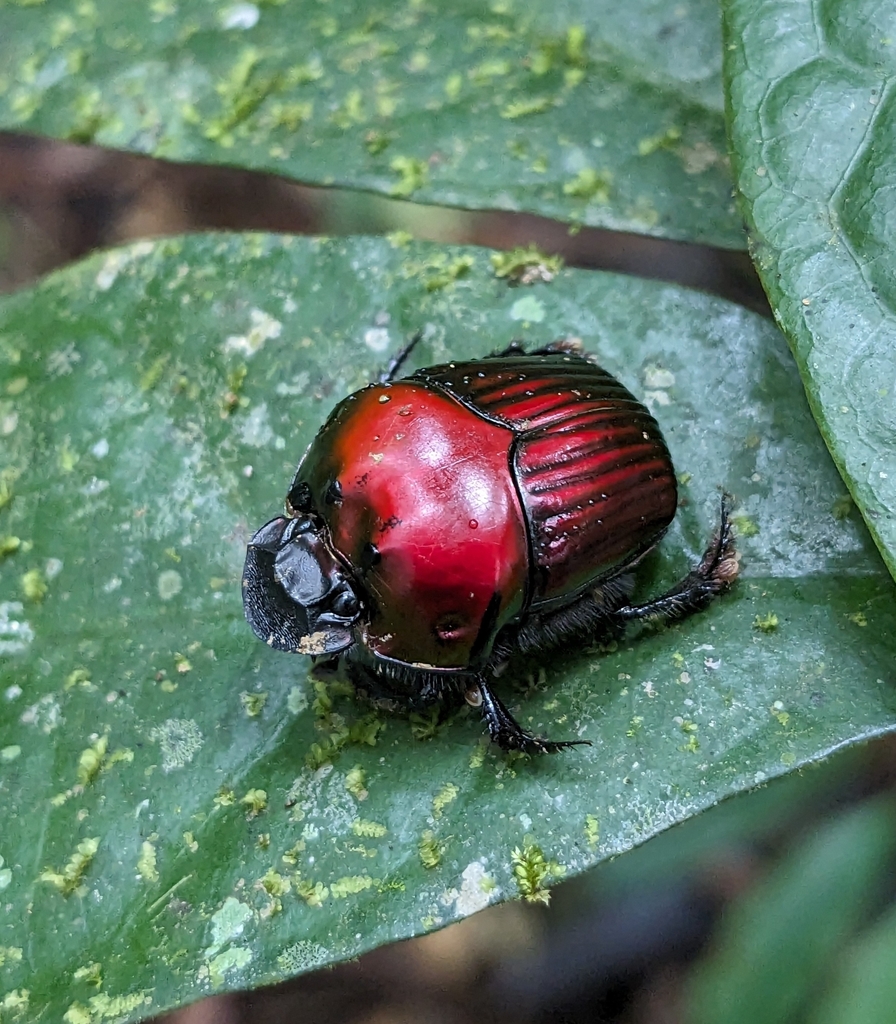
Oxysternon festivum
Oxysternon festivum is a species of dung beetle of the scarab beetle family. It is a common, diurnal species from northeastern South America and Trinidad where it mostly inhabits forest.
From the article Oxysternon festivum on Wikipedia (CC BY-SA), quoted section by section
Description
Adults are 14–25 mm (0.55–0.98 in) long, with average being 21 mm (0.83 in). The species show sexual polymorphism: Major males are horned and females are hornless, while minor males are hornless and often smaller than major males. Females and minor males differ in details of the head shape, specifically the transverse carina. O. festivum has a colored upperside and black head and underside; the pronotum is smooth. As most Oxysternon species, it has considerable variation in the color of the upperside. In mainland South America, it is typically metallic coppery-red, sometimes with greenish highlights, but occasionally it can be metallic green or rarely black with reddish tones. On the island of Trinidad, the upperside is entirely black and thus it is considered as a separate subspecies, O. festivum nigerrimum.
Wikipedia: “Appearance”
Range & habitat
This species largely is restricted to the Guiana Shield and can be found in French Guiana, Guyana, Suriname, Venezuela, eastern Colombia, northeastern Brazil, and Trinidad. The vast majority of its range is north of the Amazon River. O. festivum mostly lives in tropical humid forests, but may also occur in savanna and can tolerate certain degree of habitat changes. It occurs from near sea level to an altitude of 1,500 m (4,900 ft).
Wikipedia: “Distribution and habitat”
What it does
O. festivum is attracted to dung, carrion and fruits as food resources, but only commonly feeds and breeds on dung from mammals, less frequently carrion. It has not been studied in O. festivum, but in related species of dung beetles where it has been studied the distinct male morphotypes are associated with different reproductive tactics: major males fight for females and guard and defend burrows actively, while minor males evade fights and try to sneak to the burrows to mate with females.
== References ==
Wikipedia: “Behaviour”
Listen
Looking for field recordings…
Where it lives
Recorded sightings
—
geo-referenced records in GBIF, from museums, herbaria and field observers.
Drag the globe to turn it. Dots are where records exist, not a range map; darker means more records.
In the stacks
Searching the stacks…
Every page naming Oxysternon festivum in the Biodiversity Heritage Library →
This page is assembled live from iNaturalist, GBIF, Wikipedia, the Source Library and the Internet Archive. It is not yet part of the hand-edited codex. iNaturalist taxon 635095.