- Animals
- ›Chordates
- ›Vertebrates
- ›Ray-finned Fishes
- ›Spiny-rayed fishes
- ›Butterflyfishes, Angelfishes, and Allies
- ›Snappers
- ›Fusiliers
- ›Lutjanus
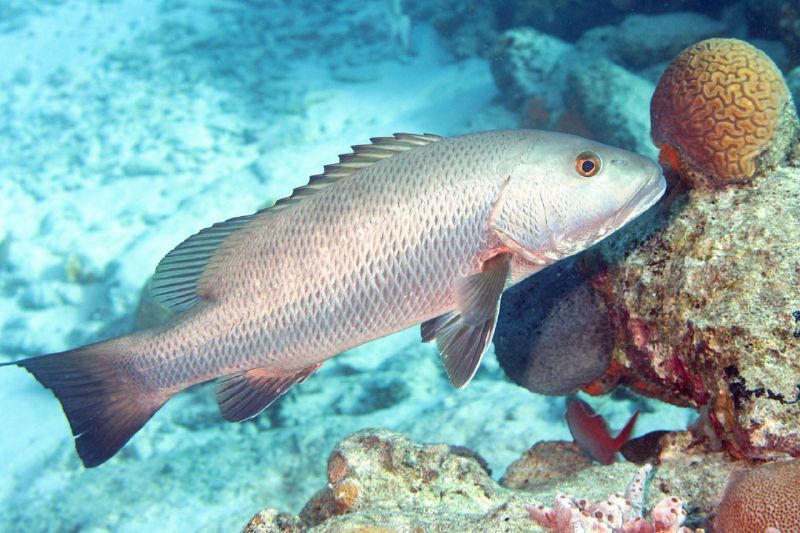
Cubera Snapper
Lutjanus cyanopterus
The cubera snapper (Lutjanus cyanopterus) is a species of snapper native to the western Atlantic Ocean from Nova Scotia to the Amazon River in Brazil, though it is rare north of Florida. It can also be found in the Caribbean Sea and, rarely, in the Gulf of Mexico. It inhabits areas associated with reefs, preferring areas with rocky substrates, and feeds on ray-finned fishes, shrimp and crabs. It can be found at depths from 18 to...
From the article Cubera snapper on Wikipedia (CC BY-SA), quoted section by section
Description
The cubera snapper has an oval-shaped, rather streamlined, elongate body, which is less deep than many other snapper species. It has a pair of front nostrils and a pair of rear nostrils that are simple holes in its snout. The mouth is relatively large with thick lips. The jaws are equipped with canine teeth, one enlarged pair being visible when the mouth is closed. The vomerine teeth are arranged in a crescent-shaped or triangular patch with no central posterior extension, with a tooth patch on each side of the roof of the mouth. The preoperculum has a weakly developed knob and notch. This species has long pectoral fins, a continuous dorsal fin, and a truncated caudal fin. The dorsal fin contains 10 spines and 14 soft rays, while the anal fin has three spines and seven or eight soft rays, sometimes, a notch is seen behind the spiny part of the dorsal fin. The maximum total length recorded for this species is 160 cm (63 in), although a length of 90 cm (35 in) is more typical; the maximum published weight is 57 kg (126 lb). The overall colour of this species is grey to dark brown with pale to dark-grey flanks with some individuals showing a slight reddish hue on the body. The caudal fin is light grey, the pectoral fins may be translucent to pale grey, and a bluish hue is seen on the anal, pectoral, and pelvic fins. The juveniles show an indistinct barred pattern on their flanks.
Range & habitat
The cubera snapper is found in the western Atlantic Ocean, from as far north as Nova Scotia to as far south as Santa Catarina in Brazil, and throughout the Caribbean Sea and the Gulf of Mexico and around Bermuda. It has been recorded from the Flores Islands in the Azores. It occurs at depths between 1 and 85 m (3 ft 3 in and 278 ft 10 in). The juveniles shelter within beds of sea grass in in-shore waters or in mangroves, and have been recorded entering fresh water. The adults move off-shore, where they inhabit rocky ledge and reef habitats.
Wikipedia: “Distribution and habitat”
What it does
The cubera snapper is the largest species of snapper and is a predatory fish, its main prey being other fishes, with some crustaceans. The large canine teeth allow this species to feed on large crustaceans such as lobsters and crabs. They forage near the bottom or in the vicinity of hard structures. The whale shark (Rhincodon typus) feeds on the newly laid pelagic spawn of cubera snappers, while the larger fish are prey to moray eels, barracudas, groupers, other snappers, and large sharks.
Wikipedia: “Feeding”
Where it lives
Recorded sightings
—
geo-referenced records in GBIF, from museums, herbaria and field observers.
Drag the globe to turn it. Dots are where records exist, not a range map; darker means more records.
In the stacks
Searching the stacks…
Every page naming Lutjanus cyanopterus in the Biodiversity Heritage Library →
This page is assembled live from iNaturalist, GBIF, Wikipedia, the Source Library and the Internet Archive. It is not yet part of the hand-edited codex. iNaturalist taxon 63418.