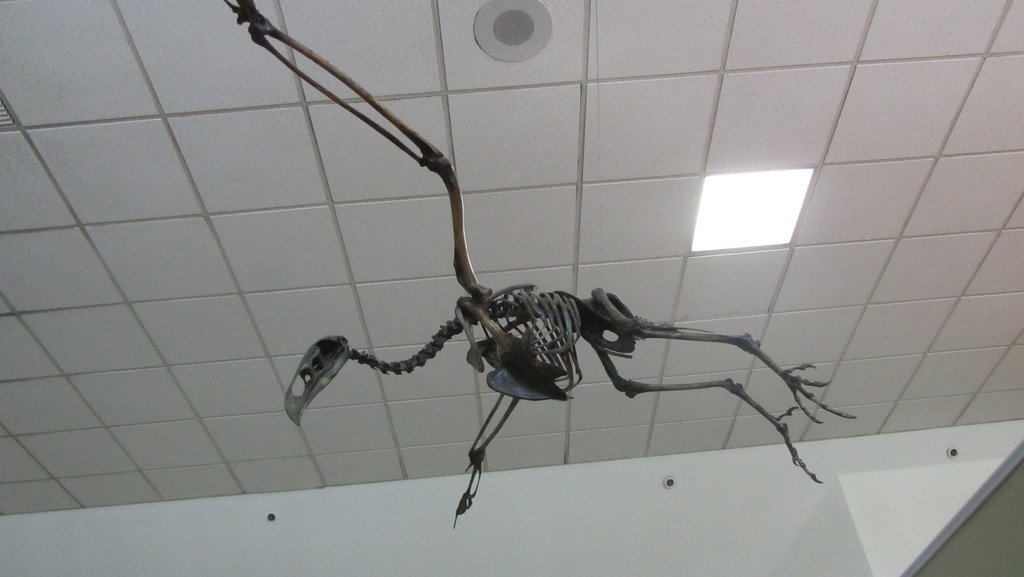
Merriam's Teratorn
Teratornis merriami
Teratornis is an extinct genus of huge North American birds of prey—the best-known of the teratorns—of which, two species are known to have existed: Teratornis merriami and Teratornis woodburnensis. A large number of fossil and subfossil bones, representing more than 100 individuals, have been found in locations in California, Oregon, southern Nevada, Arizona, and Florida, though most are from the Californian La Brea Tar Pits. All remains are known from the Late Pleistocene except one partial skeleton from the Early Pleistocene Leisey Shell Pit near Charlotte Harbor, Florida.
From the article Teratornis on Wikipedia (CC BY-SA), quoted section by section
Description
According to description of 1945, Teratornis merriami had a wingspan of around 3.5 to 3.8 m (11 to 12 ft) and a wing area of 17.5 square meters, standing an estimated 75 cm (30 in) tall. It was somewhat larger than the extant Andean condor, and by calculating the area of the organism's sternum and synsacrum, Teratornis was estimated to weigh about 22.5 kg (50 lb), which was nearly double the weight of an average Californian condor. A 1983 study gives a range of wingspan of 2.938–3.379 m (9.64–11.09 ft) and a weight of 13.7 kg (30 lb). The finger bones of Teratornis were fused as in all modern birds; however, part of the index finger forms a shelf which aided in bearing the load of long and stout primaries, enabling the bird to utilize strong upcurrents in flight. Their legs were similar to an Andean condor's, but stouter, and the feet could hold prey for tearing off pieces, but could not exert a very forceful grip like birds of prey. Its wing loading was not much larger than a Californian condor's, and Merriam's teratorn should have been able to take off by simply jumping and beating its wings under most circumstances. Nonetheless, it seems to have been better adapted for utilizing a short run into the wind from an elevated location as condors do, as its legs are proportionally smaller and its stride less than in condors. …
Range & habitat
Teratornis had legs that were too short for it to take flight by running on flat ground. It is theorized that Teratornis primarily inhabited cliff terrain, where it could take off and soar through the air easily. Many teratorn bone samples contributing to modern research have been found at the La Brea Tar Pits in Los Angeles, California. Teratorns are thought to have been attracted by Pleistocene megafauna that became stuck and died in the viscous asphalt while trying to drink from pools of water that gathered on the surface, with the teratorns subsequently falling victim to the sticky deposits. Merriam's teratorn probably played an important role in opening up the body cavities of carcasses trapped in asphalt for smaller birds like eagles and ravens, which are also known to have frequented the locality, as mammalian predators would have been unable to reach most carcasses without getting mired in the asphalt themselves.
== References ==
Wikipedia: “Habitat”
What it does
Teratornis merriami was similar to condors, although an analysis of the functional morphology of its skull, namely its larger beak and ability to spread its mandibles and swallow its prey whole, suggests that it was an active predator rather than a scavenger. In fact, some studies of skull morphology indicated that T. merriami was incapable of tearing pieces of flesh off of carcasses in the manner of condors. Alternative viewpoints note that many Old World vultures possess large bills, and a longer bill is a common feature among scavenging raptors, as this allows them to probe deeper into large carcasses - larger than those fed upon by active-hunting raptors. Other anatomical features, such as the relatively small and sideward facing orbits and the low skull, are also consistent with a scavenging lifestyle. For T. merriami, small prey such as frogs, lizards, young birds, and small mammals were swallowed whole, while carrion would have been fed on in a manner similar to that of condors or vultures. δ2H, δ13C, and δ15N analysis has found that T. merriami relied significantly on terrestrial megafaunal carrion, which may have contributed to its disappearance during the Late Pleistocene megafaunal extinction.
Wikipedia: “Diet and feeding habits”
Listen
Looking for field recordings…
Where it lives
Recorded sightings
—
geo-referenced records in GBIF, from museums, herbaria and field observers.
Drag the globe to turn it. Dots are where records exist, not a range map; darker means more records.
In the stacks
Searching the stacks…
Every page naming Teratornis merriami in the Biodiversity Heritage Library →
This page is assembled live from iNaturalist, GBIF, Wikipedia, the Source Library and the Internet Archive. It is not yet part of the hand-edited codex. iNaturalist taxon 631781.