On eBird ↗
Chestnut-collared Swallow
Live sightings near you, the range map, bar charts of when it is seen, and Macaulay Library photos and recordings.
Chestnut-collared Swallow
Petrochelidon rufocollaris
The chestnut-collared swallow (Petrochelidon rufocollaris) is a species of bird in the family Hirundinidae. It is found in Ecuador and Peru. Its natural habitats are pastureland and heavily degraded former forest.
From the article Chestnut-collared swallow on Wikipedia (CC BY-SA), quoted section by section
Description
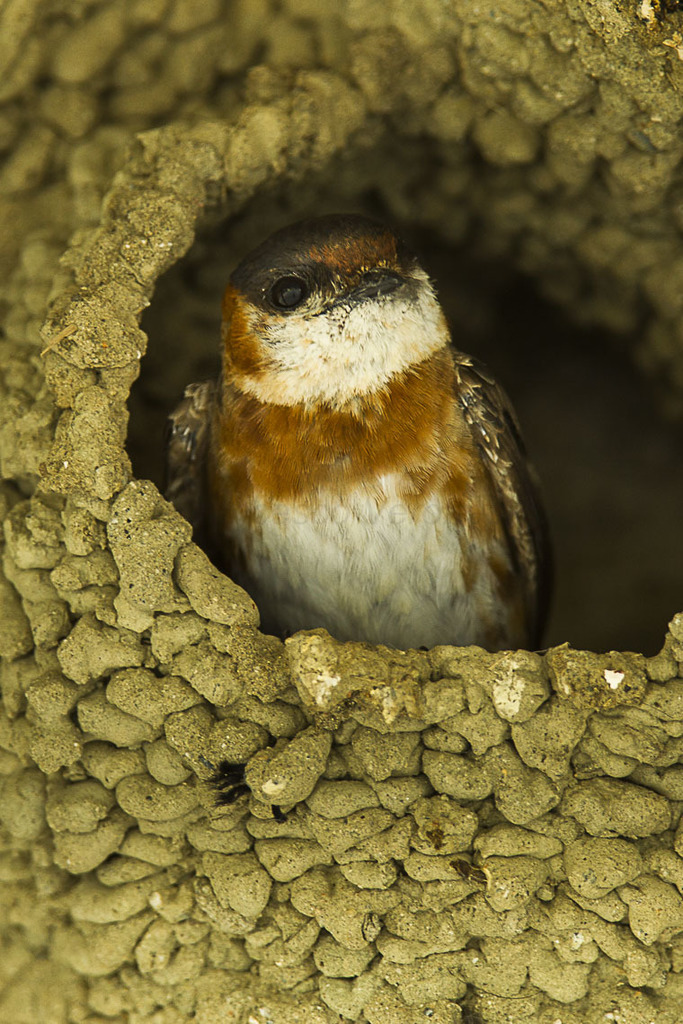
The chestnut-collared swallow is 12 to 12.5 cm (4.7 to 4.9 in) long and weighs 14 to 18 g (0.49 to 0.63 oz). Both sexes of both subspecies have essentially the same plumage. Adults have a dark chestnut forecrown and hindneck. Their crown and back are glossy blue-black with white streaks on the mantle and their rump is chestnut. Their ear coverts and throat are white that sometimes has a buff tinge. Their wings and tail are blackish brown. Their underparts are partially white with a rufous-chestnut band across the upper breast, rufous-chestnut flanks, and a brown or chestnut vent. They have a black bill, pinkish brown legs, and black feet. Juveniles are duller and browner than adults.
Range & habitat
Subspecies P. r. aequatorialis of the chestnut-collared swallow is the more northerly of the two. It is found in southwestern Ecuador from central Manabí Province south about to the Peruvian border in Loja Province. The nominate subspecies is found from there south in Peru through Lima Department. The species primarily inhabits agricultural areas and their associated towns. In elevation it ranges from sea level to about 2,000 m (6,600 ft) in Ecuador and to 1,000 m (3,300 ft) in Peru.
Wikipedia: “Distribution and habitat”
What it does
The chestnut-collared swallow's diet has not been studied. It is assumed to feed on insects captured in mid-air like other swallows. It forages in flocks that often include other swallow species, usually low to the ground over fields and around buildings.
Wikipedia: “Feeding”
Listen
Looking for field recordings…
Where it lives
Recorded sightings
—
geo-referenced records in GBIF, from museums, herbaria and field observers.
Drag the globe to turn it. Dots are where records exist, not a range map; darker means more records.
In the stacks
Searching the stacks…
Every page naming Petrochelidon rufocollaris in the Biodiversity Heritage Library →
This page is assembled live from iNaturalist, GBIF, Wikipedia, the Source Library and the Internet Archive. It is not yet part of the hand-edited codex. iNaturalist taxon 62557.