On eBird ↗
Moustached Antwren
Live sightings near you, the range map, bar charts of when it is seen, and Macaulay Library photos and recordings.
Moustached Antwren
Myrmotherula ignota
The moustached antwren (Myrmotherula ignota) is a species of small Neotropical bird in the family Thamnophilidae. It has two allopatric subspecies, both sometimes considered separate monotypic species: The Griscom's antwren (M. (i.) ignota) is found the Chocó of north-western Ecuador, western Colombia and eastern Panama, and the short-billed antwren (M. (ignota) obscura) is found in the Amazon of north-eastern Peru, eastern Ecuador, south-eastern Colombia and north-western Brazil. The former has sometimes been considered conspecific with the...
From the article Moustached antwren on Wikipedia (CC BY-SA), quoted section by section
Description
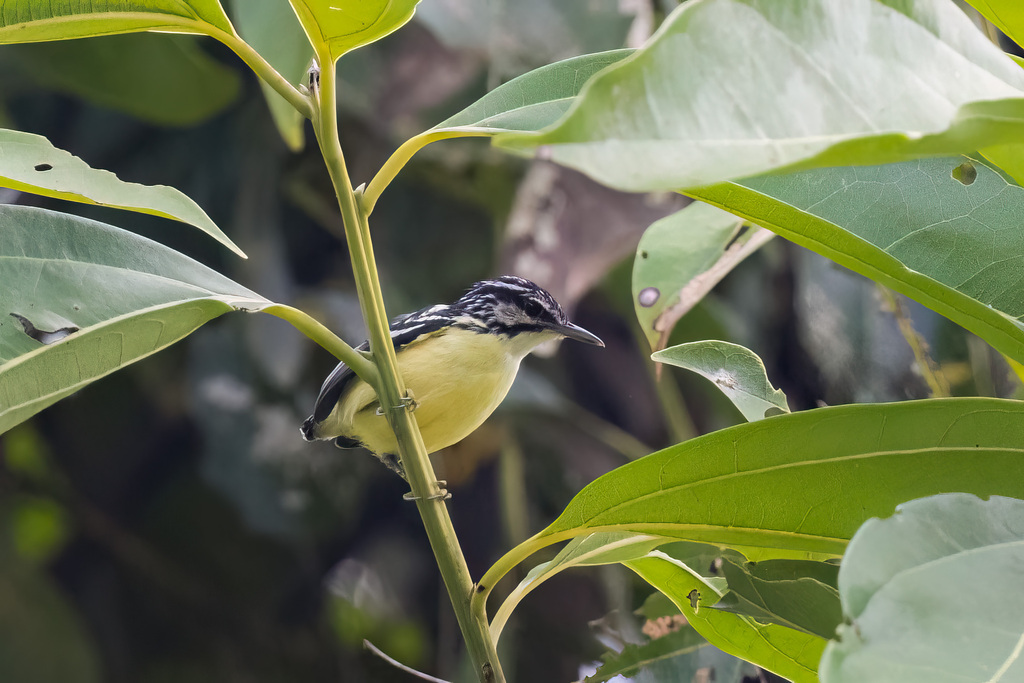
The moustached antwren is 7.5 to 8 cm (3.0 to 3.1 in) long. It is a small bird with a tiny tail. Adult males of the nominate subspecies have the eponymous wide black "moustache", a black streak through the eye, and white cheeks. Their crown, back, rump, and tail are black with thin white streaks that are faintly yellow except on the crown. They have a white patch between the shoulders. Their wings are black with white tips on the coverts and white edges on the flight feathers. Their underparts are yellow with sparse black streaks. Adult females have buff to tawny buff streaks on the crown and lack the white patch between the shoulders. Males of subspecies M. i. obscura have fewer pale streaks on their upperparts than the nominate. Females have a buffier head, throat, and breast than the nominate.
Range & habitat
The moustached antwren has a disjunct distribution. The nominate subspecies is found in Panama, on the Caribbean slope in the Panama Canal area and Guna Yala (San Blas) and on the Pacific slope from Panamá Province east. Its range continues into northern Colombia to Santander Department and through western Colombia into northwestern Ecuador as far as northwestern Pichincha Province. Subspecies M. i. obscura is found from south-central and southeastern Colombia south through eastern Ecuador into northeastern Peru and east into southwestern and west-central Brazil as far as the Rio Negro. The moustached antwren primarily inhabits the canopy and subcanopy of lowland evergreen forest. The nominate subspecies also occurs in mature secondary forest. In the Amazon Basin M. i. obscura is found in both terra firme and várzea. In all areas the species favors forest edges, the edges of openings provided by fallen trees, and along watercourses. In elevation the species reaches 1,100 m (3,600 ft) in Panama, 1,000 m (3,300 ft) in Colombia, and 600 m (2,000 ft) elsewhere.
Wikipedia: “Distribution and habitat”
What it does
The moustached antwren feeds on arthropods, especially insects and including spiders. It typically forages singly, in pairs, or in family groups and sometimes joins mixed-species feeding flocks. It forages in the forest's mid-storey to the canopy, typically between 10 and 40 m (30 and 130 ft) up. It actively seeks prey along thin branches and vines, and gleans from foliage, branches, and mosses. It occasionally flutters from a perch to capture prey in mid-air or by hover-gleaning.
Wikipedia: “Feeding”
Listen
Looking for field recordings…
Where it lives
Recorded sightings
—
geo-referenced records in GBIF, from museums, herbaria and field observers.
Drag the globe to turn it. Dots are where records exist, not a range map; darker means more records.
In the stacks
Searching the stacks…
Every page naming Myrmotherula ignota in the Biodiversity Heritage Library →
This page is assembled live from iNaturalist, GBIF, Wikipedia, the Source Library and the Internet Archive. It is not yet part of the hand-edited codex. iNaturalist taxon 62539.