On eBird ↗
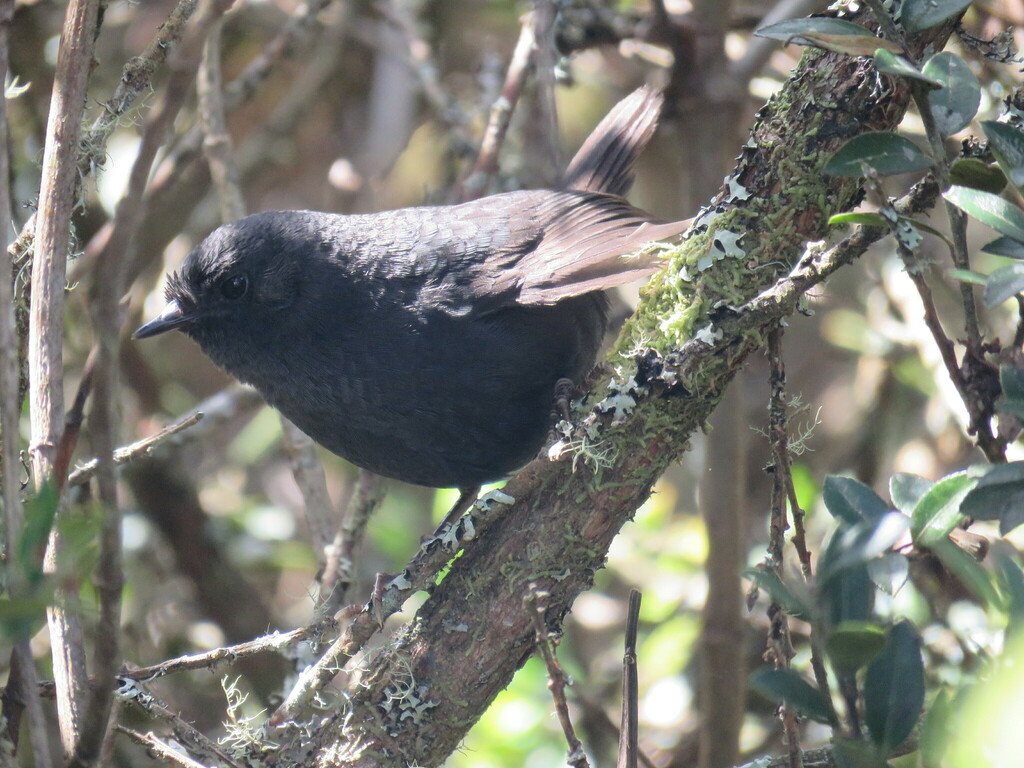
Blackish Tapaculo
Live sightings near you, the range map, bar charts of when it is seen, and Macaulay Library photos and recordings.
Blackish Tapaculo
Scytalopus latrans
The blackish tapaculo (Scytalopus latrans) is a species of bird in the Rhinocryptidae family. It is found in Colombia, Ecuador, Peru, and Venezuela. Its natural habitat is subtropical or tropical moist montane forests.
From the article Blackish tapaculo on Wikipedia (CC BY-SA), quoted section by section
Description
The blackish tapaculo is approximately 11 cm (4.3 in) long. Males weigh 16 to 21 g (0.56 to 0.74 oz) and females 14 to 20 g (0.49 to 0.71 oz). The male of the "blackish" subspecies is dark to very dark gray and the female is dark gray, sometimes with an olive wash. The juvenile is not well known but is believed to be dull brown. The "Pacific" subspecies male is black while the female is gray, darker above and lighter below, with brown flanks. The juvenile is brown.
Range & habitat
The "blackish" subspecies of blackish tapaculo inhabits both slopes and interior ranges of the Andes from western Venezuela through Colombia and Ecuador to northern Peru. The "Pacific" subspecies inhabits the western slope of the Andes of southwest Ecuador and northwest Peru. The species is believed to be sedentary. The blackish tapaculo is found in the understory of moist montane forest at elevations between 1,500 and 4,000 m (4,900 and 13,100 ft). Typical vegetative associations include Chusquea bamboo and Polylepis scrub. It also inhabits other shrubs, swampy areas, and second growth.
Wikipedia: “Distribution and habitat”
What it does
The blackish tapaculo feeds on and near the ground, gleaning soil, moss, foliage, and stems for small arthropods.
Wikipedia: “Feeding”
Listen
Looking for field recordings…
Where it lives
Recorded sightings
—
geo-referenced records in GBIF, from museums, herbaria and field observers.
Drag the globe to turn it. Dots are where records exist, not a range map; darker means more records.
In the stacks
Searching the stacks…
Every page naming Scytalopus latrans in the Biodiversity Heritage Library →
This page is assembled live from iNaturalist, GBIF, Wikipedia, the Source Library and the Internet Archive. It is not yet part of the hand-edited codex. iNaturalist taxon 62506.