- Plants
- ›Vascular Plants
- ›flowering plants
- ›Dicots
- ›Legumes, Milkworts, and Allies
- ›Legumes
- ›Faboideae
- ›Peas, Vetches, and Allies
- ›Lathyrus
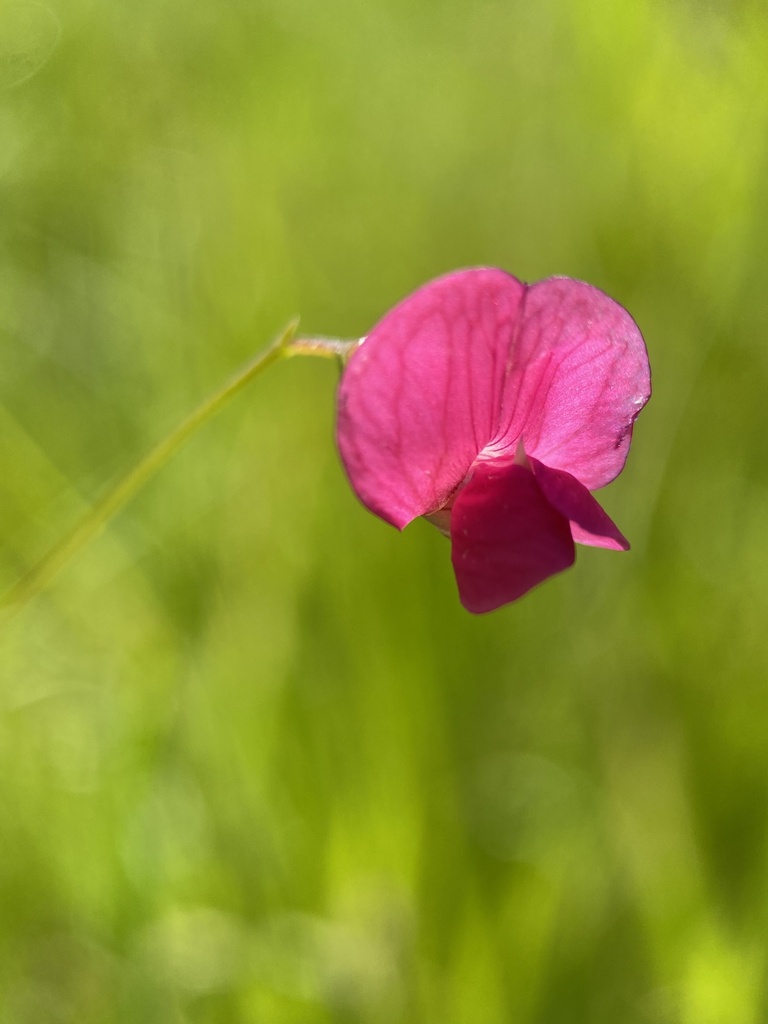
Grass Vetchling
Lathyrus nissolia
Lathyrus nissolia, the grass vetchling, is a species of flowering plant in the pea and bean family Fabaceae. Its common name refers to the grass-like foliage; an older alternative name is grass pea.
From the article Lathyrus nissolia on Wikipedia (CC BY-SA), quoted section by section
Description
Grass vetchling is an annual plant, with an erect stem branching from the base, and growing to a height of up to 90 cm. It is entirely without true leaves, leaflets or tendrils. The leaf stalk, however, is flattened out until it closely resembles a blade of grass up to 15 cm long and ending in a fine point, and the stipules at its base greatly help the deception. The crimson flowers come out in June and July, and are rather small (8–18 mm long), solitary or in pairs, on a very long peduncle. They have the ability to self-pollinate. The flowers are succeeded by long, slender, straight pods, which are at first very flat, but become cylindrical when the contained peas are fully developed.
Range & habitat
It is native to most of Europe, Maghreb, Levant and the Caucasus. In the United Kingdom, where it is currently spreading, it is widespread in southern and central England and Wales, but scarcer in northern England, and localised in Scotland where it is restricted to the Central Belt. In 2012 it had not been recorded from Ireland, but had become established there as a neophyte by 2020.
Wikipedia: “Distribution”
Where it lives
Recorded sightings
—
geo-referenced records in GBIF, from museums, herbaria and field observers.
Drag the globe to turn it. Dots are where records exist, not a range map; darker means more records.
In the stacks
Searching the stacks…
Every page naming Lathyrus nissolia in the Biodiversity Heritage Library →
This page is assembled live from iNaturalist, GBIF, Wikipedia, the Source Library and the Internet Archive. It is not yet part of the hand-edited codex. iNaturalist taxon 62017.