- Plants
- ›Vascular Plants
- ›flowering plants
- ›Dicots
- ›Sunflowers, Bellflowers, Fanflowers, and Allies
- ›Sunflowers, Daisies, Asters, and Allies
- ›chicories, dandelions, and allies
- ›Lettuce, Chicory, Dandelion and Salsify Tribe
- ›Oxtongues, Hawkbits and Allies
- ›Helminthotheca
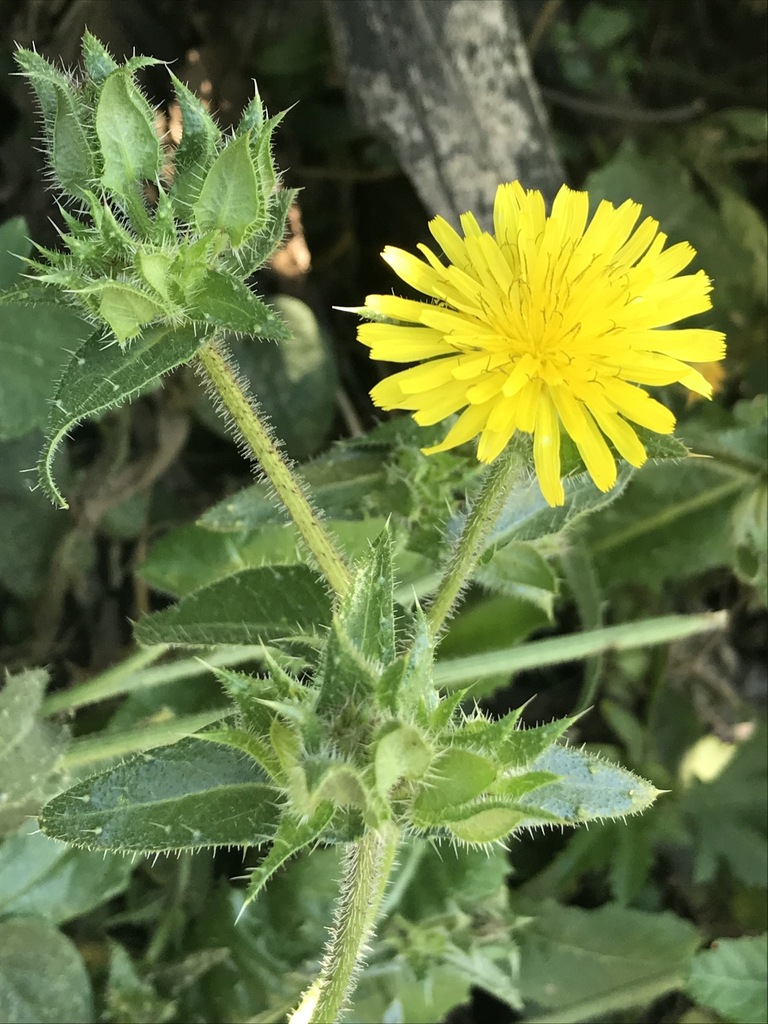
bristly oxtongue
Helminthotheca echioides
Helminthotheca echioides, known as bristly (or prickly) oxtongue, is a sprawling annual or biennial herb native to Europe and North Africa. It was originally placed within the genus Picris but is often separated within the small genus Helminthotheca alongside a few other (mainly North African) plants which also have the distinctive outer row of bracts around the flowerheads. It is a ruderal plant, found on waste ground and agricultural soils around the world, and in some places it is considered a troublesome weed.
From the article Helminthotheca echioides on Wikipedia (CC BY-SA), quoted section by section
Description
Bristly oxtongue is an annual to biennial herb with an erect or sprawling habit that grows up to 90 cm (35 in) tall (often up to 150 cm in fertile soils and shady places), with a solid, furrowed stem and spreading branches. The basal rosette leaves are 10–20 cm (4–8 in) long, oblanceolate with a short petiole, whereas the cauline leaves are lanceolate and sessile with clasping, cordate bases. On the leaves and stem (especially on the basal leaves) there are distinctive sharp bristles, 2 mm long, with swollen whitish bases that resemble blisters. On other parts of the plant there is a scattering of smaller, anchor-shaped hairs with recurved double-pronged tips which make the plant feel sticky.
In northern Europe it flowers from May to October. The inflorescences arise on long stalks from the leaf axils in an irregular corymb. Each flowerhead is 2–3.5 cm (0.8–1.4 in) wide with numerous yellow ray flowers (the outer florets sometimes tinged red/brown). They are surrounded by three rows of involucral bracts: an inner ring which is narrow and blunt-tipped with a spiny awn that arises just below the tip; a middle ring of tiny bracts which are easily overlooked and sit at the base of the inner row (they are important in separating this from other species of Helminthotheca); and an outer ring which is made up of 3 to 5 large, ovate-cordate flaps that later surround the seed head. …
Range & habitat
Helminthotheca echioides is thought to be native to North Africa and the Mediterranean Basin, where it grows in semi-arid conditions that are reproduced in the ruderal habitats associated with agriculture and the disturbed soils created by human activity throughout the world. As a result, it has spread as a weed to all the continents (except mainland Antarctica), and it is often abundant in farmland and towns. The IUCN has not yet assessed the global status of bristly oxtongue, but where it has been assessed within its native range, it is generally assigned to the category LC (least concern).
In Great Britain it is common in the south and east and more patchily distributed to the north and west, whereas it is rare in Ireland. It is considered to be an archaeophyte (ancient introduction) throughout the British Isles, and it is thought to be increasing in many areas. It has been introduced to North America, where it can now be found from Nova Scotia to British Columbia and California, and it is classified as an invasive weed. It was first noticed in Australia in 1871 and has since spread to most parts of the country.
Wikipedia: “Distribution and status”
What it does
Bristly oxtongue is an opportunist species which will colonise disturbed ground very quickly. It is considered to act as a therophyte, which completes its life cycle quickly, or a hemicryptophyte, which has a basal rosette to survive unfavourable conditions such as winter or drought. The feathery pappus allows seeds to be widely dispersed by the wind, but it has no capacity for vegetative spread (for example, by stolons or bulbs). Typical habitats for it include waste ground, field margins, sea walls, road verges and banks on clay soils or chalk. One reason for its success is that it is particularly resistant to drought, being able to sprout from basal shoots after dry periods. It generally grows in places where there is full sunlight, whilst also tolerating partial shade, for example, by hedgerows; it requires moderately damp soils with a slightly alkaline reaction; and it prefers moderately fertile conditions. The Ellenberg values in Britain are L = 7, F = 5, R = 7, N = 6, and S = 0. It is a lowland plant in the British Isles, recorded only up to 370 m (in south Wales). The UK Database of Insects and their Food Plants lists four species that make use of bristly oxtongue. The larvae of the fly Tephritis separata, which is widespread throughout Europe and Asia, live on the flowers. …
Wikipedia: “Ecology”
At the table
The leaves were formerly used as a pot herb, and were "esteemed good to relax the bowels". There are also various reports of it being used as an antihelminthic treatment, although this may be due to confusion about the meaning of its name. The English herbalist Nicholas Culpeper considered "lang de boeuf" to be a good cure for melancholy (when steeped in wine), and a general alexipharmic (antidote to unspecified toxins). Although it is not a popular culinary herb, some foragers like to use the flowers to flavour vinegar. Some pet owners feed bristly oxtongue to their tortoises, but they do not like it.
== References ==
Wikipedia: “Uses”
Where it lives
Recorded sightings
—
geo-referenced records in GBIF, from museums, herbaria and field observers.
Drag the globe to turn it. Dots are where records exist, not a range map; darker means more records.
In the stacks
Searching the stacks…
Every page naming Helminthotheca echioides in the Biodiversity Heritage Library →
This page is assembled live from iNaturalist, GBIF, Wikipedia, the Source Library and the Internet Archive. It is not yet part of the hand-edited codex. iNaturalist taxon 61906.