- Plants
- ›Vascular Plants
- ›flowering plants
- ›Dicots
- ›Legumes, Milkworts, and Allies
- ›Legumes
- ›Faboideae
- ›Trifolieae
- ›Trifolium
- ›Trifolium
- ›Vesicastrum
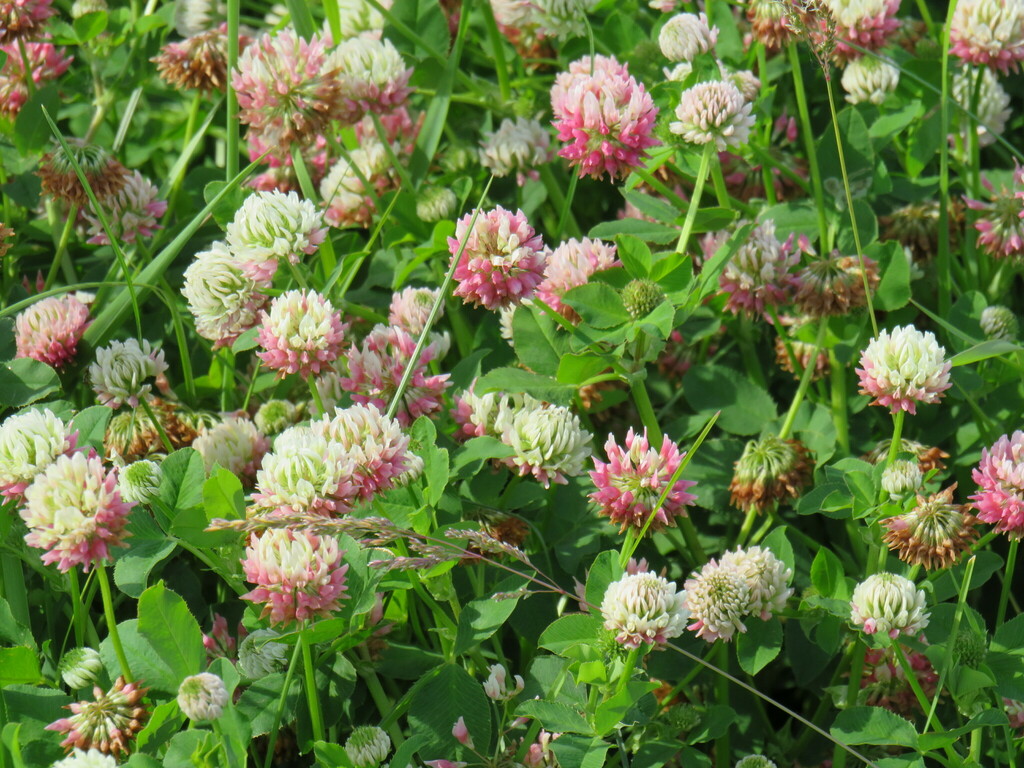
Alsike clover
Trifolium hybridum
Trifolium hybridum, the alsike clover, is a plant species of the genus Trifolium in the pea family Fabaceae. The stalked, pale pink or whitish flower head grows from the leaf axils, and the trifoliate leaves are unmarked. The plant is up to 40 centimetres (1.3 ft) tall,:152 and is found in fields and on roadsides – it is also grown as fodder (hay or silage). The plant blooms from spring to autumn (April to October in the...
From the article Trifolium hybridum on Wikipedia (CC BY-SA), quoted section by section
Description
Growing up to 40 centimetres (1+1⁄2 ft) tall, T. hybridum is a perennial plant with a semi-erect, sparsely branched, grooved stem, hairy in its upper regions. The leaves are alternate and stalked with small stipules. The leaves have three blunt-tipped ovate, unspotted leaflets with finely toothed margins. From April to October in the Northern Hemisphere, the densely globose inflorescence blooms from a long stalk attached to the leaf axils. The individual florets have a five-lobed calyx and an irregular corolla consisting of five pink petals, one upstanding "standard", two lateral "wings" and the lower two fused to form a "keel". There are ten stamens and a single carpal.
Range & habitat
Originating in mainland Europe, it has become established as an introduced plant in the British Isles and throughout the temperate regions of the world. It is native to southern Europe and southwestern Asia, especially in mountainous regions. Because of its wide cultivation and use as forage, its subspecies T. h. hybridum is used and has become naturalised further north in Europe and in other parts of the world. Its natural habitat is fields, meadows, roadsides, banks and waste ground. When added to seed mixtures, it seldom persists once the sward has closed up.
Wikipedia: “Distribution and habitat”
At the table
The species has been found to quickly lower soil pH, increasing its viable area of reproduction, whilst reducing the bio-density of weeds by up to 57%. Under the right conditions it may become invasive unless properly managed. With regard to inbreeding, it was found that there were disadvantageous changes to height, persistence, and vigor unless selectively bred for said traits. It is also grown as fodder (hay or silage).
== References ==
Wikipedia: “Uses”
Toxicity
There is limited evidence of T. hybridum having toxic effects on horses including photosensitization and Alsike clover poisoning. Photosensitivity in horses, also known as alsike rash, is a reversible condition in which the mechanism is unknown. A diet in equestrians of at least 20% T. hybridum over the course of four weeks could lead to poisoning which includes deleterious neurological effects and liver failure. The active toxin is unknown. The plant can irritate skin if handled.
Where it lives
Recorded sightings
—
geo-referenced records in GBIF, from museums, herbaria and field observers.
Drag the globe to turn it. Dots are where records exist, not a range map; darker means more records.
In the stacks
Searching the stacks…
Every page naming Trifolium hybridum in the Biodiversity Heritage Library →
This page is assembled live from iNaturalist, GBIF, Wikipedia, the Source Library and the Internet Archive. It is not yet part of the hand-edited codex. iNaturalist taxon 61824.