- Animals
- ›Chordates
- ›Vertebrates
- ›Ray-finned Fishes
- ›Carps, Characins, Catfishes and Allies
- ›Catfishes
- ›Loricarioidei
- ›Armored Catfishes
- ›Cascudinhos
- ›Pareiorhaphis
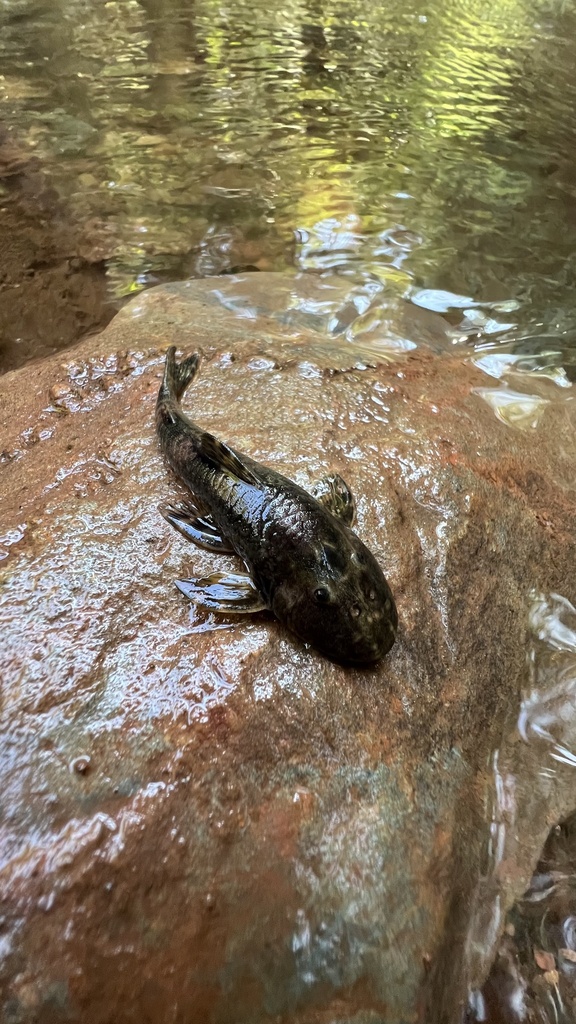
Pareiorhaphis mutuca
Pareiorhaphis mutuca is a species of catfish in the family Loricariidae. It is native to South America, where it occurs in the headwaters of the Das Velhas River basin in Brazil, with its type locality being listed as near Nova Lima in the state of Minas Gerais. It is typically found in rocky areas, where it is known to hide under stones during the day. The species reaches 9.6 cm (3.8 inches) in standard length and is...
From the article Pareiorhaphis mutuca on Wikipedia (CC BY-SA), quoted section by section
Description
Pareiorhaphis mutuca has 7 soft rays in its dorsal fin and 6 in its anal fin. This species can be told from the other species of Pareioraphis by the shape and size of the cleithrum and the pattern of hypertrophied odontodes on the side of the head which are longer to teh rear and point backwards. This catfish has an elongated body and it reaches a standard length of 10.2 cm (4.0 in).
Range & habitat
Pareiorhaphis mutuca was formerly known only from its type locality but the population there hase becomne locally extinct. However, new populations were recorded in the municipality of Caeté, in the Prata stream, a tributary of the right bank of the Velhas River, and in the Maquine stream, a tributary of the right bank of the Prata stream, both belonging to the Velhas River basin, both being in the São Francisco drainage system. This catfish is found in rocky and stony reaches of rivers, hding under stones and in crevices during the day but it is active throughout the day.
Wikipedia: “Distribution and habitat”
In human culture
Pareiorhaphis mutuca is a species in the genus Pareiorhaphis, the name of which is a combination pareio, derived from pareiá, which means "cheek" in Greek, and rhaphis, meaning "needle". This is a reference to the needle like hypertrophied odontodes on the cheeks of the males when they are in breeding condition. The specific name, mutuca, refers to the type locality of this species, the Mutuca stream.
Wikipedia: “Etymology”
Where it lives
Recorded sightings
—
geo-referenced records in GBIF, from museums, herbaria and field observers.
Drag the globe to turn it. Dots are where records exist, not a range map; darker means more records.
In the stacks
Searching the stacks…
Every page naming Pareiorhaphis mutuca in the Biodiversity Heritage Library →
This page is assembled live from iNaturalist, GBIF, Wikipedia, the Source Library and the Internet Archive. It is not yet part of the hand-edited codex. iNaturalist taxon 616711.