- Animals
- ›Chordates
- ›Vertebrates
- ›Ray-finned Fishes
- ›Carps, Characins, Catfishes and Allies
- ›Catfishes
- ›Loricarioidei
- ›Armored Catfishes
- ›Suckermouth Catfishes
- ›Acanthicus
Acary avion
Acanthicus adonis
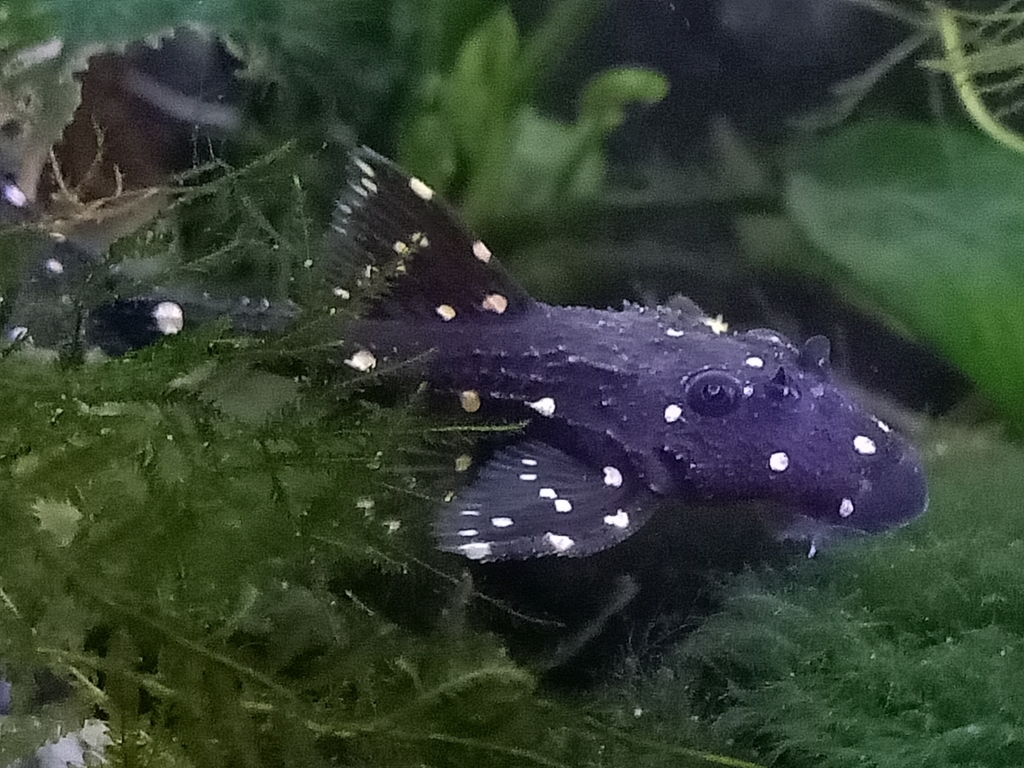
Acanthicus adonis, the adonis pleco or polka dot lyre-tail pleco, is a large species of armored catfish. It was originally described from the lower Tocantins River in Brazil, but individuals resembling the species have also been recorded from Amazonian Peru. The species is occasionally seen in the aquarium trade, but its massive adult size and territorially aggressive behavior means that a very large tank is required. These fish are opportunistic omnivores.
From the article Acanthicus adonis on Wikipedia (CC BY-SA), quoted section by section
Description
Acanthicus adonis is among the largest armored catfish species and reaches a length of 1 m (3.3 ft). It is dark brown to black with numerous white spots as a juvenile. As the fish matures, the spots become less numerous and smaller, often disappearing entirely in large adults. Its close relative A. hystrix always lack white spots, regardless of age. In contrast, A. adonis lacks the vermiculated pattern often (but not always) found on the underparts of A. hystrix.
Wikipedia: “Appearance”
Range & habitat
Acanthicus adonis is found in South America where it has been recorded from the Tocantins River basin in Brazil, in the Solimões River at the triple border between Brazil, Colombia and Peru, and in the Yujo River basin, part of the Ucayali River basin, in Peru. This catfish is found in white and clear water rivers where it is a demersal species. These fish are opportunistic omnivores.
Wikipedia: “Distribution and habitat”
In human culture
Acanthicus adonis is classified in the genus Acanthicus which is derived from the Greek akánthinos, meaning "thorny", alluding to entire upper surface of the head of A. hystrix, the type species, being armed with long erectile odontodes. The specific name, adonis, is from Greek mythology, where Adonis was a handsome young man loved by the goddess Aphrodite, here referring to the attractive spotted juvenile colour pattern.
Wikipedia: “Etymology”
Where it lives
Recorded sightings
—
geo-referenced records in GBIF, from museums, herbaria and field observers.
Drag the globe to turn it. Dots are where records exist, not a range map; darker means more records.
In the stacks
Searching the stacks…
Every page naming Acanthicus adonis in the Biodiversity Heritage Library →
This page is assembled live from iNaturalist, GBIF, Wikipedia, the Source Library and the Internet Archive. It is not yet part of the hand-edited codex. iNaturalist taxon 616096.