- Animals
- ›Arthropods
- ›Hexapods
- ›Insects
- ›Winged and Once-winged Insects
- ›Dragonflies and Damselflies
- ›Damselflies
- ›Coenagrionoid Damselflies
- ›Narrow-winged Damselflies
- ›Ischnura
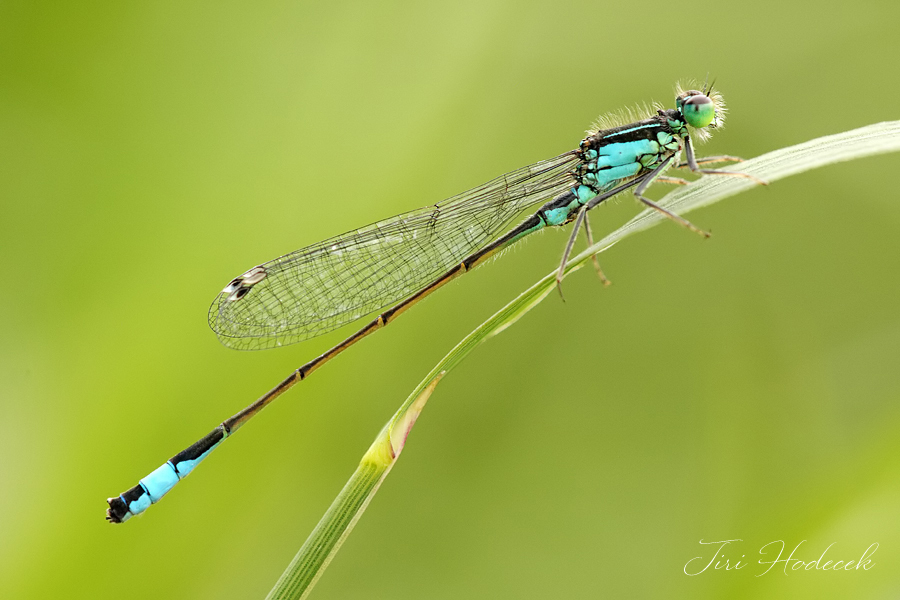
Blue-tailed Damselfly
Ischnura elegans
The blue-tailed damselfly or common bluetail (Ischnura elegans) is a damselfly, belonging to the family Coenagrionidae.
From the article Blue-tailed damselfly on Wikipedia (CC BY-SA), quoted section by section
Description
Ischnura elegans can reach a body length of 27–35 millimetres (1.1–1.4 in) and a wingspan of about 35 millimetres (1.4 in). Hindwings reach a length of 14–20 millimetres (0.55–0.79 in). Adult male blue-tailed damselflies have a head and thorax patterned with blue and black. There is a bi-coloured pterostigma on the front wings. Eyes are blue. They have a largely black abdomen with very narrow pale markings where each segment joins the next. Segment eight, however, is entirely pale blue. At rest, the wings of most damselfly species are held back together, unlike dragonflies, which rest with their wings out flat. The thorax of juvenile males has a green tinge. Female blue-tailed Damselflies come in a variety of colour forms. Juveniles may be salmon pink, form rufescens; violet, form violacea and a pale green form. The colour darkens as the damselfly ages. Mature females may be blue like the male, form typica; olive green thorax and brown spot, form infuscans or pale brown thorax and brown spot, form infusca-obseleta.
Range & habitat
This species is present in most of Europe and the Middle East. It is a common species.
Wikipedia: “Distribution”
What it does
Adults fly from April to September to early October. The adult damselflies prey on small flying insects, caught using their legs like a basket to scoop the prey up while flying, or insects taken from leaves. Damselfly nymphs are aquatic, and prey on small aquatic insects or other aquatic larvae. A male can try to interfere with a mating pair, by attaching itself to the mating male. The females always lay their eggs on the floating parts of the plants without any involvement of the male. Blue-tailed damselflies are superb fliers and can alter each of their four wings' kinematics in order to maneuver. A recent study has shown that they can compensate for a whole wing loss and even successfully maneuver and catch prey.
Wikipedia: “Biology and behavior”
Listen
Looking for field recordings…
Where it lives
Recorded sightings
—
geo-referenced records in GBIF, from museums, herbaria and field observers.
Drag the globe to turn it. Dots are where records exist, not a range map; darker means more records.
In the stacks
Searching the stacks…
Every page naming Ischnura elegans in the Biodiversity Heritage Library →
This page is assembled live from iNaturalist, GBIF, Wikipedia, the Source Library and the Internet Archive. It is not yet part of the hand-edited codex. iNaturalist taxon 61508.