- Plants
- ›Vascular Plants
- ›flowering plants
- ›Dicots
- ›Mints, Plantains, Olives, and Allies
- ›Mint Family
- ›Lamioideae
- ›Leonureae
- ›Leonurus
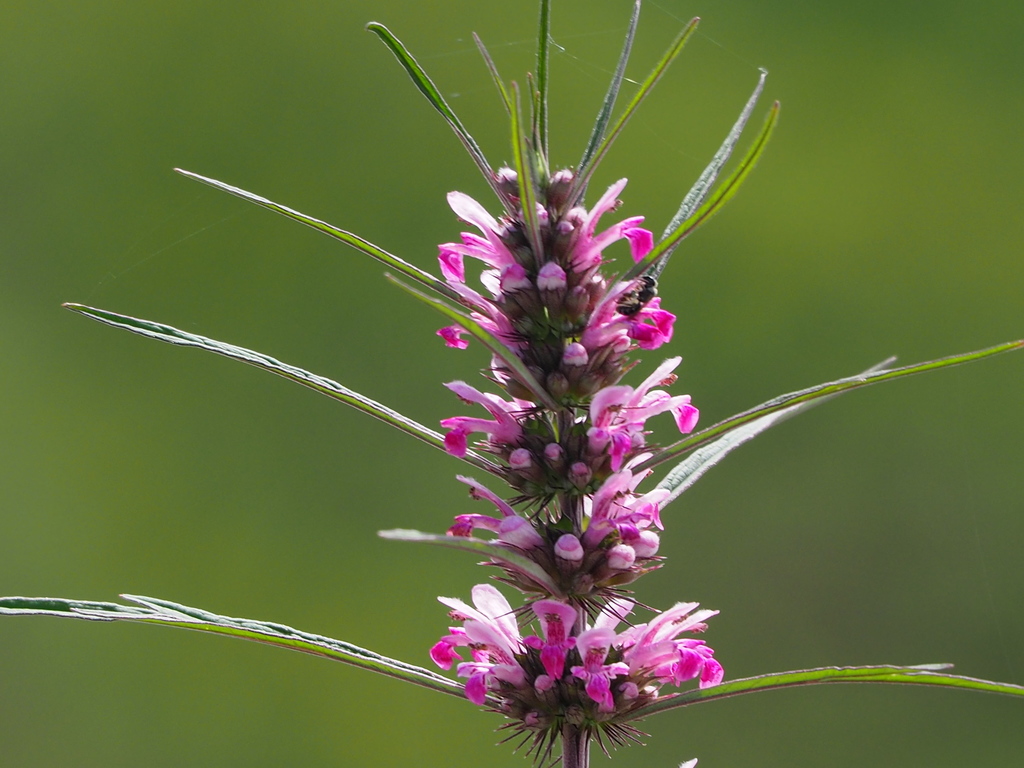
Chinese motherwort
Leonurus japonicus
Paraleonurus japonicus, synonym: Leonurus japonicus, commonly called oriental motherwort or Chinese motherwort, is a herbaceous flowering plant native to Asia, including Korea and Japan, and China to Cambodia.
From the article Leonurus japonicus on Wikipedia (CC BY-SA), quoted section by section
Description
Plants are annual or biennial, growing from taproots. The stems are upright growing to a height of 30 to 120 cm (12 to 47 in). The flowers are sessile and produced in verticillasters. The calyx is tubular-campanulate shaped and 6 to 8 mm (0.24 to 0.31 in) long with broad triangle shaped teeth. The corolla is white or reddish to purplish red in color. Plants bloom from June to September. It has escaped cultivation and become naturalized in other parts of the world including South and North America, Europe and Africa.
At the table
Leonurus japonicus is one of the 50 fundamental herbs used in traditional Chinese medicine, where it is called yìmǔcǎo (Chinese: 益母草), literally "beneficial herb for mothers". It is used in cases of menstrual and delivery disorders caused by blood stasis such as dysmenorrhea and amenorrhea.
Wikipedia: “Uses”
Where it lives
Recorded sightings
—
geo-referenced records in GBIF, from museums, herbaria and field observers.
Drag the globe to turn it. Dots are where records exist, not a range map; darker means more records.
In the old herbals & bestiaries


In the stacks
Searching the stacks…
Every page naming Leonurus japonicus in the Biodiversity Heritage Library →
This page is assembled live from iNaturalist, GBIF, Wikipedia, the Source Library and the Internet Archive. It is not yet part of the hand-edited codex. iNaturalist taxon 61479.