- Plants
- ›Vascular Plants
- ›flowering plants
- ›Dicots
- ›Mints, Plantains, Olives, and Allies
- ›Mint Family
- ›Nepetoideae
- ›Mentheae
- ›balms, mints, and thymes
- ›Origanum
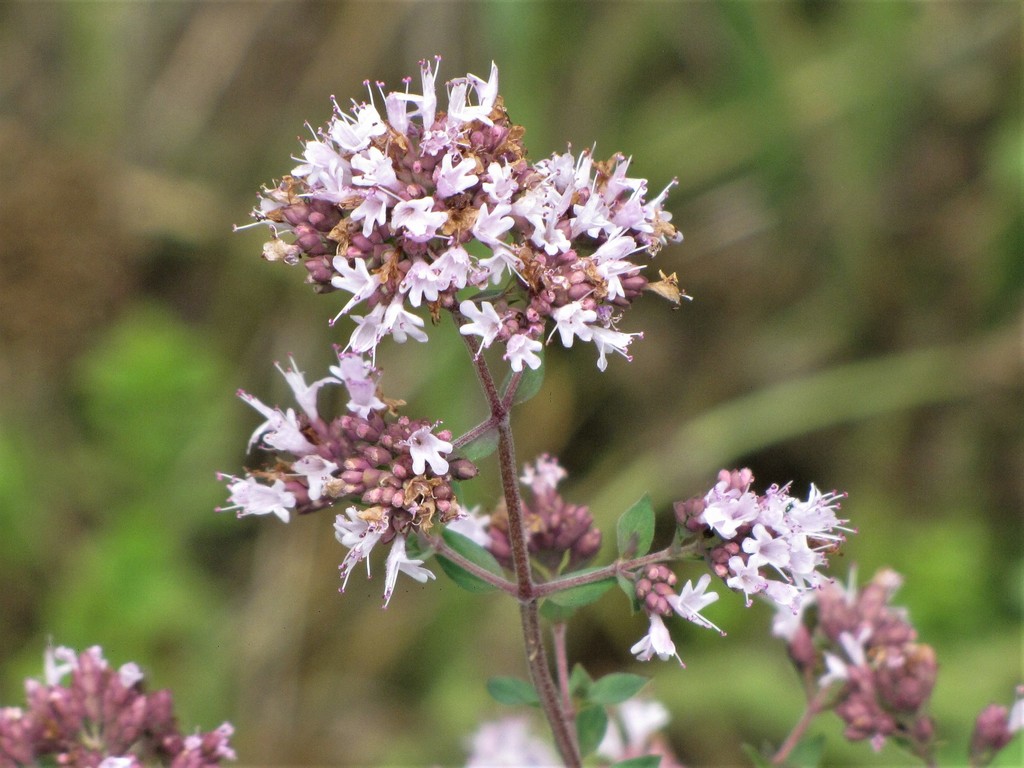
Oregano
Origanum vulgare
Oregano (US: , UK: ; Origanum vulgare), sometimes called wild marjoram, is a species of flowering plant in the mint family, Lamiaceae. It is native to the Mediterranean region but widely naturalised elsewhere in the temperate Northern Hemisphere, particularly the United States and Mexico.
Oregano is a woody perennial plant, growing up to 90 cm (35 in) tall, with opposite leaves 1–4 cm (0.5–1.5 in) long covered with trichome. Young stems are typically square and hairy and become woody with age. The flowers, which can be white, pink or light purple, are 3–4 mm (0.12–0.18 in) long and produced in clustered, erect spikes in summer.
From the article Oregano on Wikipedia (CC BY-SA), quoted section by section
Description
Oregano is a perennial, although it is grown as an annual in colder climates, as it often does not survive the winter. It grows to 90 centimetres (35 in) tall and 50 cm (20 in) wide. The leaves are spade-shaped and olive-green. The flowers are purple, pink or white, 4–7 cm (1+1⁄2–2+3⁄4 in) long and grouped in clusters. Oregano is related to the herb marjoram, sometimes being referred to as wild marjoram.
Chemistry. Oregano contains polyphenols, including numerous flavones. The essential oil of oregano is composed primarily of monoterpenoids and monoterpenes, with the relative concentration of each compound varying widely across geographic origin and other factors. Over 60 different compounds have been identified, with the primary ones being carvacrol and thymol ranging to over 80%, while lesser abundant compounds include p-cymene, γ-terpinene, caryophyllene, spathulenol, germacrene D, β-fenchyl alcohol and δ-terpineol. Drying of the plant material affects both quantity and distribution of volatile compounds, with methods using higher heat and longer drying times having greater negative impact. A sample of fresh whole plant material found to contain 33 g/kg dry weight (3.1 g/kg wet) decreased to below a third after warm-air convection drying. Much higher concentrations of volatile compounds are achieved towards the end of the growing season.
At the table
Oregano is a culinary herb, used for the flavour of its leaves, which can be more intense when dried than fresh. It has an earthy, warm, and slightly bitter taste, which can vary in intensity. Good-quality oregano may be strong enough to almost numb the tongue, but cultivars adapted to colder climates may have a lesser flavour. Factors such as climate, season, and soil composition may affect the aromatic oils present, and this effect may be greater than the differences between the various species of plants. Among the chemical compounds contributing to the flavour are carvacrol, thymol, limonene, pinene, ocimene, and caryophyllene. Oregano is the staple herb of Italian cuisine, most frequently used with roasted, fried, or grilled vegetables, meat, and fish. Oregano combines well with spicy foods popular in Southern Italy. It is less commonly used in the North, where marjoram is preferred. It became popular in the U.S. after soldiers returning from World War II brought back a taste for the "pizza herb", which had probably been eaten in Southern Italy for centuries. Oregano is widely used in cuisines of the Mediterranean Basin and Latin America, especially in Mexican cuisine and Argentine cuisine. In Turkish cuisine, oregano is mostly used for flavouring meat, especially mutton and lamb. …
Wikipedia: “Culinary”
How it is grown
Oregano is planted in early spring, the plants being spaced 30 cm (12 in) apart in fairly dry soil, with full sun. It will grow in a pH range between 6.0 (mildly acidic) and 9.0 (strongly alkaline), with a preferred range between 6.0 and 8.0. It prefers a hot, relatively dry climate, but does well in other environments.
Wikipedia: “Cultivation”
In human culture
The English word "oregano" is a borrowing of the Spanish orégano, which derives from the Latin orīganum, which itself comes from Classical Greek ὀρίγανον (orī́ganon). The ultimate origin is disputed; some claim it is a compound Greek term that consists of ὄρος (óros) meaning "mountain", and γάνος (gános) meaning "joy" while The Oxford English Dictionary states it is "probably a loanword [as] the plant comes from Africa".
Wikipedia: “Etymology”
Where it lives
Recorded sightings
—
geo-referenced records in GBIF, from museums, herbaria and field observers.
Drag the globe to turn it. Dots are where records exist, not a range map; darker means more records.
In the old herbals & bestiaries

History of Monsters
Ulisse Aldrovandi · 1642 · p.555

Ortus sanitatis
1491 · p.297

Commentaries on the Six Books of Dioscorides
Pietro Andrea Mattioli · 1560 · p.506

Commentaries on the Six Books of Dioscorides
Pietro Andrea Mattioli · 1560 · p.505

On the Virtues of Herbs
Macer Floridus (Odo of Meung) · 1090 · p.76

Latin Herbal
1484 · p.209

Herbal of Virtues
1499 · p.209

Garden of Health
1507 · p.241

Book of Herbs
Hieronymus Bock (Tragus) · 1546 · p.63

On Medical Materials in Six Books
Dioscorides · 1550 · p.385

On the Names of Plants
Hieronymus Bock (Tragus) · 1552 · p.108

De medicinali materia libri sex
Dioscorides · 1552 · p.393
In the stacks
Searching the stacks…
Every page naming Origanum vulgare in the Biodiversity Heritage Library →
This page is assembled live from iNaturalist, GBIF, Wikipedia, the Source Library and the Internet Archive. It is not yet part of the hand-edited codex. iNaturalist taxon 61396.