- Animals
- ›Chordates
- ›Vertebrates
- ›Ray-finned Fishes
- ›Carps, Characins, Catfishes and Allies
- ›Minnows, Suckers, Carps, and Loaches
- ›Carps and Minnows
- ›True Minnows
- ›Old World Minnows
- ›Leucos
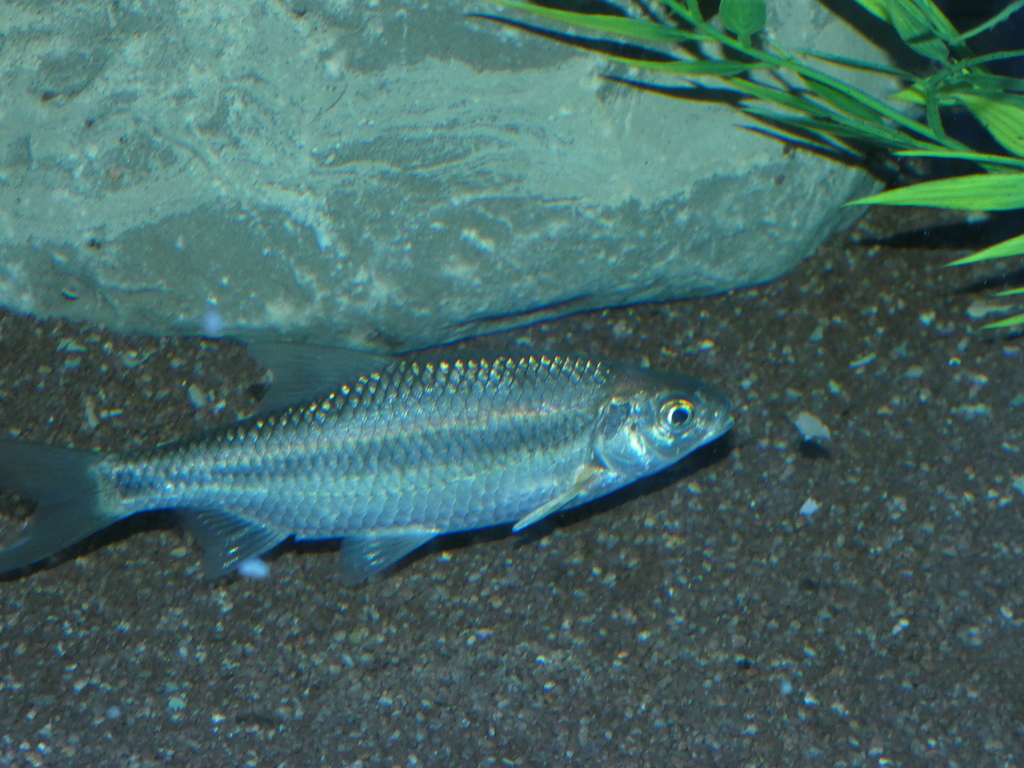
North Italian Roach
Leucos aula
Leucos aula is a species of freshwater fish in the family Cyprinidae. It is native to the Adriatic basin in southern Europe, originally occurring in Italy, Slovenia, Croatia, and Switzerland. It has been introduced to other parts of Italy. This is an abundant fish, occurring in canals, swamps, lakes, and streams with slow current and dense vegetation.
From the article Leucos aula on Wikipedia (CC BY-SA), quoted section by section
Description
Leucos aula has its dorsal and anal fins each supported by 12 soft rays. It can be distinguished from all other species in the genus Leucos by a band along the lateral line and a shorter head. Within Italy this species can be distinguished by commonly having 9+1⁄2 branched rays in the dorsal and anal fins. It also has between 36 and 42, typically 38 or 39, scales in the lateral line. The mouth is subterminal, the pelvic, pectoral and anal fins are greyish, and the eye is red in life. There is an obvious dark brown midlateral stripe running from the eye to the base of the tail. The North Italian roach has a maximum total length of 26 cm (10 in).
Range & habitat
Leucos aula is found in rivers draining into the northern Adriatic Sea, extending from the Esino River in the Marche region of Italy to the Raša River in Istria County in Croatia. There are a few isolated populations further south in Croatia in Zadar County, including Lake Veliko on the island of Pag, and at least two short coastal streams in Ravni Kotari near the city of Zadar. It may also be found in the Lake Vrana basin. In Italy the North Albania roach has been introduced to the south of its natural range to rivers draining into the Ligurian Sea and Tyrrhenian Sea, where it is considered invasive. This species has also become naturalised in at least one reservoir in Sardinia. The North Italian roach is found in slow moving river stretches, lakes and ponds, mostly in the lowlands, but it can also be found in perialpine lakes within the Po River drainage in Italy and Switzerland. This species is frequently associated with submerged vegetation, and frequently colonises reservoirs and drainage channels.
== References ==
Wikipedia: “Distribution and habitat”
In human culture
Leucos aula is the type species of the genus Leucos. This name is derived from the Greek leukos, which means "white". The genus was named by Johann Jakob Heckel. He did not explain why he chose this name, but it may refer to the silvery colour of Squalius aula. The specific name, aula, was not explained by Bonaparte, but may be a latinisation of avola, the Italian or Venezian name for a bleak, which may have been applied to this species as well.
Wikipedia: “Etymology”
Where it lives
Recorded sightings
—
geo-referenced records in GBIF, from museums, herbaria and field observers.
Drag the globe to turn it. Dots are where records exist, not a range map; darker means more records.
In the stacks
Searching the stacks…
Every page naming Leucos aula in the Biodiversity Heritage Library →
This page is assembled live from iNaturalist, GBIF, Wikipedia, the Source Library and the Internet Archive. It is not yet part of the hand-edited codex. iNaturalist taxon 613179.