- Animals
- ›Arthropods
- ›Hexapods
- ›Insects
- ›Winged and Once-winged Insects
- ›Butterflies and Moths
- ›Owlet Moths and Allies
- ›Prominent Moths
- ›Processionary Moths
- ›Thaumetopoea
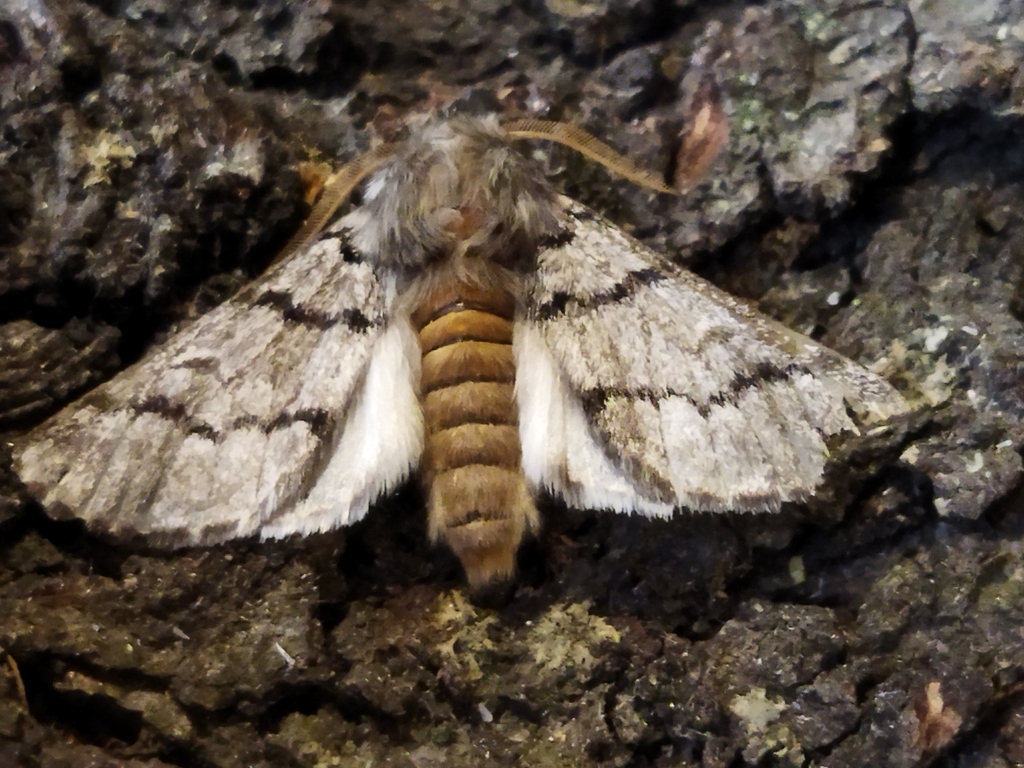
Pine Processionary-moth
Thaumetopoea pityocampa
The pine processionary (Thaumetopoea pityocampa) is a moth of the subfamily Thaumetopoeinae in the family Notodontidae, known for the irritating hairs of its caterpillars, their processions, and the economic damage they cause in coniferous forests. The species was first described scientifically by Michael Denis and Ignaz Schiffermüller in 1775, though it was known to the ancients, with remedies described by Theophrastus, Dioscorides and Pliny the Elder. Its processionary behaviour was described in 1916 by the French entomologist Jean-Henri Fabre. It is one of the most destructive species to pines and cedars in Central Asia, North Africa and southern Europe.
The species is notable for the behaviour of its caterpillars, which overwinter in tent-like nests high in pine trees, and which proceed through the woods in nose-to-tail columns, protected from predators by their severely irritating hairs.
From the article Pine processionary on Wikipedia (CC BY-SA), quoted section by section
Description
The adult is a stout furry moth which holds its wings like a tent over the body, in the manner of the eggar moths (Lasiocampidae). The adult is larger than the oak processionary, Thaumetopoea processionea, has a crescent marking on the wings (unlike the pale eggar moth; the oak processionary has an indistinct marking), and is found in coniferous rather than broad-leaved forests. The caterpillars are readily recognised by their processionary habit and their presence (with large silken nests and signs of defoliation) in coniferous woods. They are orange-brown and hairy with blue bands.
Range & habitat
The species is native to the southern Mediterranean area, North Africa, the Middle East, and southern Europe. It has been spreading northwards since the 1990s, assisted by climate change and by commercial activities including planting of host trees and transportation, and has reached Brittany, forests to the north of Paris, and Strasbourg in northern France. A paler subspecies, T. pityocampa orana, occurs in North Africa from Morocco to Libya, at altitudes to 2,000 metres (6,600 ft) in the Middle Atlas; the adults fly between April and August.
Wikipedia: “Distribution”
What it does
Though most individuals of the species only live one year, some in high altitudes or more northern areas may survive for over two years. Each female lays an "enormous number" of eggs near the tops of pine trees. After hatching, the larvae eat pine needles while progressing through five stages of development (instars). To survive through the winter, the caterpillars construct a nest of silk threads, making them one of the few species of temperate zone insects where the larvae develop in winter. Around the beginning of April, the caterpillars leave the nests in the procession for which the species is known. They burrow underground, pupate, and emerge between mid May and August. The eggs are laid in cylindrical bodies ranging from 4 to 5 centimetres (1.6 to 2.0 in) in length. The eggs are covered with scales which come from the female and mimic pine shoots.
The larva is a major forest pest, living communally in large "tents", usually in pine trees but occasionally in cedar or larch, marching out at night in single file (hence the common name) to feed on the needles. There are often several such tents in a single tree. When they are ready to pupate, the larvae march in their usual fashion to the ground, where they disperse to pupate singly on or just below the surface. The moth's pupal stage occurs in a white silken cocoon under soil. …
Wikipedia: “Life cycle”
In human culture
The Greek physician Dioscorides noted in the 1st century AD the urtication caused by the pine-dwelling pityokampē caterpillar, the name meaning "Aleppo pine larva" (Ancient Greek: πιτυοκάμπη; from πίτυς pitys "pine" and κάμπη kampē "caterpillar"), in his 77 AD book De materia medica, Pliny the Elder recorded a treatment for the resulting itching in his Natural History; Theophrastus had earlier recommended the medicinal plant elecampane (horse-heal) in oil and wine to treat contact with "pine larvae" in his Historia Plantarum. The French entomologist Jean-Henri Fabre conducted a famous study on the pine processionary caterpillar where a group of them followed head-to-tail in a circle around the rim of a flower pot; they continued marching in the circle for a week. He described the experiment in his 1916 book The Life of the Caterpillar. The study has been cited innumerable times by inspirational and religious speakers who view it as a metaphor for blindly following a leader or for confusing activity with accomplishment. Fabre considered his caterpillars to be mindless automatons, trapped because they were pre-programmed to blindly follow trails, in this case the endless one that they had laid down around the circular pot rim. …
Wikipedia: “History of study”
Listen
Looking for field recordings…
Where it lives
Recorded sightings
—
geo-referenced records in GBIF, from museums, herbaria and field observers.
Drag the globe to turn it. Dots are where records exist, not a range map; darker means more records.
In the stacks
Searching the stacks…
Every page naming Thaumetopoea pityocampa in the Biodiversity Heritage Library →
This page is assembled live from iNaturalist, GBIF, Wikipedia, the Source Library and the Internet Archive. It is not yet part of the hand-edited codex. iNaturalist taxon 61293.