- Plants
- ›Vascular Plants
- ›flowering plants
- ›Dicots
- ›Legumes, Milkworts, and Allies
- ›Legumes
- ›Faboideae
- ›Trifolieae
- ›Medicago
- ›Arabicae
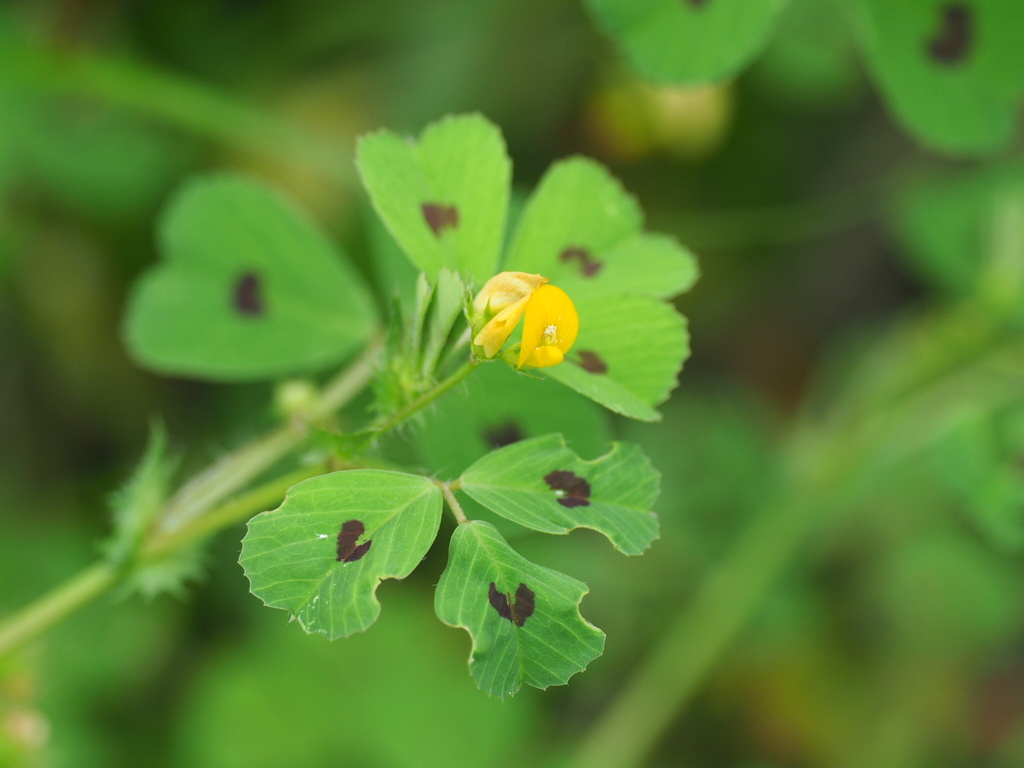
Spotted medick
Medicago arabica
Medicago arabica, the spotted medick, spotted burclover, heart clover, is a flowering plant in the pea and bean family Fabaceae. It is native to the Mediterranean basin but is found throughout the world. It forms a symbiotic relationship with the bacterium Sinorhizobium medicae, which is capable of nitrogen fixation.
From the article Medicago arabica on Wikipedia (CC BY-SA), quoted section by section
Description
It is a sprawling plant with a height of 20–60 centimetres (8–24 in). It usually has spotted trifoliate leaves, but the number of leaflets per leaf can sometimes be different. The flowers are pale yellow and appear spring and summer. The fruits are legumes, strangely coiled and sharply spiny.
Range & habitat
It is native to the Mediterranean basin but is found throughout the world, usually on clifftop grasslands and grassy places. It forms a symbiotic relationship with the bacterium Sinorhizobium medicae, which is capable of nitrogen fixation.
Wikipedia: “Distribution and habitat”
At the table
Due to its nitrogen fixation, it is sometimes considered a useful cover crop to restore soil nutrients by farmers in its native range, though it is also weedy and can thus be a nuisance. It is edible both for livestock and humans, and attracts pollinators. It also has been used in traditional medicine for possible diuretic, expectorant, and anti-inflammatory properties.
== References ==
Wikipedia: “Uses”
Where it lives
Recorded sightings
—
geo-referenced records in GBIF, from museums, herbaria and field observers.
Drag the globe to turn it. Dots are where records exist, not a range map; darker means more records.
In the stacks
Searching the stacks…
Every page naming Medicago arabica in the Biodiversity Heritage Library →
This page is assembled live from iNaturalist, GBIF, Wikipedia, the Source Library and the Internet Archive. It is not yet part of the hand-edited codex. iNaturalist taxon 61012.