- Plants
- ›Vascular Plants
- ›flowering plants
- ›Dicots
- ›Mustards, Capers, and Allies
- ›mustard family
- ›Brassicoideae
- ›Brassicodae
- ›Brassiceae
- ›Cakile
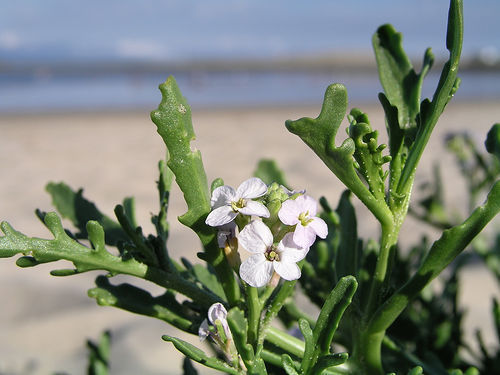
European Searocket
Cakile maritima
Cakile maritima, sea rocket (Britain and Ireland) or European searocket (North America), is a common plant in the mustard family Brassicaceae. It is widespread in Europe, North Africa and western Asia, especially on coastlines. It can now be found in many other areas of the world where it has been introduced. It is present on the west and east coasts of North America, where it has the potential to become an invasive species. This is an annual plant which grows in clumps or mounds in the sand on beaches and bluffs. The shiny leaves are fleshy, green and tinted with purple or magenta, and long-lobed. It has white to light purple flowers and sculpted, segmented, corky brown fruits one to three centimetres long. The fruits float and are water-dispersed.
From the article Cakile maritima on Wikipedia (CC BY-SA), quoted section by section
Description
It is a glabrous, succulent annual, with a slender or stout taproot. It has a branched stem which is prostrate or ascending, growing up to 15–45 cm (5.9–17.7 in) long. The lobed leaves, are flesh-like and alternately spaced on the stem. They are different at the top and bottom of the stem; the lower leaves are obovate or oblanceolate, while the upper ones are oblong. It blooms in the UK, between June and August. The small flowers occur in shades of white, lilac-coloured or purple, with 4 petals measuring up to 25 mm (0.98 in) across. Later it produces green maturing to brown, with short, stubby seed capsules. They contain two yellow or brown, smooth seeds. The seed oil contains a high level of erucic acid.
Range & habitat
Cakile maritima is native to temperate areas of North Africa, western Asia and Europe.
Range. It is found in Africa within Algeria, the Canary Islands, Egypt, Libya, the Madeira Islands, Morocco and Tunisia. In Western Asia, it is found in the Caucasus, Georgia, Iran, Palestine, Syria and Turkey. In Eastern Europe, it is found in Estonia and Ukraine. In middle Europe, it is found within Belgium, Germany, the Netherlands and Poland. In Northern Europe, in Denmark, Finland, Iceland, Norway, Sweden and the United Kingdom. In South-eastern Europe, within Albania, Bulgaria, Croatia, Greece, Italy, Montenegro, Romania, Serbia and Slovenia. In Southwestern Europe, within France, Portugal and Spain. It is also widely naturalised outside of its native range, in North America.
Habitat. It grows on the foreshores near large dune systems, and in shingle banks. It is tolerant of salt spray and transient seawater inundation. It is pollinated by a wide range of insects, from Apis mellifera, Eristalis intricarius and Pieris rapae.
Wikipedia: “Distribution and habitat”
At the table
The leaves are edible, preferably cooked, and not eaten in great quantity. The seed oil can be used for industrial applications.
Wikipedia: “Uses”
In medicine
Due to its highly efficient antioxidant system, it can withstand even high doses of Cadmium pollution.
Wikipedia: “Phytochemistry”
Where it lives
Recorded sightings
—
geo-referenced records in GBIF, from museums, herbaria and field observers.
Drag the globe to turn it. Dots are where records exist, not a range map; darker means more records.
In the stacks
Searching the stacks…
Every page naming Cakile maritima in the Biodiversity Heritage Library →
This page is assembled live from iNaturalist, GBIF, Wikipedia, the Source Library and the Internet Archive. It is not yet part of the hand-edited codex. iNaturalist taxon 60982.