- Plants
- ›Vascular Plants
- ›flowering plants
- ›Dicots
- ›Mustards, Capers, and Allies
- ›mustard family
- ›Brassicoideae
- ›Brassicodae
- ›Brassiceae

Searockets
Cakile
Cakile is a genus within the flowering plant family Brassicaceae. Species in this genus are commonly known as searockets, though this name on its own is applied particularly to whatever member of the species is native or most common in the region concerned, the European searocket Cakile maritima in Europe, and the American searocket C. edentula in North America. The genus is native to Europe, Asia and North America, but the European searocket has been introduced into North America and has spread widely on both east and west coasts; in many places it is replacing the native C. edentula, and is regarded as an undesirable invasive species.
Cakile species grow as annual plants with an erect or decumbent stem. The common species in Europe and North America grow close to the coast, often in dunes. Their leaves are fleshy. Flowers are typically pale mauve to white, with petals about 1 cm in length. Each fruit has two sections, one that remains attached to the adult, and the other which that falls off for dispersal by wind or water.
8 branches of this genus, most-observed first

European Searocket
speciesCakile maritima

American searocket
speciesCakile edentula

Southern Searocket
speciesCakile lanceolata
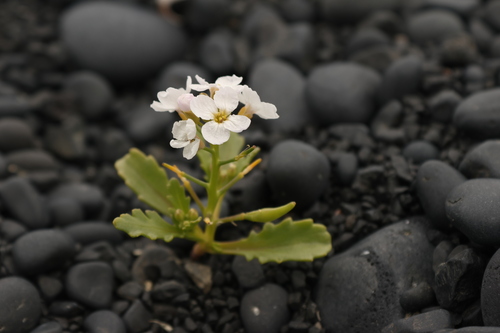
Arctic Searocket
speciesCakile arctica

Cakile arabica
speciesCakile arabica

Gulf Coast Searocket
speciesCakile constricta

Gulf Searocket
speciesCakile geniculata
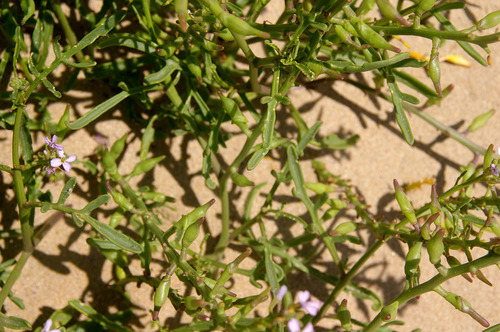
Cakile edentula × maritima
hybridCakile edentula × maritima
Where it lives
Recorded sightings
—
geo-referenced records in GBIF, from museums, herbaria and field observers.
Drag the globe to turn it. Dots are where records exist, not a range map; darker means more records.
In the stacks
Searching the stacks…
Every page naming Cakile in the Biodiversity Heritage Library →
This page is assembled live from iNaturalist, GBIF, Wikipedia, the Source Library and the Internet Archive. It is not yet part of the hand-edited codex. iNaturalist taxon 52163.