- Animals
- ›Arthropods
- ›Hexapods
- ›Insects
- ›Winged and Once-winged Insects
- ›Butterflies and Moths
- ›Butterflies
- ›Gossamer-winged Butterflies
- ›Hairstreaks
- ›Eumaeini
- ›Callophryidina
- ›Callophrys
Green Hairstreak
Callophrys rubi
The green hairstreak (Callophrys rubi) is a small butterfly in the family Lycaenidae.
From the article Green hairstreak on Wikipedia (CC BY-SA), quoted section by section
Description
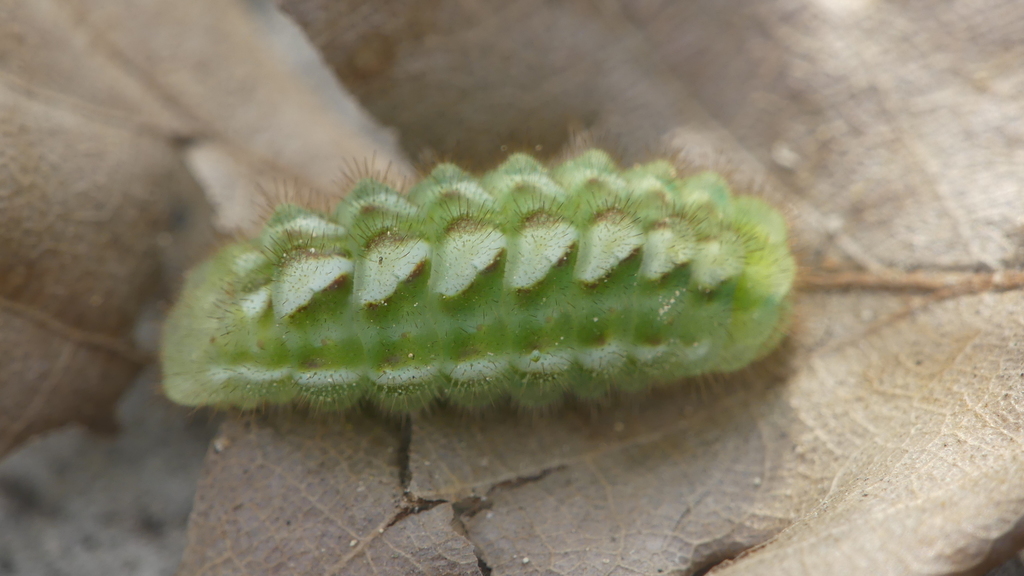
Callophrys rubi has a wingspan reaching about 26–30 millimetres (1.0–1.2 in) in length. The oversides of the wings are a uniform dull brown, with two paler patches on the male's forewings made up of scent scales. The undersides are a bright green with a thin white line, often reduced to a faint row of dots or even missing altogether. The iridescent green colour of the undersides is a structural colour caused by diffraction and interference of light by microscopic repeating structures forming a diffraction grating in the wing scales. The caterpillars are green with yellow markings along the back. Like other members of the family they are rather sluglike.
Range & habitat
The wide range of food plants means that this butterfly is able to use a wide range of habitats including chalk downland, heathland, moorland and clearings in woodland. It is present in wetlands as well as on poor dry meadows, at an elevation of about 0–2,300 metres (0–7,546 ft).
Wikipedia: “Habitat”
What it does
These butterflies can be found at the end of March, with flight time usually lasting until the end of June, but they are sometimes seen in July and early August. They never rest with their wings open, to maintain their green camouflage. The males exhibit territorial behavior. The eggs are laid singly. The caterpillars are not known to be tended by ants, unlike some lycid larvae, but the pupae, which are formed at ground level, emit squeaks that attract ants and it is thought that ants will always bury any that are found. Green hairstreaks overwinter as pupae and are univoltine, having one generation of adult butterflies per year. The larva is recorded as feeding on Vaccinium myrtillus, Vaccinum uliginosum, Betula, Rubus idaeus, Vicia cracca, Trifolium medium, Calluna vulgaris, Frangula, Rhamnus, Ribes, Spiraea, Caragana, Chamaecytisus, Hedysarum, Genista, Trifolium and Hippophae rhamnoides in different parts of its range. This polyphagous species probably has one of the largest range of food plants of any British butterfly. Early butterfly collectors thought that the only food plant was bramble (blackberry) Rubus fruticosus but as its habits became better understood the list grew and will probably continue to do so. …
Wikipedia: “Life cycle and behavior”
In human culture
The genus name Callophrys is a Greek word meaning "beautiful eyebrows", while the species Latin name rubi derives from Rubus (bramble), one of the host plants.
Wikipedia: “Etymology”
Listen
Looking for field recordings…
Where it lives
Recorded sightings
—
geo-referenced records in GBIF, from museums, herbaria and field observers.
Drag the globe to turn it. Dots are where records exist, not a range map; darker means more records.
In the stacks
Searching the stacks…
Every page naming Callophrys rubi in the Biodiversity Heritage Library →
This page is assembled live from iNaturalist, GBIF, Wikipedia, the Source Library and the Internet Archive. It is not yet part of the hand-edited codex. iNaturalist taxon 60896.