- Plants
- ›Vascular Plants
- ›flowering plants
- ›Dicots
- ›Legumes, Milkworts, and Allies
- ›Legumes
- ›Acacias, Mimosas, Mesquites, and Allies
- ›Ingeae
- ›Albizia
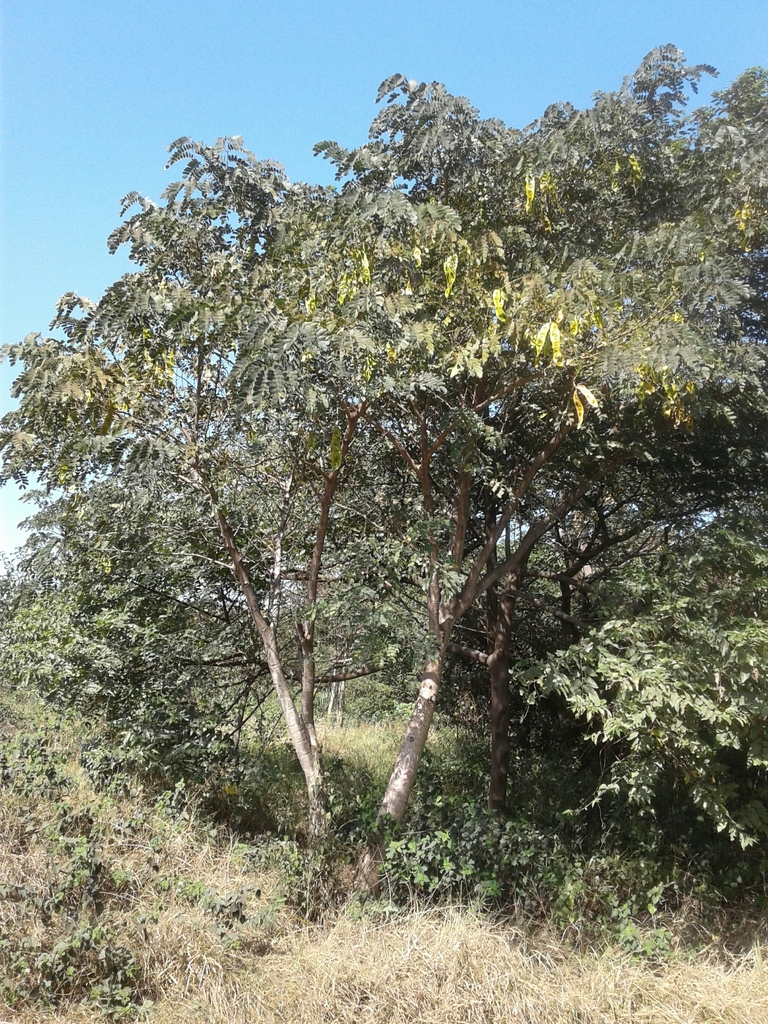
lebbeck
Albizia lebbeck
Albizia lebbeck is a species of plant in the family Fabaceae, native to the Indian subcontinent and Myanmar. It is widely cultivated and naturalised in other tropical and subtropical regions, including Australia. Common names in English include siris, Indian siris, East Indian walnut, Broome raintree, lebbeck, lebbek tree, frywood, koko and woman's tongue tree. The latter name is a play on the sound the seeds make as they rattle inside the pods. Siris is also a common name of the genus Albizia.
From the article Albizia lebbeck on Wikipedia (CC BY-SA), quoted section by section
Description
It is a tree growing to a height of 18–30 m (59–98 ft) tall with a trunk .5 to 1 m (1 ft 8 in to 3 ft 3 in) in diameter. The leaves are bipinnate, 7.5–15 cm (3–6 in) long, with one to four pairs of pinnae, each pinna with 6–18 leaflets. The flowers are white, with numerous 2.5–3.8 cm (1.0–1.5 in) long stamens, and very fragrant. The fruit is a pod 15–30 cm (6–12 in) long and 2.5–5.0 cm (1–2 in) broad, containing six to twelve seeds.
Range & habitat
Albizia lebbeck is found in a wide range of climates ranging from semi-desert, to humid regions. It can endure long cold winters, as well as very dry climate. A. lebbeck is a drought-tolerant tree that can be found throughout the tropics. Due to its ability to adapt to a broad spectrum of climates, this species has spread to different tropical regions throughout the world as an invasive species.
Wikipedia: “Habitat”
At the table
Its uses include environmental management, forage, medicine and wood. It is cultivated as a shade tree in North and South America. In India and Pakistan, the tree is used to produce timber. Wood from Albizia lebbeck has a density of 0.55-0.66 g/cm3 or higher.
Even where it is not native, some indigenous herbivores are liable to utilize lebbeck as a food resource. For example, the greater rhea (Rhea americana) has been observed feeding on it in the cerrado of Brazil.
Ethnobotany. Lebbeck is an astringent, also used by some cultures to treat boils, cough, to treat the eye, flu, gingivitis, lung problems, pectoral problems, is used as a tonic, and is used to treat abdominal tumors. The bark is used medicinally to treat inflammation. This information was obtained via ethnobotanical records, which are a reference to how a plant is used by indigenous peoples, not verifiable, scientific or medical evaluation of the effectiveness of these claims. Albizia lebbeck is also psychoactive. It is also very effective in migraine. All parts of the plant are useful, such as the leaves, root, and stem. The flowers of the plant are traditionally used in Chinese traditional medicine to treat insomnia.
Wikipedia: “Uses”
Where it lives
Recorded sightings
—
geo-referenced records in GBIF, from museums, herbaria and field observers.
Drag the globe to turn it. Dots are where records exist, not a range map; darker means more records.
In the stacks
Searching the stacks…
Every page naming Albizia lebbeck in the Biodiversity Heritage Library →
This page is assembled live from iNaturalist, GBIF, Wikipedia, the Source Library and the Internet Archive. It is not yet part of the hand-edited codex. iNaturalist taxon 60832.