- Animals
- ›Arthropods
- ›Hexapods
- ›Insects
- ›Winged and Once-winged Insects
- ›Butterflies and Moths
- ›Butterflies
- ›Swallowtails and Parnassians
- ›Swallowtails
- ›Fluted Swallowtails
- ›Papilio
- ›Pterourus
- ›Papilio glaucus
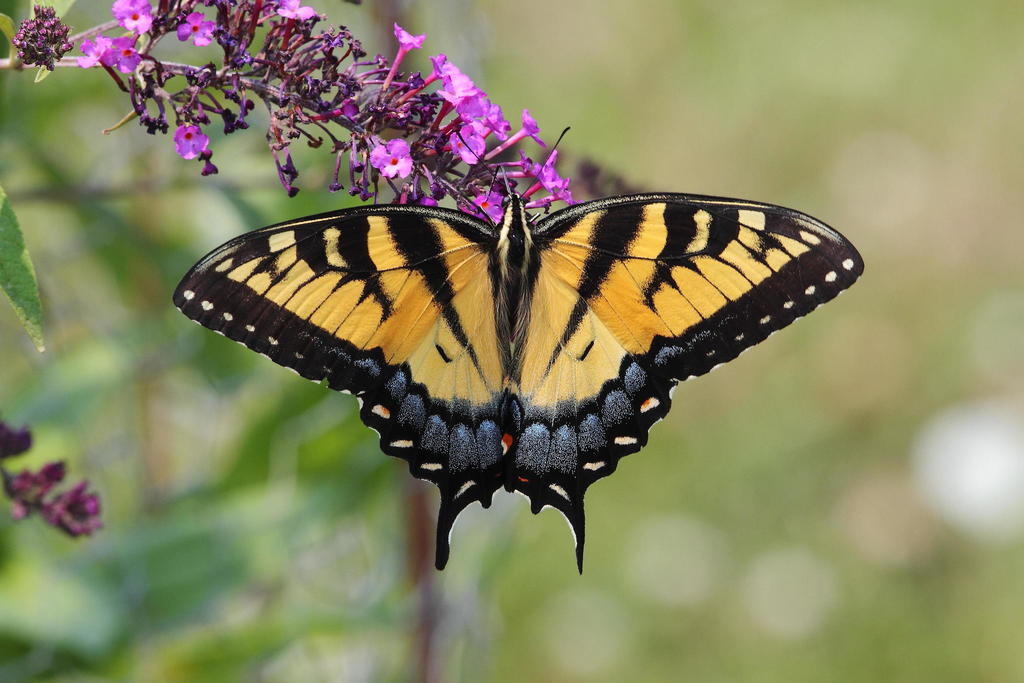
Eastern Tiger Swallowtail
Papilio glaucus
Papilio glaucus, the eastern tiger swallowtail, is a species of butterfly native to eastern North America. It is one of the most familiar butterflies in the eastern United States, ranging north to southern Ontario, Canada, and is common in many different habitats. It flies from spring until fall, during which it produces two to three broods. Adults feed on the nectar of many species of flowers, mostly from those of the families Apocynaceae, Asteraceae, and Fabaceae. P. glaucus has a wingspan measuring 7.9 to 14 cm (3.1 to 5.5 in). The male is yellow with four black "tiger stripes" on each forewing. Females may be either yellow or black, making the females dimorphic. The yellow morph has similar coloring to the male, but with a conspicuous band of blue spots along the hindwing; the dark morph is almost completely black.
The green eggs are laid singly on plants of the families Magnoliaceae and Rosaceae. Young caterpillars are brown and white; older ones are green with two black, yellow, and blue eyespots on the thorax. The caterpillar will turn brown prior to pupating. It will reach a length of 5.5 centimetres (2.2 in). The chrysalis varies from a whitish color to dark brown. Hibernation occurs in this stage in locations with cold winter months.
From the article Papilio glaucus on Wikipedia (CC BY-SA), quoted section by section
Description
The wingspan ranges from 7.9 to 14 cm (3.1 to 5.5 in) with females being the larger sex. Southern individuals are larger than northern ones. Males are yellow with four black "tiger stripes" on each forewing. The outer edge of the forewing is black with a row of yellow spots. The veins are marked with black. The postmedian area of the hindwing is black with yellow spots along the margin. The inner margin of the hindwing has small red and blue spots. The ventral forewing margin has a yellow bar that is broken into spots. This broken bar is present in both sexes, and is used to distinguish P. glaucus from its close relatives. Females are dimorphic. The yellow morph differs from the male in having a blue postmedian area on the dorsal hindwing. In the dark morph, the areas that are normally yellow are replaced with dark gray or black. The bluish postmedian area on the ventral hindwing has one row of orange spots. A shadow of the "tiger stripes" can be seen on the underside of some dark females.
P. glaucus is one of a few species of papilionids known to produce gynandromorphs. Most bilateral gynandromorphs are hybrids of P. glaucus and P. canadensis that are found along hybrid zones. Color mosaics are found in the central part of the species range.
Range & habitat
P. glaucus is found in the eastern United States from southern Vermont to Florida west to eastern Texas and the Great Plains. It is common throughout its range, although is rarer in southern Florida and absent from the Florida Keys. In 1932, a single specimen was collected in County Wicklow, Ireland. It is believed to have been an accidental introduction from North America. P. glaucus can be found almost anywhere deciduous forests occur. Common habitats include woodlands, fields, rivers, creeks, roadsides, and gardens. It will stray into urban parks and city yards. Because it has adapted to many different habitats and host plants, P. glaucus is a generalist, and is not considered threatened. Papilio glaucus is considered to be one of the most polyphagous of all swallowtail species. This is likely due to genetic traits and differential detoxification abilities. However, as compared to Papilio canadensis, at the northern overlap between the two species, P. glaucus survive very poorly through their first larval instar when settling on a quaking aspen (Populus tremeloides) tree and their survival rate under those conditions are approximately 15%, whereas P. canadensis thrives on this food plant. Adults are seen from spring to fall, although the exact date varies depending on the location. …
Wikipedia: “Distribution and habitat”
What it does
Eastern tiger swallowtails are diurnal, and are usually solitary. Adults are known to fly high above the ground, usually seen above the tree canopy. Males seek females by patrolling habitats containing the larval host plants. During courtship, the male and female fly about each other prior to landing and mating. The male releases perfume-like pheromones during courtship to entice the female into mating. Adults use a wide range of food sources, most preferring to nectar on sturdy plants with red or pink flowers. Many members of the families Apocynaceae, Asteraceae and Fabaceae are used as common nectar sources. Males participate in a behavior called puddling, in which they congregate on mud, damp gravel or puddles. They extract sodium ions and amino acids from these sources which aid in reproduction. Males that puddle are typically fresh, and puddle only for their first couple of days. Females will occasionally puddle, but do not form congregations. Adults have also been seen feeding on dung, carrion, and urine. The eastern tiger swallowtail, Papilio glaucus, is probably the most polyphagous of all 560+ species of swallowtail butterflies in the world.
Wikipedia: “Behavior”
Listen
Looking for field recordings…
Where it lives
Recorded sightings
—
geo-referenced records in GBIF, from museums, herbaria and field observers.
Drag the globe to turn it. Dots are where records exist, not a range map; darker means more records.
In the old herbals & bestiaries

In the stacks
Searching the stacks…
Every page naming Papilio glaucus in the Biodiversity Heritage Library →
This page is assembled live from iNaturalist, GBIF, Wikipedia, the Source Library and the Internet Archive. It is not yet part of the hand-edited codex. iNaturalist taxon 60551.