On eBird ↗
Magnificent Riflebird
Live sightings near you, the range map, bar charts of when it is seen, and Macaulay Library photos and recordings.
Magnificent Riflebird
Ptiloris magnificus
The magnificent riflebird (Ptiloris magnificus) is a species of passerine bird in the birds-of-paradise family Paradisaeidae.
Magnificent riflebirds are widely distributed throughout lowland rainforests of western New Guinea and the northern Cape York Peninsula of Australia. A relatively common species throughout its range, it is evaluated as a species of Least Concern on the IUCN Red List of Threatened Species. It is listed on Appendix II of CITES.
From the article Magnificent riflebird on Wikipedia (CC BY-SA), quoted section by section
Description
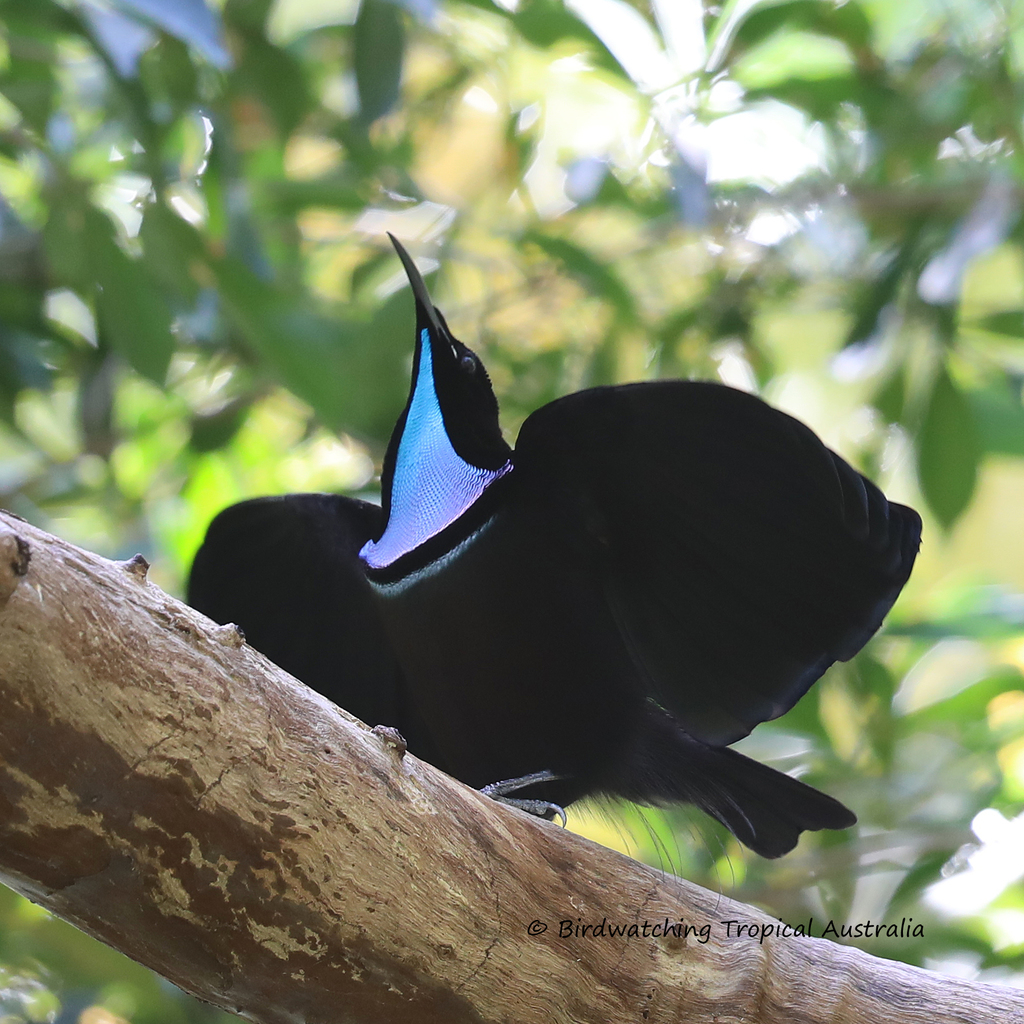
This riflebird is a medium-sized bird, being up to 34 cm (13 in) long. The male is velvet-black bird-of-paradise with elongated black filamental flank plumes, an iridescent blue-green crown, a wide, triangle-shaped breast shield, and on central tail feathers. It has a black curved bill, yellow mouth, blackish feet and a dark brown iris. The female is brownish with dark spots and buff bars below with a white brow. The immature male resembles the male but with less tail plumes.
What it does
The diet of the magnificent riflebird consists mainly of fruits and a variety of invertebrates such as spiders, millipedes, etc. Males are polygamous and perform solitary courtship displays on a 'dancing perch'. During these displays, the male fully extends his wings and raises his tail; he jerks upward while swinging his head from side to side, showing off his metallic blue-green breast shield, and producing a distinctive "woosh" sound as he flaps his wings. Multiple females will observe these displays, and, if satisfied with the performance, reward the male with mating rights. Females subsequently build nests, incubate, brood, and feed young without male assistance.
== References ==
Wikipedia: “Behaviour”
Listen
Looking for field recordings…
Where it lives
Recorded sightings
—
geo-referenced records in GBIF, from museums, herbaria and field observers.
Drag the globe to turn it. Dots are where records exist, not a range map; darker means more records.
In the old herbals & bestiaries

In the stacks
Searching the stacks…
Every page naming Ptiloris magnificus in the Biodiversity Heritage Library →
This page is assembled live from iNaturalist, GBIF, Wikipedia, the Source Library and the Internet Archive. It is not yet part of the hand-edited codex. iNaturalist taxon 604103.