- Plants
- ›Vascular Plants
- ›flowering plants
- ›Dicots
- ›Sunflowers, Bellflowers, Fanflowers, and Allies
- ›Sunflowers, Daisies, Asters, and Allies
- ›Thistles and Allies
- ›Cardueae
- ›Thistles and Burdocks
- ›Cirsium
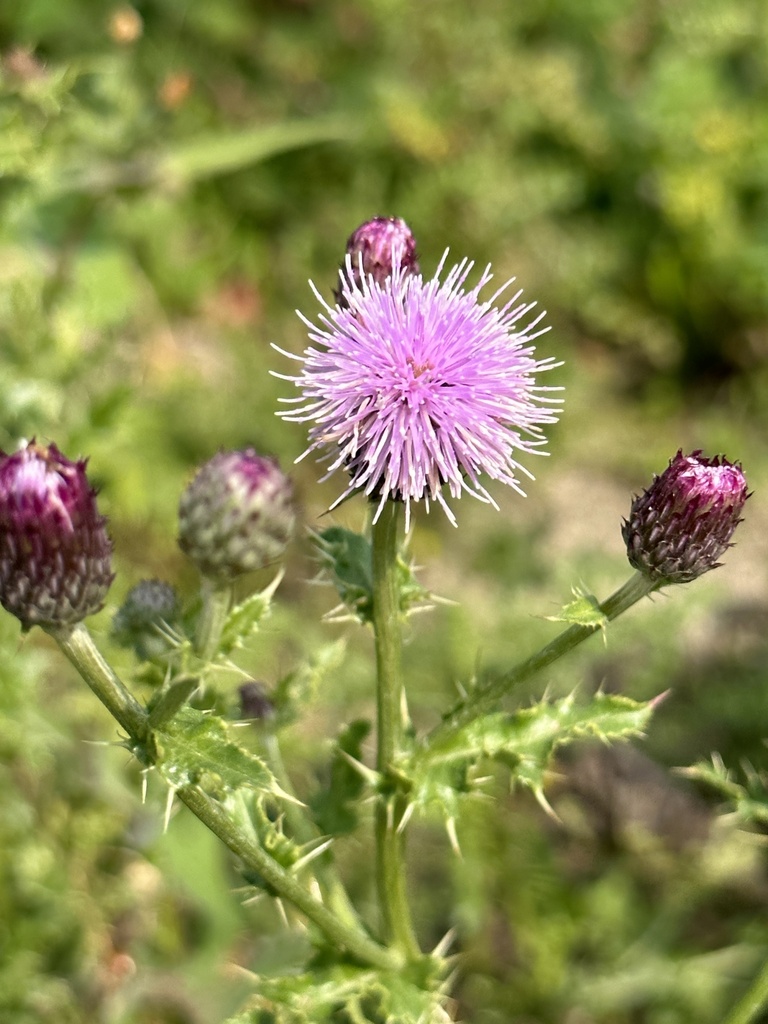
creeping thistle
Cirsium arvense
Cirsium arvense is a perennial species of flowering plant in the family Asteraceae, native throughout Europe and western Asia, northern Africa and widely introduced elsewhere. The standard English name in its native area is creeping thistle. It is also commonly misnomered as Canada thistle and sometimes as field thistle.
From the article Cirsium arvense on Wikipedia (CC BY-SA), quoted section by section
Description
Cirsium arvense is a C3 carbon fixation plant. The C3 plants originated during Mesozoic and Paleozoic eras, and tend to thrive in areas where sunlight intensity is moderate, temperatures are moderate, and ground water is plentiful. C3 plants lose 97% of the water taken up through their roots to transpiration. Creeping thistle is a herbaceous perennial plant growing up to 150 cm, forming extensive clonal colonies from thickened roots that send up numerous erect shoots during the growing season. It is a ruderal species. Given its adaptive nature, Cirsium arvense is one of the worst invasive weeds worldwide. Through comparison of its genetic expressions, the plant evolves differently with respect to where it has established itself. Differences can be seen in their R-protein mediated defenses, sensitivities to abiotic stresses, and developmental timing.
Taxonomy. Cirsium arvense is placed in the subtribe Carduinae, tribe Cardueae of the family Asteraceae. Unlike other species in the same genus, it is dioecious, although male plants sometimes produce bisexual flowers. It also differs from other native North American species in having large roots and multiple small flower heads on a branched stem. Cirsium arvense grows in diverse habitats (ranging from moist places to grasslands, mountain slopes, flooded lands, disturbed sites, etc.) at 100–4,300 m. …
What it does
The seeds are an important food for the goldfinch and the linnet, and to a lesser extent for other finches. Creeping thistle foliage is used as a food by over 20 species of Lepidoptera, including the painted lady butterfly and the engrailed moth, and several species of aphids. The C. arvense species is also noted to be a food source for the Altica cirsicola beetle species. The flowers are visited by a wide variety of insects such as bees, moths, wasps and beetles (the generalised pollination syndrome). The plant is beneficial for pollinators that rely on nectar. It also was a top producer of nectar sugar in a 2016 study in Britain, with a second-place ranking due to a production per floral unit of (2609±239 μg).
Wikipedia: “Ecology”
At the table
Like other Cirsium species, the roots are edible, though rarely used, not in the least because of their propensity to induce flatulence in some people. The taproot is considered the most nutritious part. The leaves are also edible, though the spines make their preparation for food too tedious to be worthwhile. The stalks, however, are also edible and more easily despined. Bruichladdich distillery on Isle of Islay lists creeping thistle as one of the 22 botanical forages used in their gin, The Botanist. The feathery pappus is also used by the Cherokee to fletch blowgun darts.
Wikipedia: “Uses”
Where it lives
Recorded sightings
—
geo-referenced records in GBIF, from museums, herbaria and field observers.
Drag the globe to turn it. Dots are where records exist, not a range map; darker means more records.
In the stacks
Searching the stacks…
Every page naming Cirsium arvense in the Biodiversity Heritage Library →
This page is assembled live from iNaturalist, GBIF, Wikipedia, the Source Library and the Internet Archive. It is not yet part of the hand-edited codex. iNaturalist taxon 60132.