On eBird ↗
Masked Finfoot
Live sightings near you, the range map, bar charts of when it is seen, and Macaulay Library photos and recordings.
Masked Finfoot
Heliopais personatus
The masked finfoot or Asian finfoot (Heliopais personatus) is a highly endangered aquatic bird that was formerly distributed throughout the fresh and brackish wetlands of the eastern Indian subcontinent, Indochina, Malaysia and Indonesia. Like the rest of the family, the African finfoot and the sungrebe, the relationship to other birds is poorly understood.
From the article Masked finfoot on Wikipedia (CC BY-SA), quoted section by section
Description
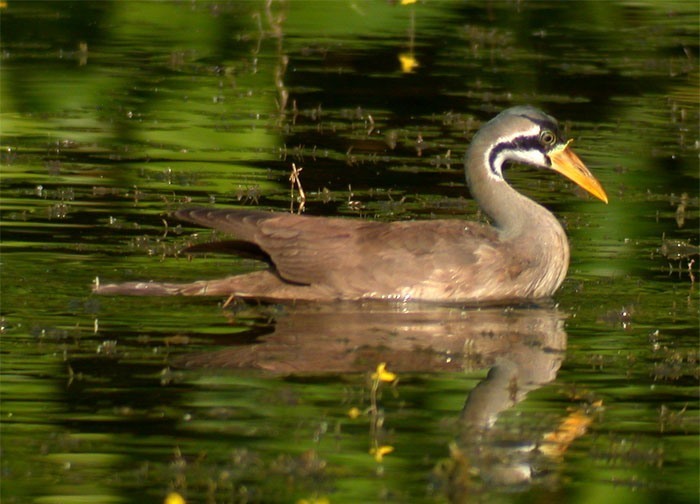
The masked finfoot is an underwater specialist with a long neck, a striking sharp beak, and lobed feet which are green. Both males and females have a black mask and eyebrow that contrasts with a white eyering and lateral cervical stripe. The rest of the neck is grey, the breast is pale and the back, wings, and tail are a rich brown. The males have an all-black chin while the females have a white chin.
Range & habitat
The masked finfoot can be found in a range of habitats across the eastern Indian subcontinent through to Malaysia and Indonesia in a variety of fresh to brackish wetlands, although due to habitat destruction it has disappeared from most of this range. This range includes forest, wooded savannah, flooded forest, and even mangrove swamps. The finfoot feeds on aquatic invertebrates, including both adults and larval mayflies, dragonflies, crustaceans, also snails, fish and amphibians. They are thought to be highly opportunistic and take some of their prey directly off the waters surface. They are adept out of water and will forage on the banks as well, unlike the grebes, which they resemble but are not related to. Finfoots are only seen singly or in pairs. They are very secretive. Because they are so elusive, it is not known if they spend most of their time in the water, where they are almost always seen, or on land. The breeding biology is poorly known. It is thought to coincide with the rainy season. In Bangladesh, the breeding season was observed to extend from June to September. They build a pad-shaped nest of small sticks low above water. The nests are occasionally seen to have few long leaves, grass and reeds. Three to seven eggs are laid. The chicks are dark grey in colour with a white spot on the tip of the beak. The chicks are fed with fish and shrimps. …
Wikipedia: “Distribution and habitat”
Listen
Looking for field recordings…
Where it lives
Recorded sightings
—
geo-referenced records in GBIF, from museums, herbaria and field observers.
Drag the globe to turn it. Dots are where records exist, not a range map; darker means more records.
In the stacks
Searching the stacks…
Every page naming Heliopais personatus in the Biodiversity Heritage Library →
This page is assembled live from iNaturalist, GBIF, Wikipedia, the Source Library and the Internet Archive. It is not yet part of the hand-edited codex. iNaturalist taxon 60.