- Plants
- ›Vascular Plants
- ›flowering plants
- ›Dicots
- ›Mints, Plantains, Olives, and Allies
- ›Mint Family
- ›Nepetoideae
- ›Mentheae
- ›Melissas and sages
- ›Melissa
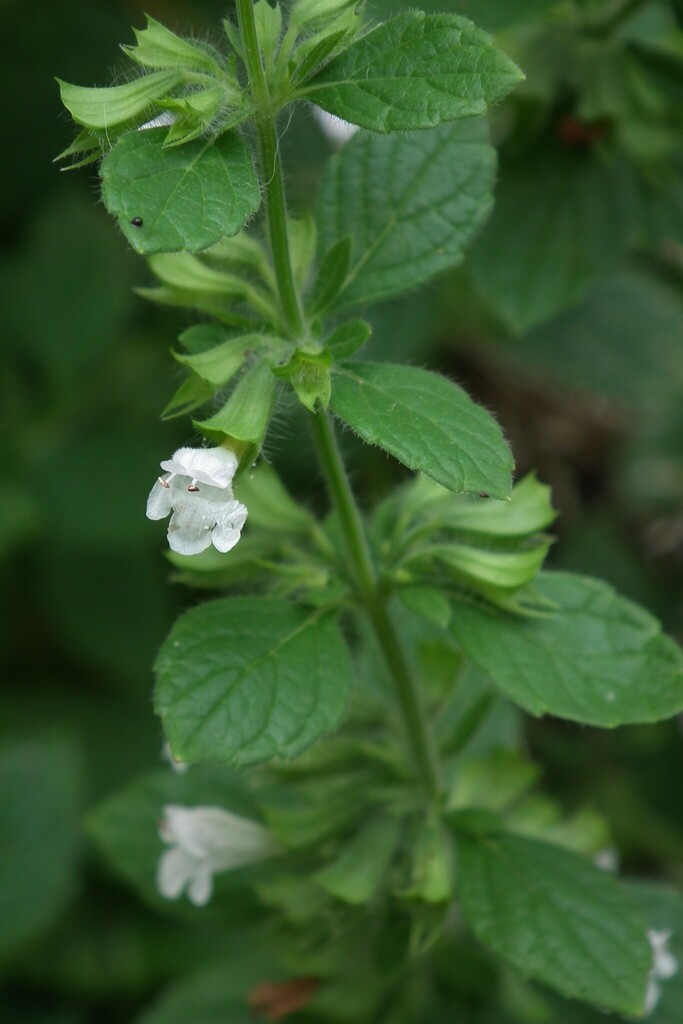
lemon balm
Melissa officinalis
Lemon balm (Melissa officinalis) is a perennial herbaceous plant in the mint family. It has lemon-scented leaves, white or pale pink flowers, and contains essential oils and compounds, such as geranial and neral.
It grows to a maximum height of 1 m (3+1⁄2 ft). The species is native to south-central Europe, the Mediterranean, Central Asia, and Iran. It is naturalized worldwide. It grows easily from seed in rich, moist soil.
From the article Lemon balm on Wikipedia (CC BY-SA), quoted section by section
Description
Lemon balm (Melissa officinalis) is a perennial herbaceous plant in the mint family, Lamiaceae. Lemon balm grows vigorously from seed or vegetative fragments in temperate zones. Key producing countries such as Hungary, Egypt, Ireland, and Italy cultivate a variety of cultivars for hand-harvested leaves and low-yield essential oils. Lemon balm plants grow bushy and upright to a maximum height of 100 centimetres (39 in). The heart-shaped leaves are 2–8 cm (3⁄4–3+1⁄4 in) long, and have a rough, veined surface. They are soft and hairy with scalloped edges, and have a mild lemon scent. During summer, small white or pale pink flowers appear. The plants live for ten years; the crop plant is replaced after five years to allow the ground to rejuvenate.
Range & habitat
Melissa officinalis is native to south-central Europe, the Mediterranean Basin, Central Asia and Iran, but is now naturalized in the Americas and elsewhere around the world. It grows easily from seed, preferring rich, moist soil.
Wikipedia: “Distribution and habitat”
At the table
Lemon balm is used as a flavouring in ice cream and herbal teas, often in combination with other herbs, such as spearmint. The leaves can be used in fish dishes and lemon balm pesto.
Wikipedia: “Uses”
How it is grown
Lemon balm seeds requires light and a minimum temperature of 20 °C (68 °F) to germinate. The plant grows in clumps and spreads vegetatively (a new plant growing from a fragment of its parent), as well as by seed. In mild temperate zones, the plant stems die off at the start of winter, but shoot up again in spring. Lemon balm grows vigorously. As of 1992, Hungary, Egypt, and Italy are the major producing countries of lemon balm. The leaves are harvested by hand in June and August in the northern hemisphere, on a day when the weather is dry, to prevent the crop from turning black if damp. The cultivars of M. officinalis include:
M. officinalis 'Citronella' M. officinalis 'Lemonella' M. officinalis 'Quedlinburger' M. officinalis 'Lime' M. officinalis 'Mandarina' M. officinalis 'Variegata' M. officinalis 'Aurea' M. officinalis 'Quedlinburger Niederliegende', a variety reportedly bred for higher essential oil content.
Essential oil production. Ireland is a major producer of lemon balm essential oil, which has a pale yellow colour and a lemon scent. The essential oil is commonly co-distilled with lemon oil, citronella oil or other essential oils. Yields are low; 0.014% for fresh leaves and 0.112% for dried leaves.
Wikipedia: “Cultivation”
In human culture
The white flowers attract bees, hence the genus Melissa (Greek for "honey bee"). It is not to be confused with bee balm (genus Monarda). The second name, officinalis (Latin, 'of the shop'), originates from the use of the herb by apothecaries, who sold herbal remedies directly to their customers.
Wikipedia: “Etymology”
Where it lives
Recorded sightings
—
geo-referenced records in GBIF, from museums, herbaria and field observers.
Drag the globe to turn it. Dots are where records exist, not a range map; darker means more records.
In the old herbals & bestiaries

Herbal of Virtues
1499 · p.179

Commentaries on the Six Books of Pedanius Dioscorides on Medical Matter
Pietro Andrea Mattioli · 1565 · p.998

Latin Herbal with German Synonyms
1484 · p.207

Herbarius latinus (with Dutch synonyms)
1486 · p.177

Latin Herbal with German Synonyms
1486 · p.180

The Great Herbary with all the figures of the herbs
1532 · p.202

Notable Commentaries on the History of Plants
Leonhart Fuchs · 1542 · p.532

Notable Commentaries on the History of Plants
Leonhart Fuchs · 1549 · p.530

On the Names of Plants
Hieronymus Bock (Tragus) · 1552 · p.84

De medicinali materia libri sex
Dioscorides · 1552 · p.464

On the Names of Plants
Hieronymus Bock (Tragus) · 1552 · p.85

Commentaries on the Six Books of Dioscorides
Pietro Andrea Mattioli · 1560 · p.596
In the stacks
Searching the stacks…
Every page naming Melissa officinalis in the Biodiversity Heritage Library →
This page is assembled live from iNaturalist, GBIF, Wikipedia, the Source Library and the Internet Archive. It is not yet part of the hand-edited codex. iNaturalist taxon 59901.