- Animals
- ›Arthropods
- ›Hexapods
- ›Insects
- ›Winged and Once-winged Insects
- ›Butterflies and Moths
- ›Hawk, Sphinx, Silk, Emperor, and Allied Moths
- ›Emperor and Giant Silk Moths
- ›Emperor Moths
- ›Saturniini
- ›Saturnia
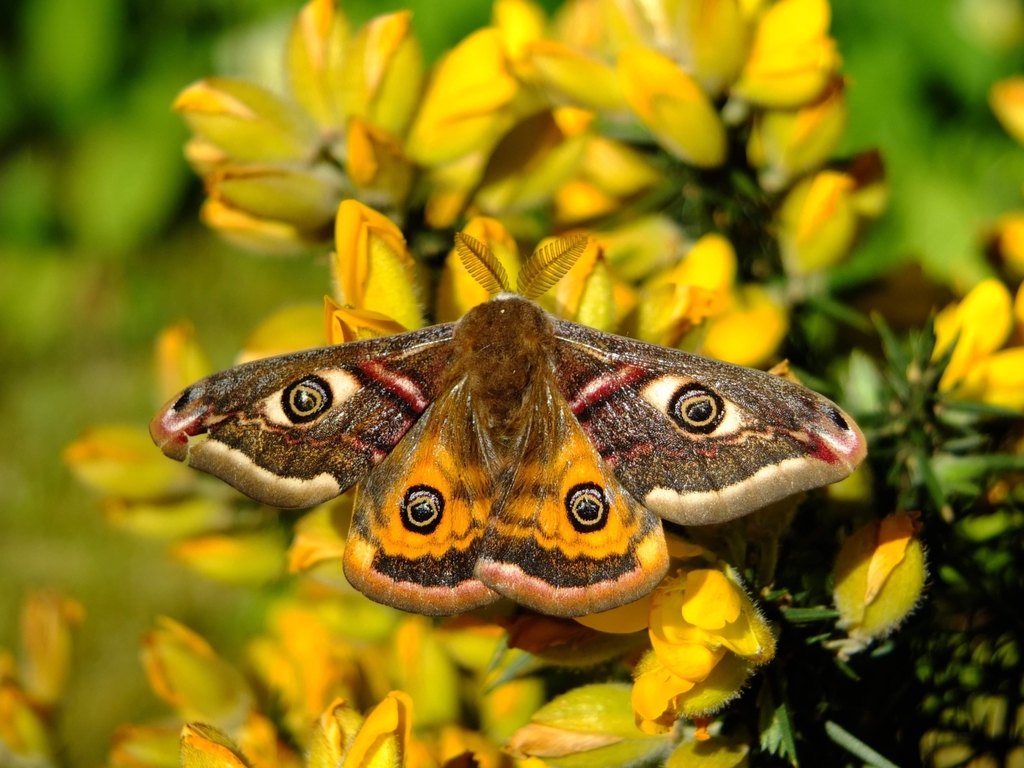
Small Emperor Moth
Saturnia pavonia
Saturnia pavonia, the small emperor moth, is a moth of the family Saturniidae. It was first described by Carl Linnaeus in his 1758 10th edition of Systema Naturae. Sometimes, the incorrect genus name Pavonia is still used for this species. This moth occurs throughout the Palearctic region and is the only member of its family to be found in the British Isles, where it is usually called simply the emperor moth.
From the article Saturnia pavonia on Wikipedia (CC BY-SA), quoted section by section
Description
The male has a wingspan of about 60 mm (2.4 in) with brown and white forewings marked with red and orange fascia and a bold black and orange eyespot. The hindwings are orange with a similar eyespot. The female is larger with a wingspan of about 80 mm (3.1 in), but less brightly coloured than the male, being generally grey and white but has all wings marked with eyespots similar to the male. The male flies rapidly during the day from mid-April to late June looking for the rather sluggish females, which usually only fly at night. The species inhabits a range of habitats but is most often associated with heathland and moorland. The caterpillar is black and orange at first, later becoming green with black rings and yellow and red spots. The commonest food plant is heather but the species has also been recorded feeding on a huge range of other plants (see list below). The species overwinters as a pupa within a fibrous cocoon.
At the table
S. pavonia larvae have been recorded feeding on Alchemilla, Alnus, Arbutus, Betula, Calluna, Cornus, Crataegus, Erica, Fagus, Filipendula, Fragaria, Fraxinus, Hippophae, Humulus, Juglans, Lythrum, Malus, Myrica gale, Pistacia, Populus, Potentilla, Prunus, Pyrus, Quercus, Rhamnus, Rosa, Rubus, Rumex, Salix, Sambucus, Schinus, Sorbus, Spiraea, Ulmus, Vaccinium.
Wikipedia: “Recorded food plants”
Listen
Looking for field recordings…
Where it lives
Recorded sightings
—
geo-referenced records in GBIF, from museums, herbaria and field observers.
Drag the globe to turn it. Dots are where records exist, not a range map; darker means more records.
In the stacks
Searching the stacks…
Every page naming Saturnia pavonia in the Biodiversity Heritage Library →
This page is assembled live from iNaturalist, GBIF, Wikipedia, the Source Library and the Internet Archive. It is not yet part of the hand-edited codex. iNaturalist taxon 59346.