- Animals
- ›Arthropods
- ›Hexapods
- ›Insects
- ›Winged and Once-winged Insects
- ›Butterflies and Moths
- ›Butterflies
- ›Skippers
- ›Spread-wing Skippers
- ›Duskywings and Allies
- ›Erynnis
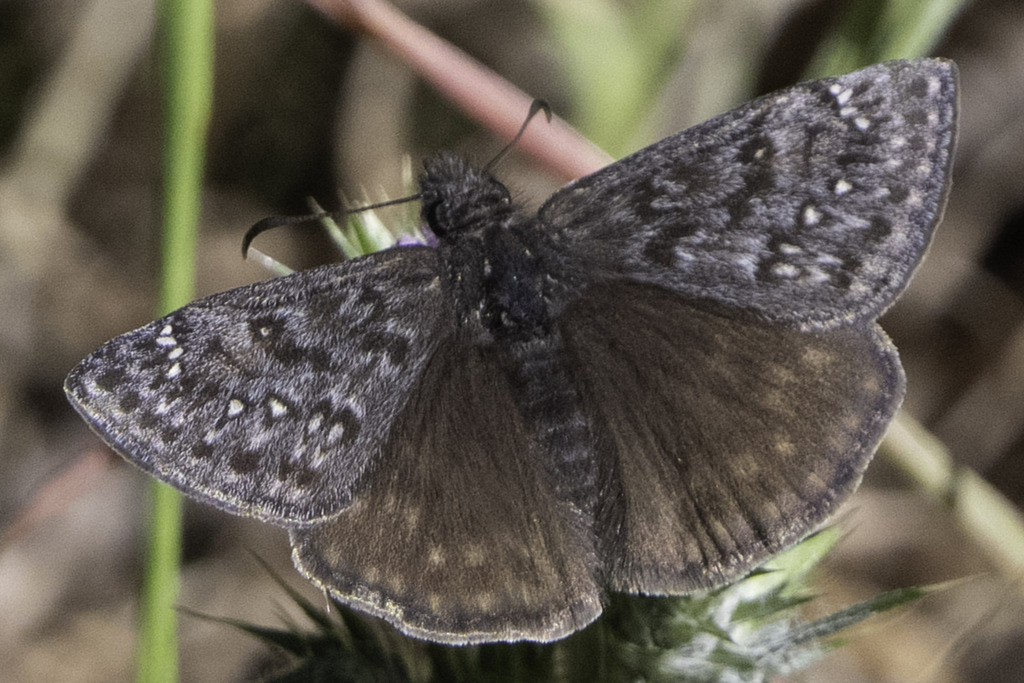
Propertius Duskywing
Erynnis propertius
Erynnis propertius, commonly known as Propertius duskywing, is a species of butterfly in the family Hesperiidae. Propertius duskywings are members of the Pyrginae subfamily. It is found in along the west coast of North America from southern British Columbia south along the Pacific Slope to Baja California Norte. It is one of the most commonly seen skippers in California.
The species was formally described and named by entomologists Samuel Hubbard Scudder and Edward Burgess in 1870. E. propertius was occasionally recorded under different names that are now considered synonymous. These include: Nisoniades propertius, Nisoniades tibullus, and Thanaos propertius.
From the article Erynnis propertius on Wikipedia (CC BY-SA), quoted section by section
Range & habitat
The distribution of E. propertius aligned with its host, Garry oak, primarily in southwestern British Columbia, Canada; the southern and northern Puget Sound and the eastern slopes of the Cascade Mountains in Washington; western Oregon; and northwestern California. In Washington, E. propertius exists only in small, isolated populations. It has also been observed in Mason County, San Juan County, Scamaria County, and Thurston County. E. propertius is frequently found in oak-dominated habitats, such as open woodlands, forest edges, and savanna habitats that contain Garry oak. It is closely associated with Quercus garryana ecosystems in British Colombia, which are naturally fragmented and have limited distribution. The scattered presence of these habitats has resulted in limited local population structure and interpopulation dispersal. In the southern part of its range, E. propertius feeds on other oak species.
Wikipedia: “Geographic range”
What it does
E. propertius go through one life cycle per year. Unlike some other butterfly species that migrate, E. propertius usually stay within a hundred meters of their birthplace. These butterflies stay in the same site all year, whether they are eggs, larvae, pupae, or adult butterflies. Larvae feed on the leaves of Garry oaks. They conceal themselves in silken nests and primarily forage at night. Their large cocoons made of folded oak leaves fall to the ground during winter, where they overwinter as sixth instar caterpillars. The larvae pupate in early spring in the oak leaf nest. Adult E. propertius typically emerge from the pupae during April and May. The males come out first, then the females. Late-season individuals are primarily female.
Wikipedia: “Life cycle”
Listen
Looking for field recordings…
Where it lives
Recorded sightings
—
geo-referenced records in GBIF, from museums, herbaria and field observers.
Drag the globe to turn it. Dots are where records exist, not a range map; darker means more records.
In the stacks
Searching the stacks…
Every page naming Erynnis propertius in the Biodiversity Heritage Library →
This page is assembled live from iNaturalist, GBIF, Wikipedia, the Source Library and the Internet Archive. It is not yet part of the hand-edited codex. iNaturalist taxon 59187.