- Animals
- ›Arthropods
- ›Hexapods
- ›Insects
- ›Winged and Once-winged Insects
- ›Butterflies and Moths
- ›Butterflies
- ›Gossamer-winged Butterflies
- ›Blues
- ›Typical Blues
- ›Everina
- ›Everes
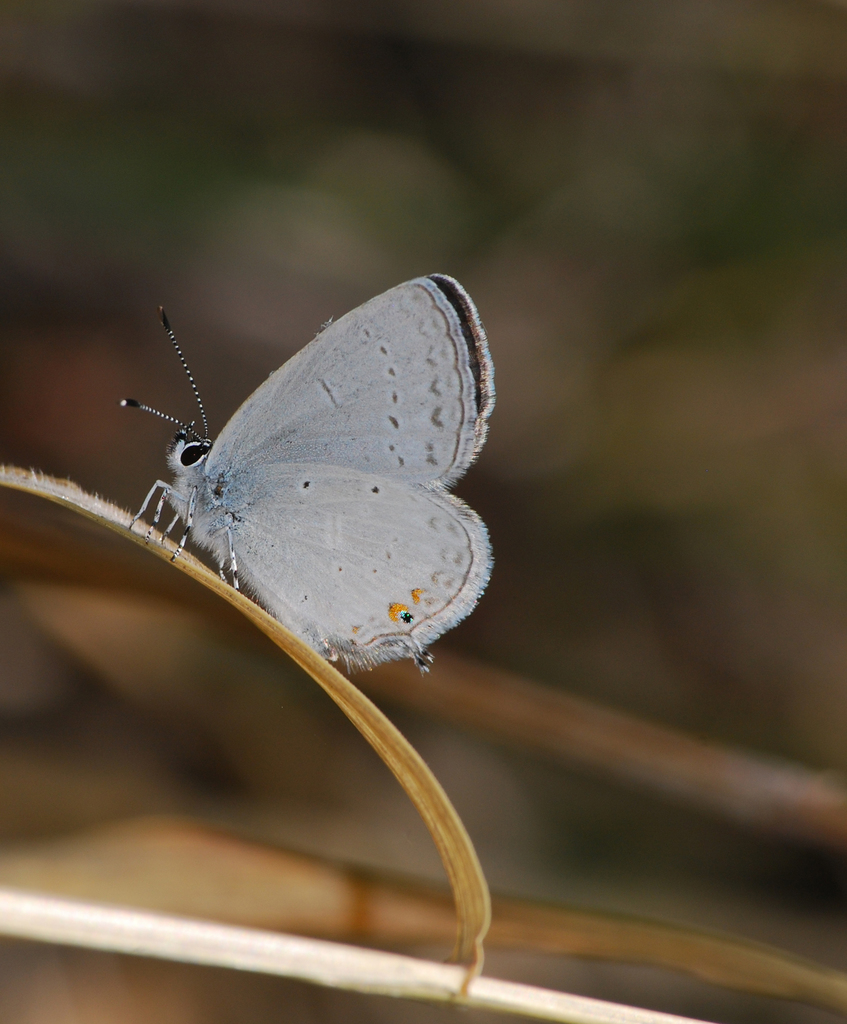
Western Tailed-blue
Everes amyntula
The western tailed-blue (Cupido amyntula) is a Nearctic non-migratory butterfly that commonly takes flight during the spring and summer seasons of March–July. They have a tail on their hindwing, an upper surface that's bluish, and an under surface that is chalky-white with occasional black spots, and an orange spot toward the base of the tail. The wingspan ranges from 0.875 to 1.125 inches (2.2 to 2.9 cm). Larvae feed on various legumes with inflated seed pods, including Astragalus (several species), Lathyrus (several species), Oxytropis, and Vicia (several species). Adults feed on various things such as flower nectar, horse and coyote manure, urine, and mud.
From the article Western tailed-blue on Wikipedia (CC BY-SA), quoted section by section
Range & habitat
The western tailed-blue can be most abundantly found in open areas containing low shrubs extending throughout western North America from as high as south Alaska to as low as northern Baja California. These species prefer to reside more in forest densities, with equal presence in mature and young forests, compared to grassland habitats within these regions. They also have no preference for an open tree canopy cover and are equally likely to be found in mature forests adjacent to agricultural fields, young forests, and grasslands. They are found in higher densities of host plant cover and nectar plants among certain sites including meadows, prairies, and young forests. Within these locations, adult C. amynula visits white, purplish, yellow, or pinkish flowers, including Sedum lanceolatum and Astragalus flexuosus. The density of these species is highest where nectar plants and forest openings are widely available. Other habitat characteristics these species are known for include moist woodland openings under mature, open forests. This species also occurs along weedy forest margins across Canada, as far as eastern Quebec, New Brunswick, and Maine.
Wikipedia: “Habitat”
Listen
Looking for field recordings…
Where it lives
Recorded sightings
—
geo-referenced records in GBIF, from museums, herbaria and field observers.
Drag the globe to turn it. Dots are where records exist, not a range map; darker means more records.
In the stacks
Searching the stacks…
Every page naming Everes amyntula in the Biodiversity Heritage Library →
This page is assembled live from iNaturalist, GBIF, Wikipedia, the Source Library and the Internet Archive. It is not yet part of the hand-edited codex. iNaturalist taxon 59150.