- Plants
- ›Vascular Plants
- ›flowering plants
- ›Dicots
- ›Sunflowers, Bellflowers, Fanflowers, and Allies
- ›Sunflowers, Daisies, Asters, and Allies
- ›Thistles and Allies
- ›Oldenburgieae
- ›Oldenburgia
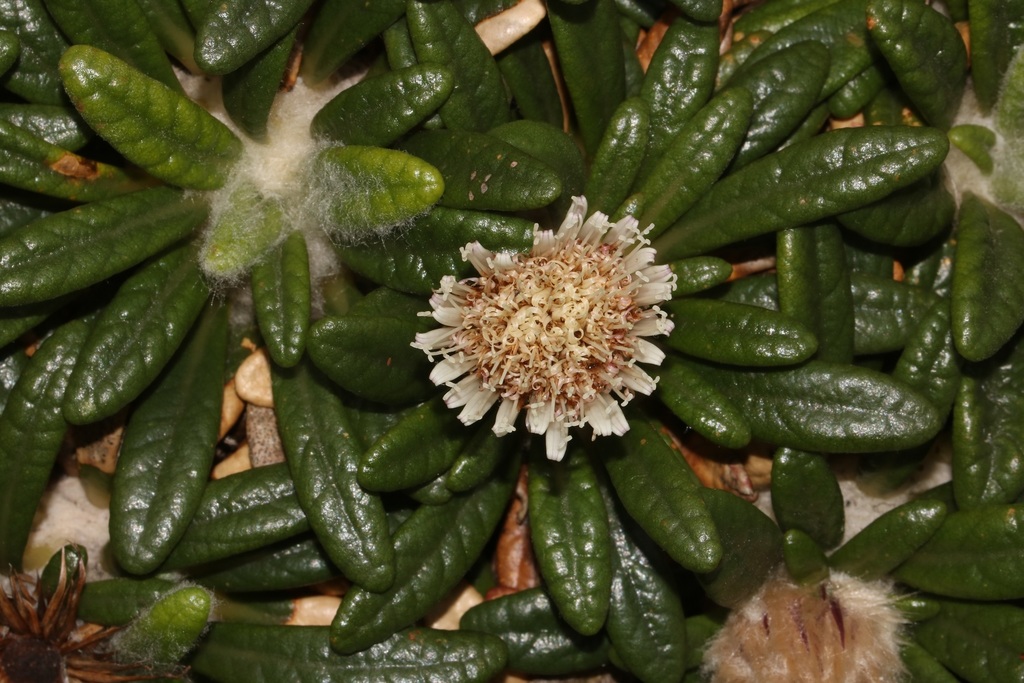
Rock Cushionbush
Oldenburgia paradoxa
Oldenburgia paradoxa Less. is a species in the genus Oldenburgia, in the family Asteraceae.
From the article Oldenburgia paradoxa on Wikipedia (CC BY-SA), quoted section by section
Description
In its habit Oldenburgia paradoxa is a remarkably dense, usually cushion-shaped, subshrub, typically growing in the form of a hemisphere. Plants will sometimes exceed a metre in height, but usually are much shorter, commonly 30 cm or so. The leaves are elliptical, alternate, and in appearance are typical of the genus, leathery, deep green above, and felted white below. They are suggestive of loquat leaves with the margins slightly rolled down. Young leaves are vividly white-felted all over; as they mature, they shed the felt on the upper surface, but retain the felt on their under-surfaces. Unlike the leaves of other members of the genus, the leaves of Oldenburgia paradoxa are crowded impenetrably closely at the branch tips around the periphery of the plant, and they are much smaller, being some 10 cm long. The branches have thick, corky bark that generally is not visible on an undamaged plant. The flower heads are pedunculate to nearly sessile, but are exceptional among Oldenburgias, being borne among the leaves at the surface of the plant cushion; the other Oldenburgia species have tall peduncles that stand proud of the plant. The flower heads are about 5 cm in diameter, creamy, sometimes with a tinge of pink or purple. The flowerheads are solitary and terminal.
Range & habitat
The species is endemic to the mountains of the southern part of the Western Cape Province in South Africa. Its status is not clear; it always was uncommon and persists largely in mountain reserves. It grows in sandstone on cliffs, in rock crevices, and near mountain tops where it has little competition from other plants.
Wikipedia: “Distribution and environment”
Where it lives
Recorded sightings
—
geo-referenced records in GBIF, from museums, herbaria and field observers.
Drag the globe to turn it. Dots are where records exist, not a range map; darker means more records.
In the stacks
Searching the stacks…
Every page naming Oldenburgia paradoxa in the Biodiversity Heritage Library →
This page is assembled live from iNaturalist, GBIF, Wikipedia, the Source Library and the Internet Archive. It is not yet part of the hand-edited codex. iNaturalist taxon 590729.