- Plants
- ›Vascular Plants
- ›conifers
- ›conifers
- ›pine family
- ›pines, spruces, larches, and allies
- ›Pinus
- ›Pinus
- ›Trifoliae
- ›Sabinianae
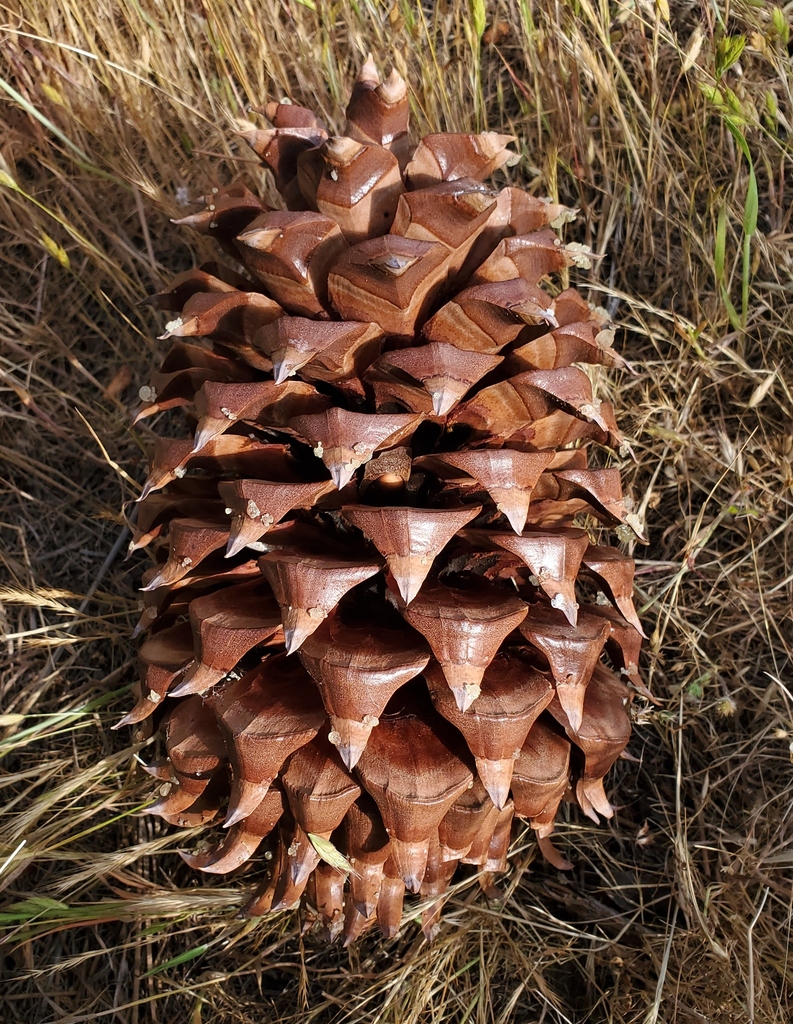
gray pine
Pinus sabiniana
Pinus sabiniana (sometimes spelled P. sabineana) is a pine endemic primarily to California, with its range extending locally into southern Oregon. Its vernacular names include towani pine, foothill pine, gray pine, ghost pine, and bull pine. The name digger pine was historically used but includes a racial slur.
From the article Pinus sabiniana on Wikipedia (CC BY-SA), quoted section by section
Description
Pinus sabiniana is a medium sized evergreen tree. Mature trees typically grow to 11–14 metres (36–45 ft), but can reach 32 m (105 ft). Young trees usually have straight trunks and a conical crown, but mature trees often divide into several forks as they age and become crooked, with sparse or irregular crowns. The bark of mature trunks is gray to reddish brown and is thick with deep fissures and irregular exfoliating scaly patches. The needles are in fascicles (bundles) of three, distinctively pale gray-green, sparse and drooping, and grow to 20–30 centimetres (8–12 in) in length. The buds are ovoid, red-brown and resinous about 1cm long with white fringed scale margins.
The pollen cones are borne in clusters at the bases of new needle shoots. The seed cones mature during their second year and are large and heavy, broadly ovoid, 12–35 cm (4+3⁄4–13+3⁄4 inches) in length and almost as wide as they are long. Each cone scale bears a distinctive woody spur that commonly elongates and curves downward, giving an armored appearance. The cones lack an abscission layer and may remain attached to the original branch long after seeds have been dispersed. The seeds are large, 19-25mm, long, heavy and pooryl winged. When fresh, they weigh from 0.3 to 0.7 kilograms (0.7 to 1.5 lb), rarely over 1 kg (2.2 lb). The male cones grow at the base of shoots on the lower branches.
Range & habitat
Pinus sabiniana is native primarily to California with scattered populations documented in southern Oregon. In California,It is found throughout the Sierra Nevada and Coast Ranges foothills that ring the Central, San Joaquin and interior valleys; the Transverse and Peninsular Ranges; and Mojave Desert sky islands. This tree usually grows at elevations between sea level and 1,200 m (4,000 ft) and is common in the northern and interior portions of the California Floristic Province. It is adapted to long, hot, dry summers and is found in areas with an unusually wide range of precipitation: from an average of 250 mm (10 in) per year at the edge of the Mojave to 1,780 mm (70 in) in parts of the Sierra Nevada. It prefers rocky, well drained soil, but also grows in serpentine soil and heavy, poorly drained clay soils. It commonly occurs in association with Quercus douglasii, and "Oak/Foothill Pine vegetation" (also known as "Oak/Gray Pine vegetation") is used as a description of a type of habitat characteristic within the California chaparral and woodlands ecoregion in California, providing a sparse overstory above a canopy of the oak woodland.
Wikipedia: “Distribution and habitat”
What it does
Pinus sabiniana is a highly drought tolerant tree and very intolerant of shade. With its sparse crown and relatively low foliage mass, it reduces total water loss giving it a competitive advantage on dry sites, though it competes poorly in wetter environments with denser-crowned trees. Its large, heavy seeds have poorly developed wings and are principally dispersed by animals and gravity rather than wind. California scrub jays and acorn woodpeckers disperse the seeds, while heavy, fallen cones may roll downslope and relatively buoyant seeds may be carried by running water. Gray pine Dwarf Mistletoe ( Arceuthobium occidentale) is a widespread and sometimes harmful parasite of this species. Established infections can cause reduced growth, deformation and eventual death, and trees of all sizes may succumb to this parasite. Additionally, Pinus sabiniana needles are a food of the caterpillars of the Gelechiid moth Chionodes sabinianus.
Wikipedia: “Ecology”
At the table
Some Native American groups relied heavily on sweet pine nuts for food and are thought to have contributed to the current distribution pattern, including the large gap in distribution in Tulare County. Native Americans also consumed the roots.
Protein and fat nutritional value of the seed are similar to Pinus pinea seeds and figured in the local indigenous diet. Ohlone people chewed the pitch as a treatment for rheumatism. Wood uses historically were determined by its particular characteristics, e.g., 0.43 mean specific gravity nearly equal to Douglas-fir (Pseudotsuga menziesii); strength properties similar to ponderosa pine; Kraft pulps high in bursting with tensile strength comparable to some northern conifer pulps; and foothill stands loggable in winter, when higher-altitude species were inaccessible. However, the high amounts of resin and compression wood, the often crooked form, heavy weight, and low stand density, made it expensive otherwise to log, transport and process. …
Wikipedia: “Uses”
Where it lives
Recorded sightings
—
geo-referenced records in GBIF, from museums, herbaria and field observers.
Drag the globe to turn it. Dots are where records exist, not a range map; darker means more records.
In the stacks
Searching the stacks…
Every page naming Pinus sabiniana in the Biodiversity Heritage Library →
This page is assembled live from iNaturalist, GBIF, Wikipedia, the Source Library and the Internet Archive. It is not yet part of the hand-edited codex. iNaturalist taxon 58772.