- Animals
- ›Chordates
- ›Vertebrates
- ›Ray-finned Fishes
- ›Carps, Characins, Catfishes and Allies
- ›Catfishes
- ›Siluroidei
- ›North American Freshwater Catfishes
- ›Noturus
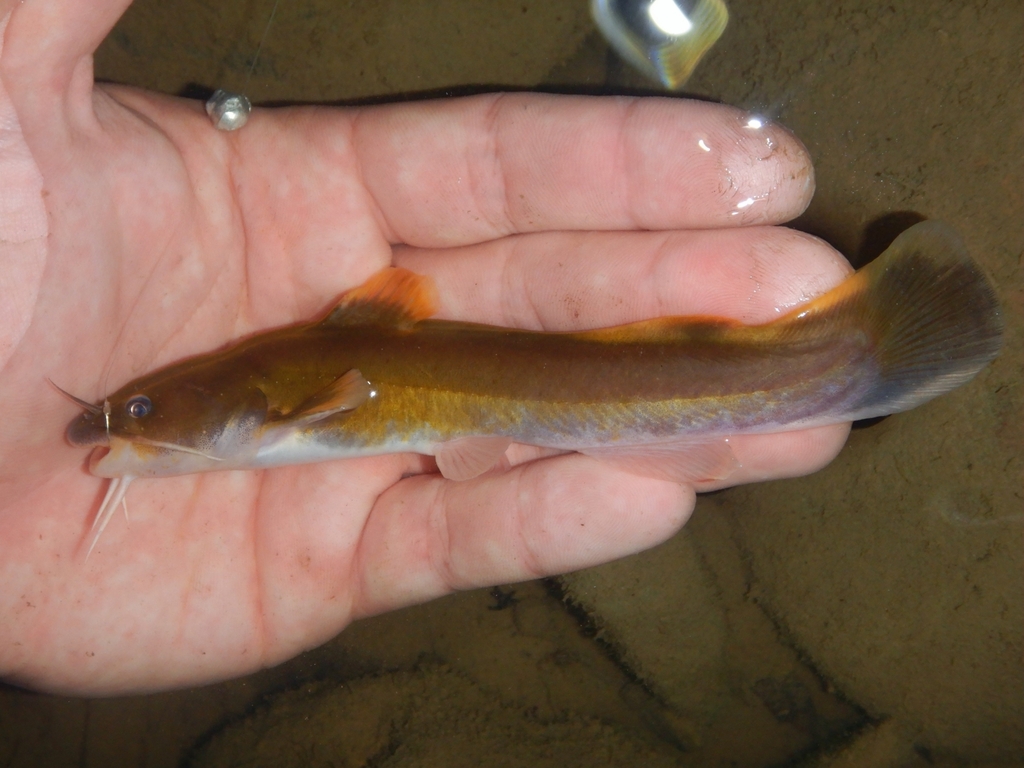
Stonecat
Noturus flavus
Noturus flavus , the stonecat, is a North American freshwater catfish of the family Ictaluridae. Its common name is due to its habit of hiding near or under stones in fast-moving water.
From the article Noturus flavus on Wikipedia (CC BY-SA), quoted section by section
Description
Stonecats are small, slender, flat-headed catfishes, with the adipose fin keel-like and continuous with the caudal fin except for a shallow notch. While the dorsal and pectoral spines of most members of this family cause wounds that irritate, the stonecat has venom glands, particularly on the bases of the pectoral spines, that cause extreme pain similar to that of a wasp sting. The pectoral fin lacks any posterior serrae. Anal fin rays number 15 to 18, pectoral fin rays 9 to 11, and pelvic fin rays 8 to 10. The caudal fin rays number 55 to 67. The upper jaw projects beyond the lower jaw and the tooth pad on the upper jaw has a narrow, crescent-shaped extension on each side. The premaxillary band of teeth has lateral backward extensions. The skin of the stonecat is thick and is yellowish-brown in color. The sides of the head shade to yellow. The belly is whitish. The stonecat has two forms. In the Cumberland drainage in Tennessee, a scientifically undescribed form possesses two light bars (perpendicular to body length) on its nape. In other areas, a patch exists in place of the bars. In both forms, the stonecat has a white spot at the rear of the dorsal fin base and one on the upper edge of the caudal fin. The rear of the pectoral spine has either no or a few weak teeth.
Wikipedia: “Anatomy”
Range & habitat
The stonecat has a widespread distribution. Stonecats exist in the Great Lakes, the St. Lawrence River, drainages of Hudson Bay, and the Mississippi River basin. Stonecats can also be found from the Hudson River drainage of New York west to the Red River drainage of Hudson Bay. Stonecats inhabit the drainage of the Mississippi River basin from Quebec to Alberta, southerly to northern Alabama and Mississippi and westerly to northeastern Oklahoma. In Colorado, stonecats are present in St. Vrain Creek near Longmont, Colorado and in the Republican River south of Wray, Colorado.
Wikipedia: “Distribution”
What it does
The stonecat is a benthic, opportunistic feeder, using its sensitive barbels during the night to search for food on the river bottom. Stonecats eat a diversity of food items, such as aquatic insect larvae (e.g., mayflies), mollusks, minnows, fish eggs, isopods, amphipods, crayfish, plant material, worms and chilopods.
Wikipedia: “Diet”
In human culture
The genus name Noturus, meaning "back tail", refers to the fusion of the adipose and caudal fins. The specific epithet flavus meaning "yellow", refers to the color distinction.
Wikipedia: “Etymology”
Where it lives
Recorded sightings
—
geo-referenced records in GBIF, from museums, herbaria and field observers.
Drag the globe to turn it. Dots are where records exist, not a range map; darker means more records.
In the stacks
Searching the stacks…
Every page naming Noturus flavus in the Biodiversity Heritage Library →
This page is assembled live from iNaturalist, GBIF, Wikipedia, the Source Library and the Internet Archive. It is not yet part of the hand-edited codex. iNaturalist taxon 58653.