- Animals
- ›Chordates
- ›Vertebrates
- ›Ray-finned Fishes
- ›Spiny-rayed fishes
- ›Freshwater Sunfishes, Grunters, and Allies
- ›Freshwater Sunfishes and relatives
- ›Freshwater Sunfishes
- ›Centrarchinae
- ›Ambloplites
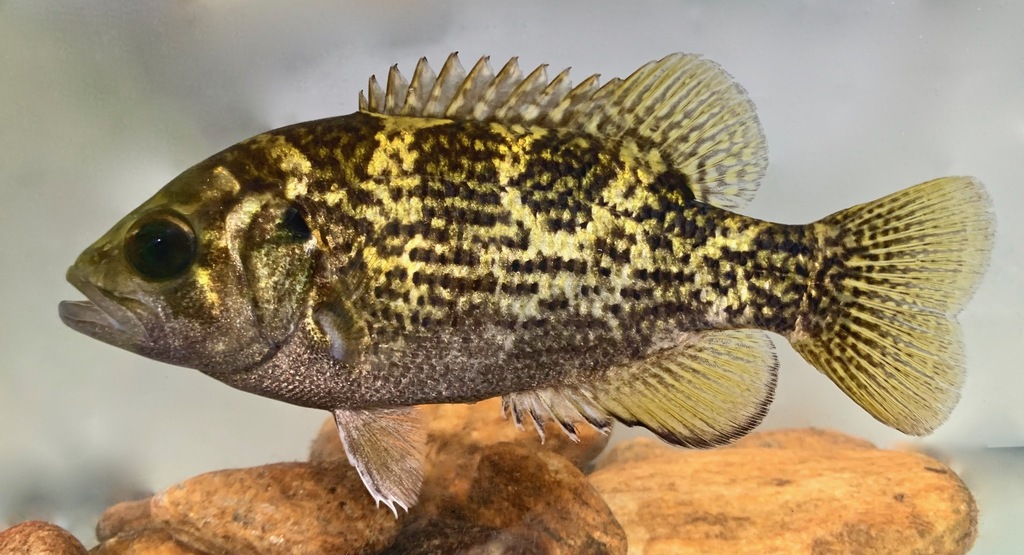
Rock Bass
Ambloplites rupestris
The rock bass (Ambloplites rupestris), also known as the rock perch, goggle-eye, red eye, and black perch, is a freshwater fish native to east-central North America. This red-eyed fish is a species of freshwater fish in the sunfish family (Centrarchidae) of order Centrarchiformes and can be distinguished from other similar species by the six spines in the anal fin (other sunfish have only three anal fin spines).
From the article Rock bass on Wikipedia (CC BY-SA), quoted section by section
Description
They are similar in appearance to smallmouth bass, but are usually quite a bit smaller. Identifying characteristics of rock bass are their two dorsal fins that have spinous and soft-rayed united portions, a large mouth, six anal spines, red eyes; rows of dark dots on their sides. The mouth of a rock bass is located in the terminal position, below the snout, with small conical teeth to eat prey. The average rock bass is between 6 and 10 in (150 and 250 mm), and they rarely weigh over a pound. Few rock bass live beyond 10 to 12 years. A. rupestris, the largest and most common of the Ambloplites species, has reached a maximum recorded length of 43 cm (17 in), and a maximum recorded weight of 1.4 kg (3.1 lb). It can live as long as 10 years. These fish have body coloring from golden brown to olive with a white to silver colored belly and have the ability to rapidly change their color to match their surroundings. This chameleon-like trait allows them to thrive throughout their wide range.
Range & habitat
Rock bass are native to the St Lawrence River and Great Lakes system, the upper and middle Mississippi River basin in North America from Québec to Saskatchewan in the north down to Missouri and Arkansas, south to the Savannah River, and throughout the eastern U.S. from New York through Kentucky and Tennessee to the northern portions of Alabama and Georgia and Florida in the south. The rock bass has also been found in the Nueces River system in Texas. A population introduced to the Loire River in France between 1904 and 1910 is successfully self-sustaining, but not invasively expanding, more than 100 years later.
Wikipedia: “Distribution”
What it does
Large bass, northern pike, muskie, and walleye prey on young rock bass. Rock bass compete with smallmouth bass for food. It is carnivorous, and its diet consists of smaller fish, including their own young at times, yellow perch, and minnows, as well as insects, and crustaceans. Rock bass are occasionally known to take food from the surface. Adult Rock bass may eat heavily, particularly in the evening and early in the morning.
Wikipedia: “Diet”
Where it lives
Recorded sightings
—
geo-referenced records in GBIF, from museums, herbaria and field observers.
Drag the globe to turn it. Dots are where records exist, not a range map; darker means more records.
In the stacks
Searching the stacks…
Every page naming Ambloplites rupestris in the Biodiversity Heritage Library →
This page is assembled live from iNaturalist, GBIF, Wikipedia, the Source Library and the Internet Archive. It is not yet part of the hand-edited codex. iNaturalist taxon 58637.