 NL·0600
Herbarium of the Nature Library
- Name
- Perca flavescens
- Family
- Percidae
- Native to
- Eastern and central North America: Atlantic, Arctic, Great Lakes, Hudson Bay and Mississippi basins; widely introduced in the west
- Habitat
- Lakes, Ponds, Slow rivers, Brackish estuaries
Yellow perch
Perca flavescens
Also calledAsaawe (Ojibwe) · Perchaude (Canadian French) · Ringed perch · Lake perch
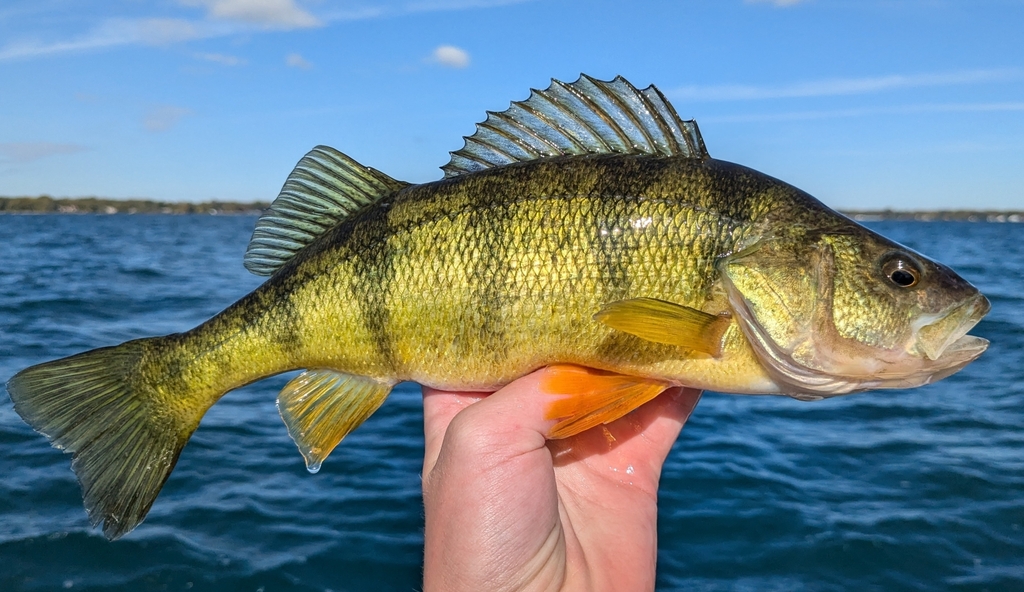
A golden, barred schooling fish of North American lakes, beloved for ice fishing and Friday-night fish fries around the Great Lakes. Females lay their eggs in strange, accordion-folded gelatinous ribbons that can be over 2 m long.
The yellow perch, commonly referred to as perch, striped perch, American perch or preacher is a freshwater ray-finned fish from the perch family Percidae, native to much of central North America, particularly the Great Lakes–St. Lawrence River basin and the Upper Mississippi River catchment. It was first described in 1814 by Samuel Latham Mitchill from New York, and is closely related and morphologically similar to the European perch, and is sometimes considered a subspecies of its European counterpart. Wikipedia
What it can do
- iLays eggs in a single long, hollow, accordion-folded gelatinous ribbon draped over plants, unique among North American freshwater fish
- iiForms large schools that feed actively all winter under ice
- iiiTolerates cool to warm water and slightly brackish estuaries
In the field
Field marks
- aYellow to golden-green flanks with 6–8 dark, saddle-like vertical bars
- bTwo separate dorsal fins, the first spiny
- cLower fins orange to reddish, brighter in breeding males
- dHumped back and no canine teeth
- Not to be confused with
- Walleye and sauger have large glassy eyes, canine teeth and no bold vertical bars, and walleye has a white tip on the lower tail lobe. European perch (Perca fluviatilis) is extremely similar, with a dark spot at the rear of the first dorsal fin, but does not occur naturally in North America.
- Where to see it
- Lake Erie, Lake Michigan's Green Bay and Lake Simcoe (Ontario), especially through winter ice; Chesapeake Bay tributaries
- When
- Resident; spawns April–May soon after ice-out; ice-fishing season December–March
Life & habits
- Diet
- Carnivore: zooplankton when young; insect larvae, crayfish, small fish and fish eggs as adults
- Habitat
- Clear, weedy lakes and ponds and slow rivers, usually in schools near the bottom
- Size
- Usually 15–25 cm; up to about 50 cm
- Lifespan
- Usually under 10 years; maximum reported about 11
Schools move inshore at dawn and dusk to feed. In early spring females drape egg ribbons over weeds or branches in the shallows, and males fertilise them.
Where it lives
Recorded sightings
—
geo-referenced records in GBIF, from museums, herbaria and field observers.
Native range
Eastern and central North America: Atlantic, Arctic, Great Lakes, Hudson Bay and Mississippi basins; widely introduced in the west
Drag the globe to turn it. Dots are where records exist, not a range map; darker means more records.
In the old herbals & bestiaries
No plate in the Source Library names this exact species, so these show its closest relatives as the old naturalists drew them: same genus, or the same kind of animal. Click a plate to read the page it came from, with translation.

Garden of Health (Hortus Sanitatis)
Relative · Jacob Meydenbach · 1491 · p.587

Garden of Health (Hortus Sanitatis)
Relative · Jacob Meydenbach · 1491 · p.552

Ortus sanitatis
Relative · 1491 · p.662

Mark Catesby — Piscium, serpentum, insectorum (pt. 1) (1750)
Relative · Mark Catesby · 1750 · p.22

Books on Marine Fishes
Relative · Guillaume Rondelet · 1554 · p.837

De Piscibus Libri V et De Cetis Liber Unus
Relative · Ulisse Aldrovandi · 1661 · p.681

The natural history of Carolina, Florida, and the Bahama Islands : containing two hundred a...
Relative · Catesby, Mark, bioloog, kunstenaar · 1743 · p.27

Books on Marine Fishes
Relative · Guillaume Rondelet · 1554 · p.203

History of Animals, Book II: On Oviparous Quadrupeds
Relative · Conrad Gessner · 1586 · p.396

History of Animals, Book II: On Oviparous Quadrupeds
Relative · Conrad Gessner · 1586 · p.670
In the stacks
Searching the stacks…
Every page naming Perca flavescens in the Biodiversity Heritage Library →
Marginalia
Yellow perch fish fries are a Great Lakes institution, and the Lake Erie commercial perch catch has supported Ohio and Ontario fishing towns since the 19th century. Ojibwe and other Great Lakes peoples have long speared and netted perch, including through winter ice.
Curiosity
A single female can lay over 40,000 eggs in one gelatinous ribbon, and the jelly seems to protect the eggs from predators.
Kinship

Fact-checked: 1 correction made to this sheet. Photographs: iNaturalist contributors under the licences shown. Records: GBIF.org. Historical plates: Source Library (CC BY-SA 4.0; originals public domain). Summary text: Nature Library editors and Wikipedia (CC BY-SA). Medicinal and edibility notes are historical and educational, not advice. iNaturalist taxon 58627.