- Animals
- ›Arthropods
- ›Hexapods
- ›Insects
- ›Winged and Once-winged Insects
- ›Butterflies and Moths
- ›Butterflies
- ›Swallowtails and Parnassians
- ›Swallowtails
- ›Fluted Swallowtails
- ›Papilio
- ›Pterourus
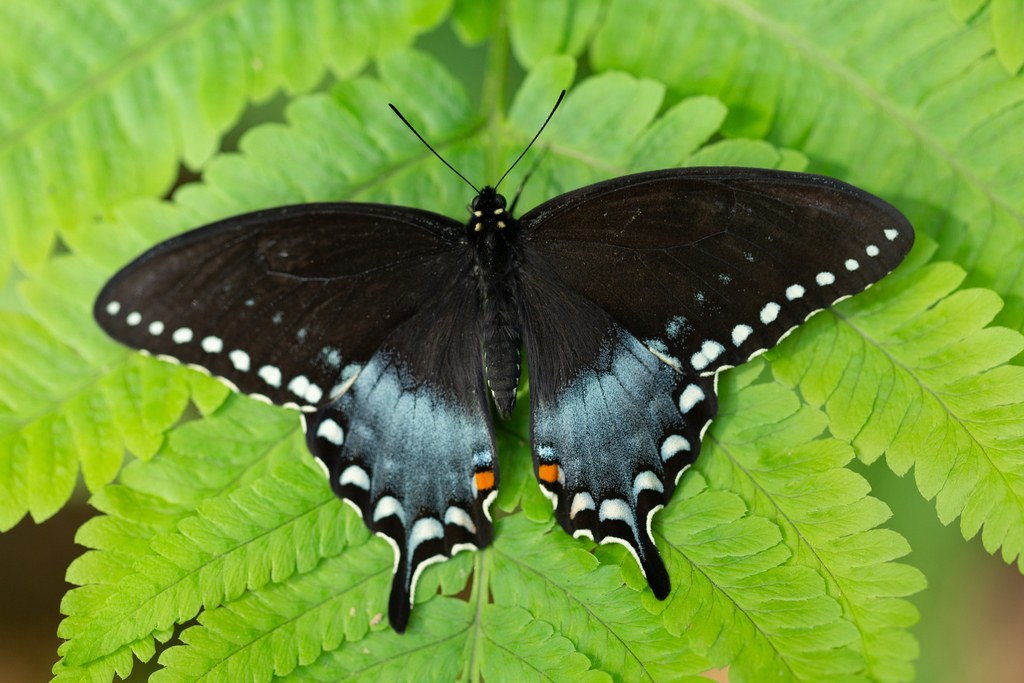
Spicebush Swallowtail
Papilio troilus
Papilio troilus, the spicebush swallowtail or green-clouded butterfly, is a common black swallowtail butterfly found in North America. It has two subspecies, Papilio troilus troilus and Papilio troilus ilioneus, the latter found mainly in the Florida peninsula. The spicebush swallowtail derives its name from its most common host plant, the spicebush, members of the genus Lindera.
The family to which spicebush swallowtails belong, Papilionidae, or swallowtails, include the largest butterflies in the world. The swallowtails are unique in that even while feeding, they continue to flutter their wings. Unlike other swallowtail butterflies, spicebushes fly low to the ground instead of at great heights.
From the article Papilio troilus on Wikipedia (CC BY-SA), quoted section by section
Range & habitat
The spicebush swallowtail is found only in the eastern US and southern Ontario, but occasionally strays as far as the American plains states, Cuba, Manitoba and Colorado. While still larvae, spicebush swallowtails remain on the leaf of the plant on which they were laid. As adults, the butterflies do not limit their flight geographically and instead are motivated mostly by availability of water and nectar and mates within the species' range. This primarily black swallowtail is normally found in deciduous woods or woody swamps, where they can be found flying low and fast through shaded areas. Females tend to stay in open plains, while males are typically found in swamp areas.
Papilio troilus troilus. The more widespread subspecies of spicebush swallowtail is prevalent throughout the Eastern United States, from New England to Wisconsin, west to Illinois, Wisconsin, North Dakota and Nebraska. It also abounds in Texas and Colorado. Temperature may be a limiting factor for the spread of P. t. troilus, as in experimental conditions, they do not fare well at or above 36 °C (97 °F) nor are they capable of flourishing at or below 14 °C (57 °F).
Papilio troilus ilioneus. The smaller subspecies of P. troilus is confined to the Southeastern coastal United States, namely throughout Florida and along coastal Georgia and in places in Texas.
Wikipedia: “Distribution and habitat”
What it does
The host plants of the spicebush swallowtail are most commonly either spicebush (Lindera benzoin) or white sassafras (Sassafras albidum). Other possible host plants include prickly ash (Zanthoxylum), as well as tulip tree (Liriodendron tulipifera), sweetbay (Magnolia virginiana), camphor (Cinnamomum camphora) and redbay (Persea borbonia). Redbay and swampbay (Persea palustris) are the primary host plants for members of the P. t. ilioneus strain, while spicebush and sassafras as the primary hosts for P. t. troilus. However, when given the choice between spicebush and sassafras, the P. t. troilus showed no significant preference for either. Additionally, P. t. ilioneus live only on redbay because that is the primary host plant within the Southern range. However, in a test of P. t. troilus and P. t. ilioneus on redbay, sassafras and spicebush, although the P. t. ilioneus had higher growth and survival rates on redbay than the P. t. troilus, as a holistic group, both subspecies performed better on sassafras or spicebush over time. In general, spicebush swallowtails tend to stick to plants that are members of the family Lauraceae. The preference for Lauraceae is so consistent among spicebush swallowtails that under experimental conditions, when placed in an environment with leaves other than Lauraceae, P. troilus died without eating anything. …
Wikipedia: “Ecology”
Listen
Looking for field recordings…
Where it lives
Recorded sightings
—
geo-referenced records in GBIF, from museums, herbaria and field observers.
Drag the globe to turn it. Dots are where records exist, not a range map; darker means more records.
In the stacks
Searching the stacks…
Every page naming Papilio troilus in the Biodiversity Heritage Library →
This page is assembled live from iNaturalist, GBIF, Wikipedia, the Source Library and the Internet Archive. It is not yet part of the hand-edited codex. iNaturalist taxon 58525.