- Animals
- ›Arthropods
- ›Hexapods
- ›Insects
- ›Winged and Once-winged Insects
- ›Butterflies and Moths
- ›Butterflies
- ›Skippers
- ›Grass Skippers
- ›Hesperiini
- ›branded grass skippers
- ›Hesperia
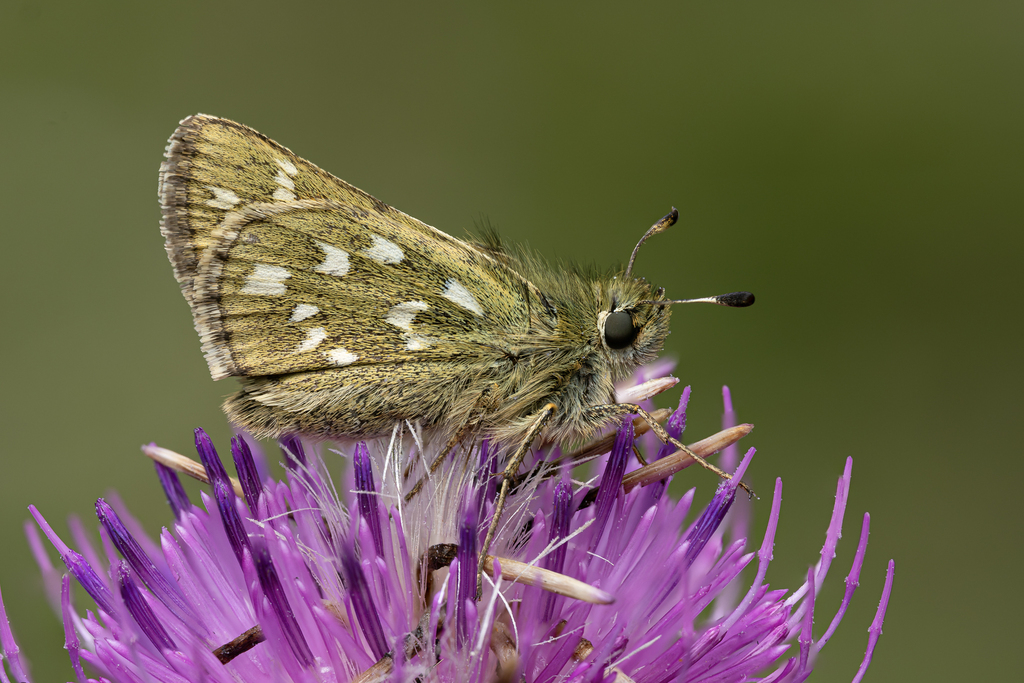
Common Branded Skipper
Hesperia comma
Hesperia comma, the silver-spotted skipper or common branded skipper, is a butterfly of the family Hesperiidae. The species is known as silver-spotted skipper in Europe and common branded skipper in North America where the butterfly Epargyreus clarus, a spread-winged skipper, also has the common name of "Silver-Spotted Skipper". Originally the species was known as the Pearl Skipper but as time went on the name Silver-Spotted Skipper began being ascribed to it more frequently.
There are numerous subspecies spread throughout the world in Asia, Europe, and North America. The species has at least 15 subspecies in North America. In the UK they are rare, usually only found in the chalk hills of the Southern UK and are believed to have arrived in the UK either in the Late Glacial Period or the Holocene. As adults they have white tips with yellowish-white spots. They typically live for a year with most of their life spend overwintering as eggs for 7 months until temperatures warm in the spring. The larvae typically grow up in grazed areas with not too much overgrown vegetation and feed on host plants such as Sheep's Fescues (Festuca ovina). The larvae form tents made of silk and grass blades and as they pupate form cocoon-like structures out of the same materials near the ground. They emerge as adults in July through September. In the UK the species was facing decline, however due to restoration efforts and global warming their populations have begun to grow again.
From the article Hesperia comma on Wikipedia (CC BY-SA), quoted section by section
Description
Often confused with the Large skipper Ochlodes sylvanus, this species is easily distinguished by the numerous white spots on the underside hindwings, and the tips of the upper forewings tend to be darker than those of the Large Skipper. The upper side is very similar to the Large Skipper however its spots are often more yellow. The dorsal side of the wings typically are orange and dark brown on the edge of the wings. The ventral side is often a green or olive color. The white spots are slightly more pale on females. Females tend to be larger than the males. While its wings are the most notable feature, the thorax and abdomen actually make up 70% of the body mass of most specimens. The thorax mass allows the butterflies to have more flight muscles permitting them to fly between habitat patches separated by large distances.
Wikipedia: “Appearance”
Range & habitat
The silver-spotted skipper prefers warm calcareous sites and has a wide distribution as far south as North Africa, northwards throughout Europe to the Arctic and eastwards across Asia to China and Japan. In the UK they are only found in chalk downlands and are difficult to find outside of certain regions in the South. In North America the species is mostly concentrated to the west coast as the Sierra Nevada and Transverse Ranges act as barriers making it difficult for populations to migrate east.
Wikipedia: “Distribution”
At the table
Sheep's Fescues (Festicua ovina) and F. liviensis are used as a host plant for larvae, while adults get their nectar from different plants. In the UK the adults have been noticed to feed on Asteraceae, Dipsaceae, Cirsium acaualon (Stemless Thistle), Centaurea scabiosa (Greater Knapweed), Hypericum (St. John's Wart), Trifolium (Clover), Lotus corniculatus (Common bird's foot trefoil), Campanula rotundifolia (Bellflower), Gentianella amarella (Autumn Gentian), Euphrasia (Eyebright), Origanum vulgare (Oregano), Prunella vulgaris (Self-Heal), and Echium vulgare (Viper's-bugloss). However of all these plants, usually Compositae and Dipsaceae are the plants most commonly fed on by these butterflies. The species also nectars on thistles, Scabiosa, and hawkbit.
Wikipedia: “Host plants and food sources”
In human culture
The butterfly was first described in the UK in 1666 by Merrett. At this time it had no scientific name. Then the scientific name comma was given by Linnaeus to a specimen that resembled both this species and the Large Skipper. The first common name given to a specimen now agreed to be this species was the Pearl Skipper. Later the name was changed to the August Skipper but in 1772 the name was changed back to the Pearl Skipper. The name Silver Spotted Skipper was ascribed in 1803 but many experts preferred the Pearl Skipper name. As time went on, the Silver Spotted Skipper name become more favored by authors and experts.
Wikipedia: “Naming history”
Listen
Looking for field recordings…
Where it lives
Recorded sightings
—
geo-referenced records in GBIF, from museums, herbaria and field observers.
Drag the globe to turn it. Dots are where records exist, not a range map; darker means more records.
In the stacks
Searching the stacks…
Every page naming Hesperia comma in the Biodiversity Heritage Library →
This page is assembled live from iNaturalist, GBIF, Wikipedia, the Source Library and the Internet Archive. It is not yet part of the hand-edited codex. iNaturalist taxon 58468.