- Plants
- ›Vascular Plants
- ›flowering plants
- ›Dicots
- ›Sunflowers, Bellflowers, Fanflowers, and Allies
- ›Sunflowers, Daisies, Asters, and Allies
- ›Asteroideae
- ›asters and allies
- ›Machaerantherinae
- ›Corethrogyne
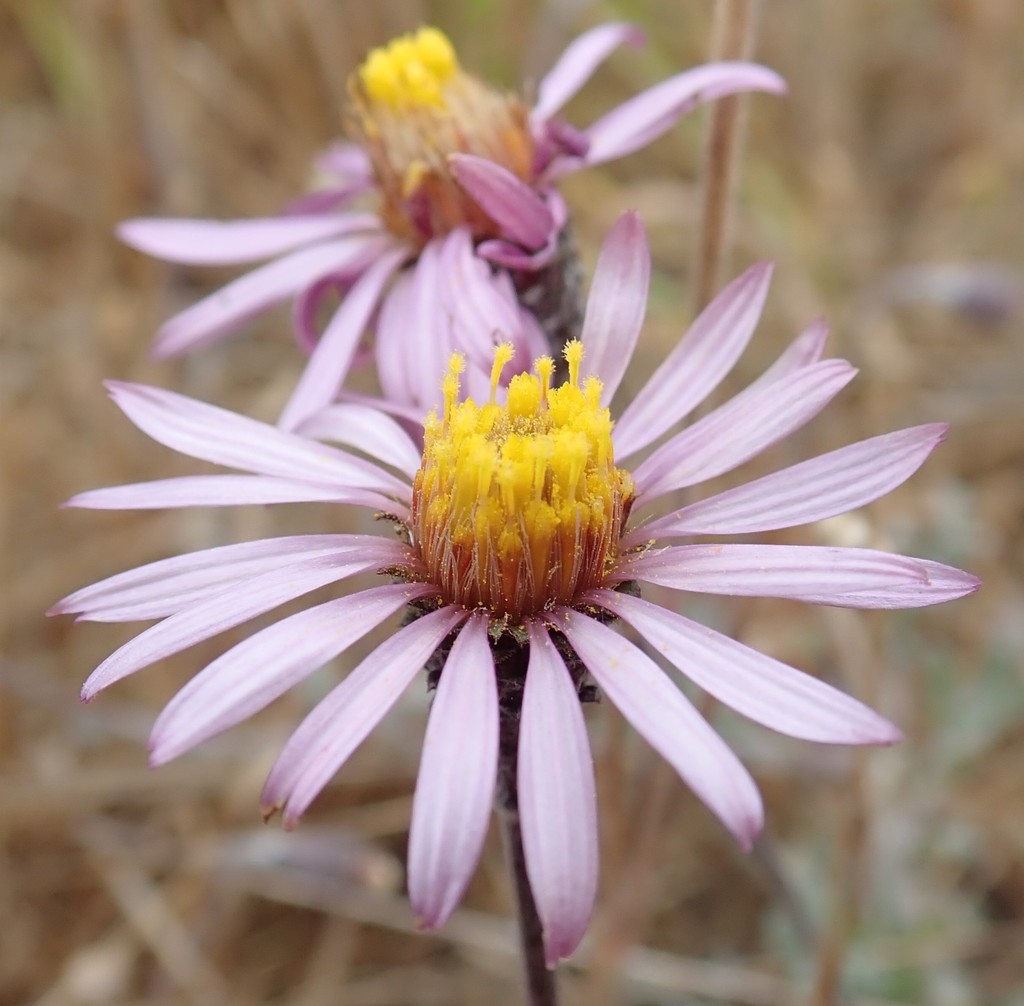
California Aster
Corethrogyne filaginifolia
Corethrogyne is a monotypic genus of flowering plant in the family Asteraceae. Its only species is Corethrogyne filaginifolia (syn. Lessingia filaginifolia), known by the common names common sandaster and California aster. Note that Symphyotrichum chilense shares its common name of California aster.
From the article Corethrogyne on Wikipedia (CC BY-SA), quoted section by section
Description
Corethrogyne filaginifolia is a robust perennial herb or subshrub producing a simple to multibranched stem approaching 1 metre (3.3 ft) in maximum length or height. The densely woolly leaves are several centimeters long and toothed or lobed low on the stem and smaller higher up the stem. The inflorescence is a single flower head or array of several heads at the tips of stem branches. The head is lined with narrow, pointed, purple-tipped phyllaries which curl back as the head matures. Inside are many purple, lavender, pink, or white ray florets and a center packed with up to 120 tubular yellow disc florets. The fruit is an achene with a pappus of reddish bristles on top.
Range & habitat
Corethrogyne filaginifolia is native to western North America from the southwestern corner of Oregon through California to Baja California, where it is a common member of many plant communities, including chaparral and woodlands, forests, scrub, grasslands, and the serpentine soils flora.
Wikipedia: “Distribution and habitat”
Where it lives
Recorded sightings
—
geo-referenced records in GBIF, from museums, herbaria and field observers.
Drag the globe to turn it. Dots are where records exist, not a range map; darker means more records.
In the stacks
Searching the stacks…
Every page naming Corethrogyne filaginifolia in the Biodiversity Heritage Library →
This page is assembled live from iNaturalist, GBIF, Wikipedia, the Source Library and the Internet Archive. It is not yet part of the hand-edited codex. iNaturalist taxon 58014.