- Plants
- ›Vascular Plants
- ›flowering plants
- ›Dicots
- ›Sunflowers, Bellflowers, Fanflowers, and Allies
- ›Sunflowers, Daisies, Asters, and Allies
- ›Asteroideae
- ›Sunflowers and Allies
- ›Helianthinae
- ›Helianthus
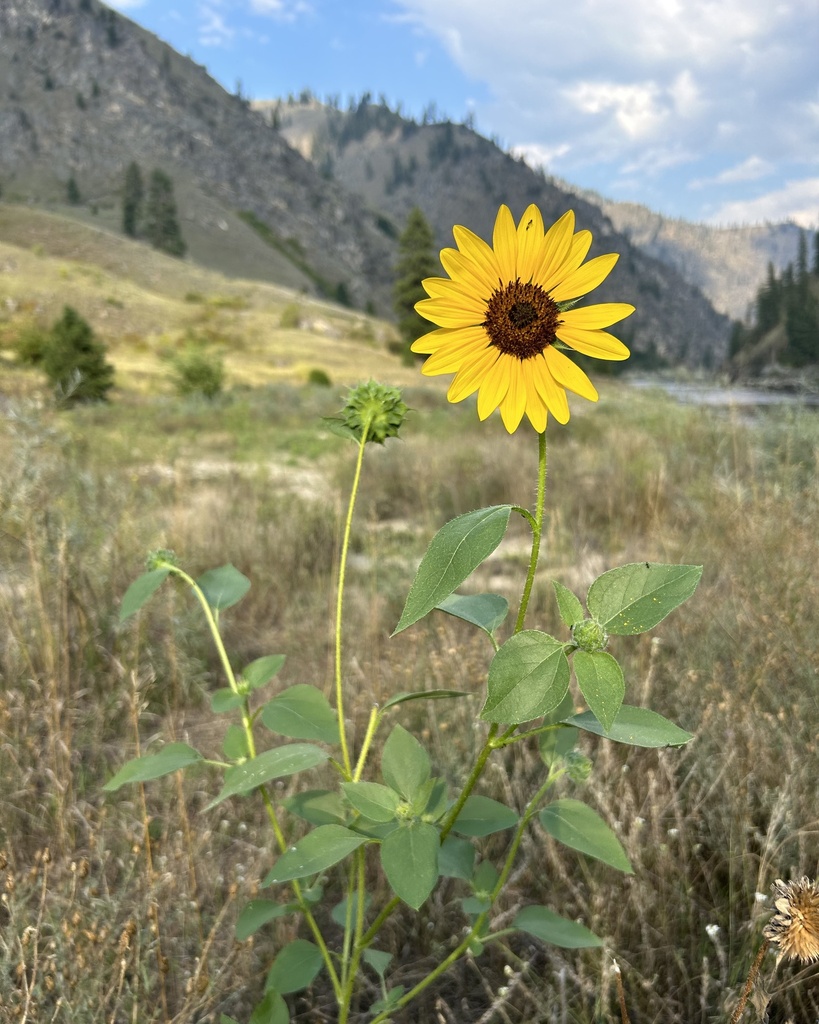
Common Sunflower
Helianthus annuus
The common sunflower (Helianthus annuus) is a large annual forb in the daisy family Asteraceae. The most common varieties have large yellow orange flowers heads, that are a tall stem. The flowers produce seeds in a floret, that follows the fibonacci sequence. The domesticated form of common sunflower is harvested for its edible seeds, which come in two types: oil and confectionery seeds.
Oilseed sunflowers are widely grown globally and represent the fourth most used vegetable oil in the world. They also are used widely as bird food or as food for livestock. In contrast, confectionery sunflower seeds are often eaten as a snack food or in baking.Though first domesticate in the Americas, production of sunflowers commercially is concentrated in Russia, Ukraine, and the European Union.
From the article Common sunflower on Wikipedia (CC BY-SA), quoted section by section
Description
The plant has an erect rough-hairy stem, reaching typical heights of 3 metres (10 feet). The tallest sunflower on record achieved 10.9 m (35 ft 9 in). Sunflower leaves are broad, coarsely toothed, rough and mostly alternate; those near the bottom are largest and commonly heart-shaped.
Flower. The plant flowers in summer. What is often called the "flower" of the sunflower is actually a "flower head" (pseudanthium), 7.5–12.5 centimetres (3–5 in) wide, of numerous small individual five-petaled flowers ("florets"). The outer flowers, which resemble petals, are called ray flowers. Each "petal" consists of a ligule composed of fused petals of an asymmetrical ray flower. They are sexually sterile and may be yellow, red, orange, or other colors. The spirally arranged flowers in the center of the head are called disk flowers. These mature into fruit (sunflower "seeds").
The prairie sunflower (H. petiolaris) is similar in appearance to the wild common sunflower; the scales in its central disk are tipped by white hairs.
Heliotropism. A common misconception is that flowering sunflower heads track the Sun across the sky. Although immature flower buds exhibit this behaviour, the mature flowering heads point in a fixed (and typically easterly) direction throughout the day. …
Range & habitat
The plant was first domesticated in the Americas. Sunflower seeds were brought to Europe from the Americas in the 16th century, where, along with sunflower oil, they became a widespread cooking ingredient. With time, the bulk of industrial-scale production has shifted to Eastern Europe, and (as of 2020) Russia and Ukraine together produce over half of worldwide seed production. Sunflowers grow best in fertile, moist, well-drained soil with heavy mulch. They often appear on dry open areas and foothills. Outside of cultivation, the common sunflower is found on clay-based soils that typically are wet in the spring, but dry out later in the summer. In contrast, the related Helianthus debilis and Helianthus petiolaris are found on drier, sandier soils. The common sunflower is considered to be native to the central and western USA, southern Canada, and northern Mexico. Regardless of its original range, it can now be found in almost every part of the world that is not tropical, desert, or tundra.
Wikipedia: “Distribution and habitat”
At the table
Confectionary sunflower "whole seed" are sold as a snack food, raw or after roasting in ovens, with or without salt and/or seasonings added. Sunflower seeds can be processed into a peanut butter alternative, sunflower butter. It is also sold as food for birds and can be used directly in cooking and salads. Native Americans had multiple uses for sunflowers in the past, such as in bread, medical ointments, dyes and body paints. Sunflower oil, extracted from the seeds of oil cultivars, is used for cooking, as a carrier oil and to produce margarine and biodiesel, as it is cheaper than olive oil. A range of sunflower varieties exist with differing fatty acid compositions; some "high-oleic" types contain a higher level of monounsaturated fats in their oil than even olive oil. The oil is also sometimes used in soap. After World War I, during the Russian Civil War, people in Ukraine used sunflower seed oil in lamps as a substitute for kerosene due to shortages. The light from such a lamp has been described as "miserable" and "smoky". The cake remaining after the seeds have been processed for oil is used as livestock feed. The hulls resulting from the dehulling of the seeds before oil extraction can also be fed to domestic animals. Some recently developed cultivars have drooping heads. …
Wikipedia: “Uses”
How it is grown
In commercial planting, seeds are planted 45 cm (1+1⁄2 ft) apart and 2.5 cm (1 in) deep.
History. The common sunflower was one of several plants cultivated by Native Americans in prehistoric North America as part of the Eastern Agricultural Complex, which also included goosefoot, little barley, squash, and a variety of other crops, most of which were replaced by maize and beans following their introduction. Although it was commonly accepted that the sunflower was first domesticated in what is now the southeastern US, roughly 5,000 years ago, there is evidence that it was first domesticated in Mexico around 2600 BCE. These crops were found in Tabasco, Mexico, at the San Andres dig site. The earliest known examples in the US of a fully domesticated sunflower have been found in Tennessee, and date to around 2300 BCE. Other very early examples come from rockshelter sites in Eastern Kentucky. Many indigenous American peoples used the sunflower as the symbol of their solar deity, including the Aztecs and the Otomi of Mexico and the Incas in South America. In 1510, early Spanish explorers encountered the sunflower in the Americas and carried its seeds back to Europe. …
Wikipedia: “Cultivation”
In human culture
The genus name Helianthus comes from Ancient Greek ἥλιος (hḗlios), meaning "sun", and ἄνθος (ánthos), meaning "flower". The species name annuus means "yearly" in Latin.
Wikipedia: “Etymology”
Where it lives
Recorded sightings
—
geo-referenced records in GBIF, from museums, herbaria and field observers.
Drag the globe to turn it. Dots are where records exist, not a range map; darker means more records.
In the old herbals & bestiaries

In the stacks
Searching the stacks…
Every page naming Helianthus annuus in the Biodiversity Heritage Library →
This page is assembled live from iNaturalist, GBIF, Wikipedia, the Source Library and the Internet Archive. It is not yet part of the hand-edited codex. iNaturalist taxon 57983.