- Plants
- ›Vascular Plants
- ›flowering plants
- ›Dicots
- ›Sunflowers, Bellflowers, Fanflowers, and Allies
- ›Sunflowers, Daisies, Asters, and Allies
- ›Asteroideae
- ›Sunflowers and Allies
- ›Enceliinae
- ›Encelia
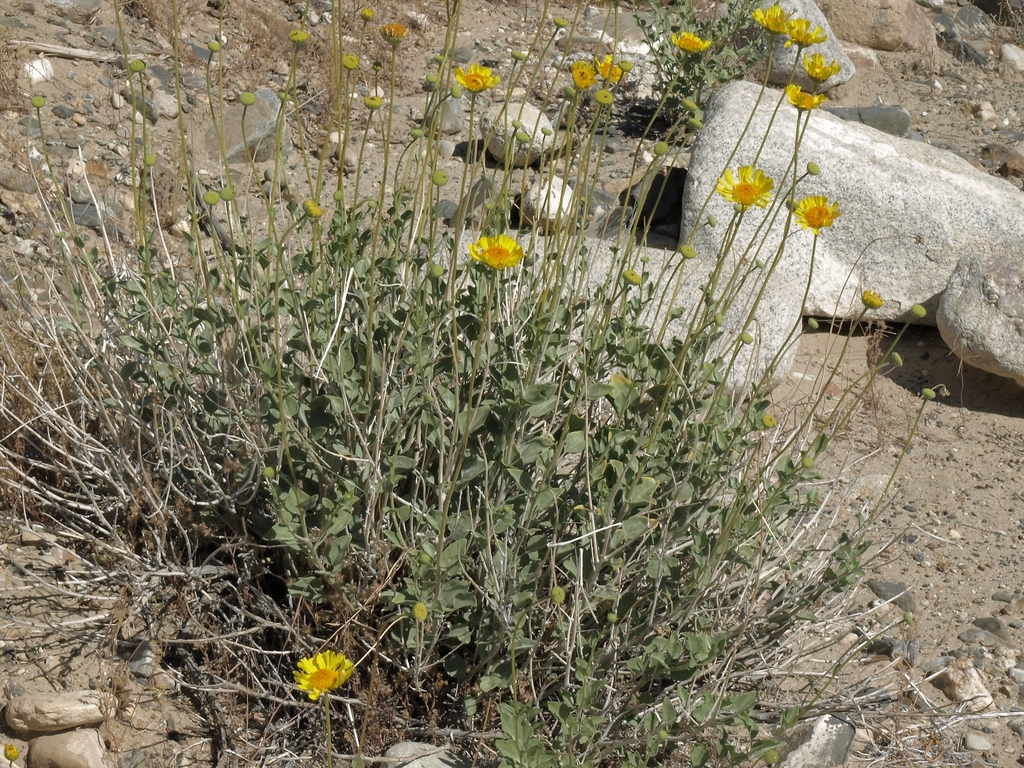
Acton Brittlebush
Encelia actoni
Encelia actoni, also known by the common names Acton brittlebush and Acton encelia, is a species of flowering plant in the family Asteraceae.
It is sometimes misspelled Encelia actonii.
From the article Encelia actoni on Wikipedia (CC BY-SA), quoted section by section
Description
Encelia actoni is a multi−branched perennial shrub, reaching 1–4 feet (0.30–1.22 m) in height. The branches are lined with oval to roughly triangular leaves a few centimeters long, that are gray-green and woolly in texture. The inflorescence is a solitary daisylike flower head 1–2 inches (2.5–5.1 cm) in diameter, on a tall, erect peduncle. The head has a center of many yellow disc florets surrounded by up to 25 yellow ray florets. It blooms in the Spring. The fruit is an achene about half a centimeter long, usually lacking a pappus. It reseeds well.
Range & habitat
The plant is native to southern California and neighboring areas of Nevada in the U.S. and Baja California in México. It grows in various types of open habitat, including deserts, chaparral, and grasslands. It is found in the Mojave Desert, Sonoran Deserts, Peninsular Ranges, Transverse Ranges, San Joaquin Valley, and southern Sierra Nevada. The species was named for the community of Acton in Southern California, located in an ecotone of the Mojave Desert ecoregion and of the montane chaparral and woodlands in the San Gabriel Mountains.
Wikipedia: “Distribution and habitat”
How it is grown
Encelia actoni is cultivated as an ornamental plant for drought tolerant and wildlife gardens, natural landscaping design, and habitat restoration projects. It needs sun and after the first summer, very limited to no supplemental irrigation. It is a honey plant, supporting diverse pollinators. The plant has a low fuel load, and so has fire retardant qualities in wildfire zones.
Wikipedia: “Cultivation”
Where it lives
Recorded sightings
—
geo-referenced records in GBIF, from museums, herbaria and field observers.
Drag the globe to turn it. Dots are where records exist, not a range map; darker means more records.
In the stacks
Searching the stacks…
Every page naming Encelia actoni in the Biodiversity Heritage Library →
This page is assembled live from iNaturalist, GBIF, Wikipedia, the Source Library and the Internet Archive. It is not yet part of the hand-edited codex. iNaturalist taxon 57969.