- Plants
- ›Vascular Plants
- ›flowering plants
- ›Dicots
- ›Sunflowers, Bellflowers, Fanflowers, and Allies
- ›Sunflowers, Daisies, Asters, and Allies
- ›Asteroideae
- ›asters and allies
- ›Baccharidinae
- ›Baccharis
- ›Molina
- ›Corymbosae
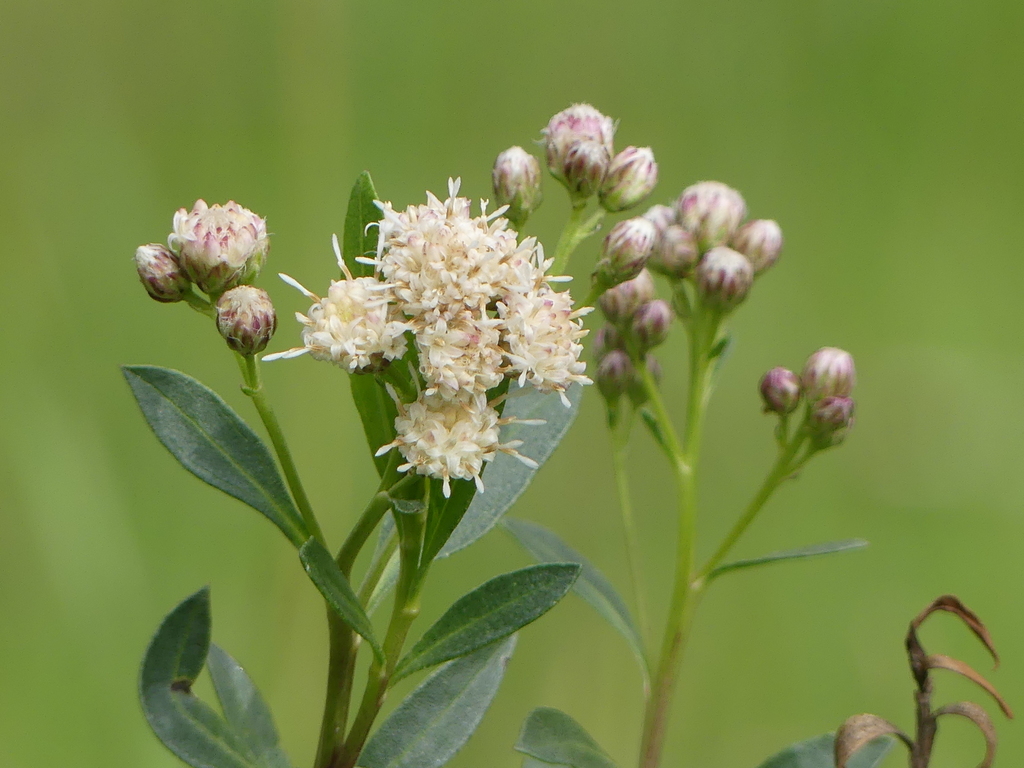
mule fat
Baccharis salicifolia
Baccharis salicifolia is a blooming shrub native to the sage scrub community and desert southwest of the United States and northern Mexico, as well as parts of South America. Its usual common name is mule fat; it is also called seepwillow or water-wally. This is a large bush with sticky foliage which bears plentiful small, fuzzy, pink, or red-tinged white flowers which are highly attractive to butterflies. It is a host plant for the larval stage of the fatal metalmark butterfly, and the adult stage also nectars on the flowers.
The long pointed leaves may be toothed and contain three lengthwise veins. It is most common near water sources.
From the article Baccharis salicifolia on Wikipedia (CC BY-SA), quoted section by section
At the table
The Kayenta Navajo people use this plant in a compound infusion of plants used as a lotion for chills from immersion. Another use is fire starting. Dried Baccharis salicifolia has a very low ignition temperature, very similar to the dried yucca stalk. It can be used for spindles and hand-drill shafts.
Wikipedia: “Uses”
Where it lives
Recorded sightings
—
geo-referenced records in GBIF, from museums, herbaria and field observers.
Drag the globe to turn it. Dots are where records exist, not a range map; darker means more records.
In the stacks
Searching the stacks…
Every page naming Baccharis salicifolia in the Biodiversity Heritage Library →
This page is assembled live from iNaturalist, GBIF, Wikipedia, the Source Library and the Internet Archive. It is not yet part of the hand-edited codex. iNaturalist taxon 57913.