On eBird ↗
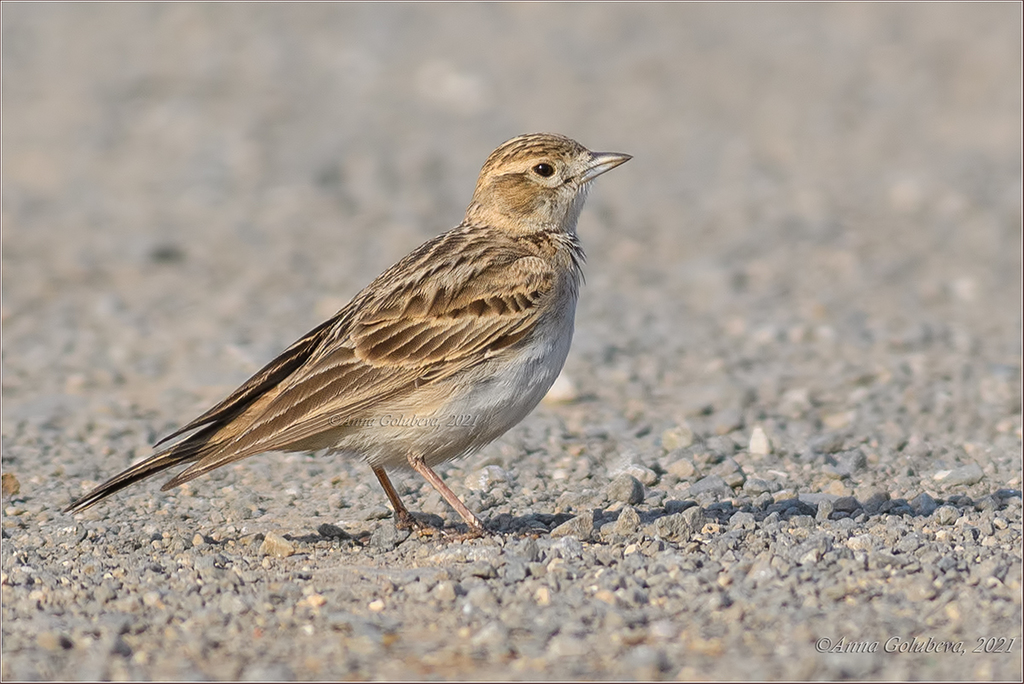
Greater Short-toed Lark
Live sightings near you, the range map, bar charts of when it is seen, and Macaulay Library photos and recordings.
Greater Short-toed Lark
Calandrella brachydactyla
The greater short-toed lark (Calandrella brachydactyla) is a small passerine bird. The current scientific name is from Ancient Greek. The genus name, Calandrella, is a diminutive of kalandros, the calandra lark, and brachydactila is from brakhus, "short", and daktulos, "toe".
It breeds in southern Europe, north-west Africa, and across the Palearctic from Turkey and southern Russia to Mongolia. During migration they form large, tight flocks that move in unison; at other times they form loose flocks.
From the article Greater short-toed lark on Wikipedia (CC BY-SA), quoted section by section
Description
Several subspecies have been named but there is considerable geneflow and the species itself forms part of a larger complex. This is a small pale lark, smaller than the skylark. It is dark-streaked greyish-brown above, and white below, and has a strong pointed bill that is pinkish with a grey culmen. It has a pale supercilium, dark patches on each side of its neck and a dark tail. Some birds in the west of the range have a rufous crown. The sexes are similar. The greater short-toed lark is paler than the Mongolian short-toed lark which also has a shorter bill. In winter they fly in large and compact flocks that swing in synchrony. Care must be taken to distinguish this species from other similar larks, such as the Mediterranean short-toed lark. The nominate form breeds in Europe (Iberia, France, Italy, the Balkans and Romania) and winters in Africa. Subspecies hungarica breeds in the eastern parts of Europe while rubiginosa breeds in north-western Africa. Subspecies hermonensis (sometimes including woltersi) breeds in Turkey, Syria and Egypt. Subspecies artemisiana (considered by some to be synonymous with longipennis) breeds in Asia Minor and winters in southern west Asia. …
Range & habitat
All but some southernmost populations are migratory, wintering south to the southern edge of the Sahara and India. This species is a fairly common wanderer to northern and western Europe in spring and autumn. Populations breeding in the Iberian Peninsula winter south of the Sahara in Africa. Here they prefer crop land and dry pastures with short shrubs while the syntopic Mediterranean short-toed larks (Calandrella rufescens) prefer drier areas. This is a common bird of dry open country and cultivation. It nests on the ground, laying two to three eggs. Its food is seeds and insects, the latter especially in the breeding season. In colonial India, they were hunted for food as ortolans. They visit parts of South Asia in large flocks during winter and are sometimes attracted to short grass areas along aerodromes and become a bird strike risk to aircraft.
Wikipedia: “Distribution and habitat”
Listen
Looking for field recordings…
Where it lives
Recorded sightings
—
geo-referenced records in GBIF, from museums, herbaria and field observers.
Drag the globe to turn it. Dots are where records exist, not a range map; darker means more records.
In the stacks
Searching the stacks…
Every page naming Calandrella brachydactyla in the Biodiversity Heritage Library →
This page is assembled live from iNaturalist, GBIF, Wikipedia, the Source Library and the Internet Archive. It is not yet part of the hand-edited codex. iNaturalist taxon 578093.