- Animals
- ›Arthropods
- ›Hexapods
- ›Insects
- ›Winged and Once-winged Insects
- ›Ants, Bees, Wasps, and Sawflies
- ›Narrow-waisted Wasps, Ants, and Bees
- ›Ants, Bees, and Stinging Wasps
- ›Bees and Apoid Wasps
- ›Bees
- ›Honey Bees, Bumble Bees, and Allies
- ›Apine Bees
- ›Honey Bees
- ›Apis
- ›Megapis
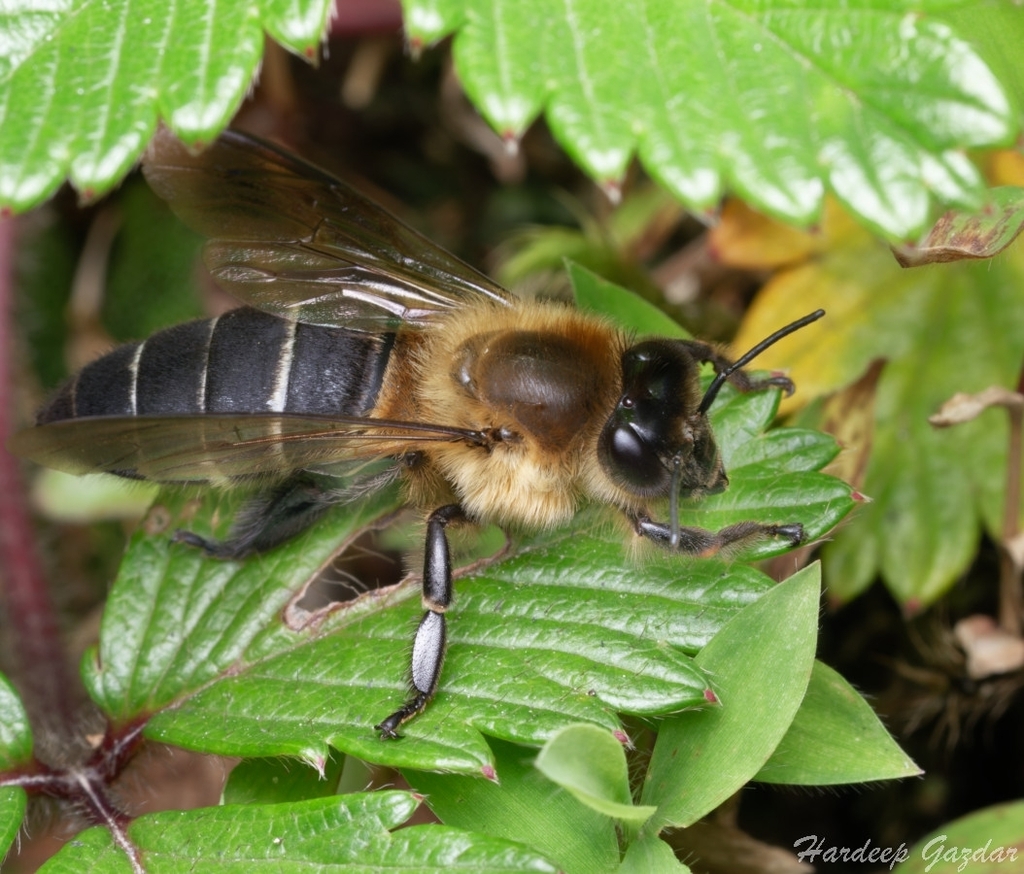
Himalayan Giant Honey Bee
Apis laboriosa
Apis laboriosa or Himalayan giant honey bee, is the world's largest honey bee; single adults can measure up to 3.0 cm (1.2 in) in length. Before 1980, Apis laboriosa was considered to be a subspecies of the widespread Apis dorsata, the giant honey bee, but in 1980 and for almost 20 years thereafter it was elevated to the rank of a separate species. It was classified once again as a subspecies of Apis dorsata by Michael S. Engel in 1999, but was confirmed as a full species in 2020 on the basis of co-occurrence with Apis dorsata at many sites with no sign of interbreeding. It is highly adapted to its highland habitat in behavior.
From the article Apis laboriosa on Wikipedia (CC BY-SA), quoted section by section
Range & habitat
Limited largely to the Himalayas, it is the largest species in the genus Apis. It is found in the mountainous regions of Bhutan, the Chinese province of Yunnan, India, Nepal, Myanmar, Laos, and Vietnam. It mostly nests at altitudes between 2,500 and 3,000 m (8,200 and 9,800 ft), building very large nests under overhangs on the southwestern faces of vertical cliffs. One nest can contain as much as 60 kg (130 lb) of honey. The bees forage at altitudes of up to 4,100 m (13,500 ft). The term "Himalayan honey bee" is sometimes used more informally for any of the four types of honey bees that are found in the Himalayan region; A. cerana, A. florea, A. dorsata and A. laboriosa. A significant portion of the range of A. laboriosa overlaps with that of yellow-rumped honeyguide (Indicator xanthonotus), a small sparrow-like bird that chiefly feeds on the beeswax. Because of this relationship between the two species, yellow-rumped honeyguides are often seen in the vicinity of A. laboriosa colonies in the Himalayas.
Wikipedia: “Distribution”
In human culture
There are three types of A. laboriosa honey: spring or red honey that is created from flowers at higher altitudes, spring honey created from flowers at mid and lower altitudes, and autumn honey is created from any site. Red honey has an intoxicating effect and various relaxing qualities that decrease over storage. It is not consumed locally as it is valuable, and honey hunters prefer to sell it at a high price. As hive bees are not kept at such high altitudes, A. laboriosa is the only bee to produce this honey. The wholesale price of the red honey is about five times the price of regular honey from A. mellifera or A. cerana and large amounts of it are exported from Nepal to Japan, Korea, and Hong Kong. The red honey is prized for its purported medicinal value and intoxicating qualities which are attributed to the grayanotoxin present in the nectar collected from white rhododendrons (Rhododendron spp.). The Gurung people in Nepal are renowned for their use of this mad honey, both for its medicinal and hallucinogenic properties.
Wikipedia: “Cultural significance”
Listen
Looking for field recordings…
Where it lives
Recorded sightings
—
geo-referenced records in GBIF, from museums, herbaria and field observers.
Drag the globe to turn it. Dots are where records exist, not a range map; darker means more records.
In the stacks
Searching the stacks…
Every page naming Apis laboriosa in the Biodiversity Heritage Library →
This page is assembled live from iNaturalist, GBIF, Wikipedia, the Source Library and the Internet Archive. It is not yet part of the hand-edited codex. iNaturalist taxon 574869.