- Animals
- ›Chordates
- ›Vertebrates
- ›Ray-finned Fishes
- ›Spiny-rayed fishes
- ›Pipefishes and Allies
- ›Syngnathoidei
- ›Cornetfishes
- ›Fistularia
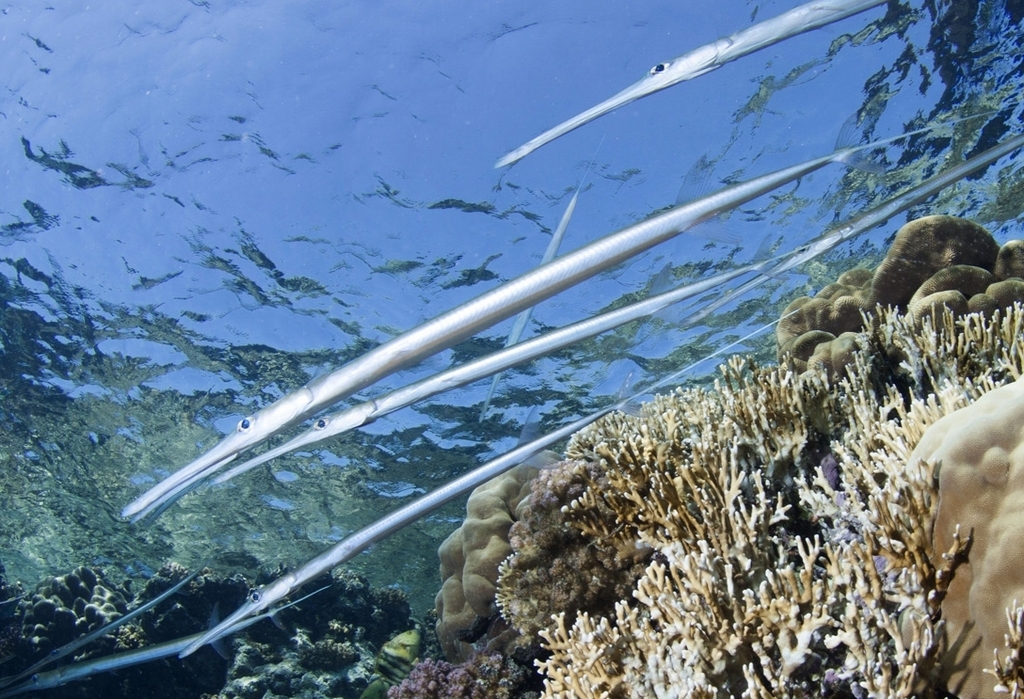
Blue-spotted Cornetfish
Fistularia commersonii
The bluespotted cornetfish (Fistularia commersonii), also known as smooth cornetfish or smooth flutemouth, is a marine fish which belongs to the family Fistulariidae. This very long and slender reef-dweller belongs to the same order as the pipefishes and seahorses, called Syngnathiformes.
From the article Bluespotted cornetfish on Wikipedia (CC BY-SA), quoted section by section
Description
The bluespotted cornetfish grows to a length of 1.6 m (5.2 ft), but the average is around 1 m (3 ft 3 in). It is notable for its unusually long, slender body shape. It has a tubular snout, large eyes, and a long tail filament lined with sensory pores that may help with detecting prey. Its body is tinted blue- to greenish-grey with two thin blue stripes or lines of dots on the back and lighter on the front. Its body pattern changes to a broad-banded pattern at night for camouflage.
Wikipedia: “Morphology”
Range & habitat
It is widespread in the tropical and subtropical waters of the Indo-Pacific as far north as Japan and east to the west coasts of the Americas, including Panama and Mexico's Sea of Cortez and the Red Sea. In 2000, its presence was reported in the Mediterranean Sea off Israel. In the past 20 years, this species experienced a population explosion in the Levantine Sea and a rapid spread westward, reaching the westernmost sectors of the Mediterranean and as far north as the Gulf of Lions by 2007. At this point, it has been recorded in all Mediterranean sub-basins and is now very common in the eastern part. F. commersonii is now considered an invasive species in the Mediterranean Sea because of its rapid development to reproductive stage and its detrimental effect on native fish populations. This is known as the Lessepsian migration which is an event that occurs when fish, usually fish from the Red Sea "migrate" to the Mediterranean Sea from the Suez Canal. The fish in the Mediterranean are all descended from a small number of ancestors, possibly as a result of a single invasion event, and are not as genetically variable as their conspecifics in the Red Sea.
Wikipedia: “Distribution”
Where it lives
Recorded sightings
—
geo-referenced records in GBIF, from museums, herbaria and field observers.
Drag the globe to turn it. Dots are where records exist, not a range map; darker means more records.
In the stacks
Searching the stacks…
Every page naming Fistularia commersonii in the Biodiversity Heritage Library →
This page is assembled live from iNaturalist, GBIF, Wikipedia, the Source Library and the Internet Archive. It is not yet part of the hand-edited codex. iNaturalist taxon 57399.