- Plants
- ›Vascular Plants
- ›flowering plants
- ›Dicots
- ›Mints, Plantains, Olives, and Allies
- ›Mint Family
- ›Nepetoideae
- ›Mentheae
- ›balms, mints, and thymes
- ›Mentha
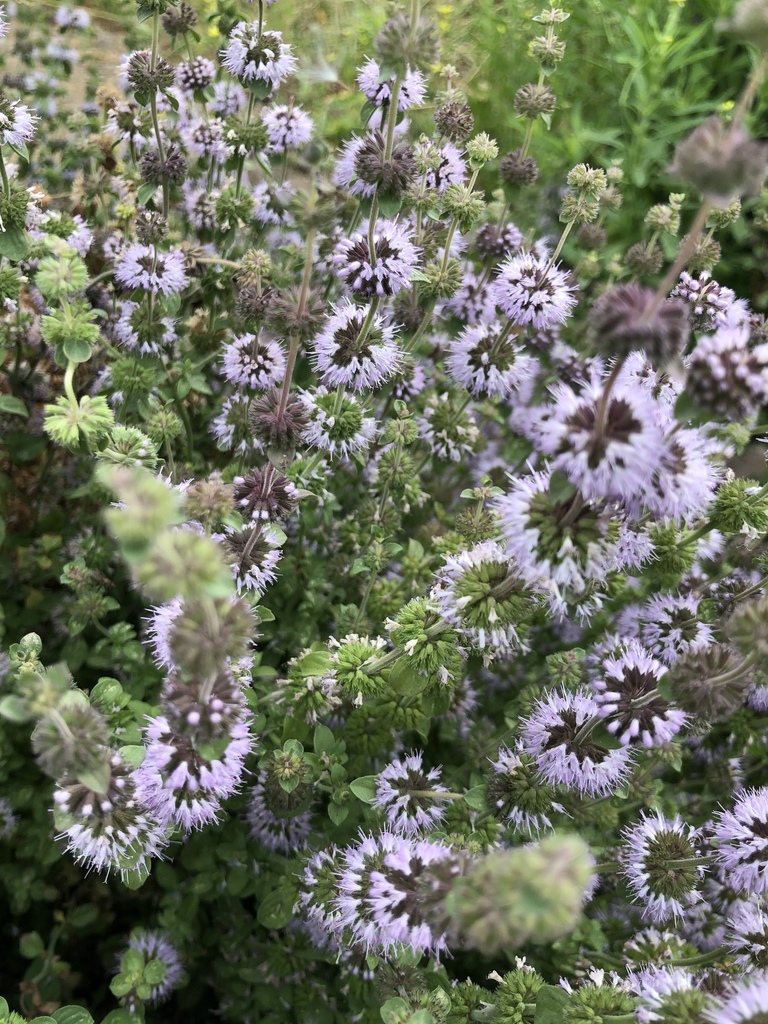
Pennyroyal
Mentha pulegium
Mentha pulegium, commonly (European) pennyroyal, or pennyrile, also called mosquito plant and pudding grass, is a species of flowering plant in the mint family, Lamiaceae, native to Europe, North Africa, and the Middle East. Crushed pennyroyal leaves emit a very strong fragrance similar to spearmint. Pennyroyal is a traditional folk remedy, emmenagogue, abortifacient, and culinary herb, but is toxic to the liver and has caused some deaths. European pennyroyal is related to an American species, Hedeoma pulegioides. Though they differ in genera, they share similar chemical properties.
From the article Mentha pulegium on Wikipedia (CC BY-SA), quoted section by section
Description
An annual to perennial plant with creeping or erect branched stems to about 40 cm in height. The stems are square in cross-section and can vary from hairless on some plants to densely hairy on others, with a green to sometimes red or purplish colour. The leaves, which grow in opposite pairs, are narrowly oval, 2–3 cm long x 1 cm wide, downy, sparsely toothed towards the tip, and taper into a short stalk. All parts of the plant are strongly scented when crushed but it does not have noticeable glands on its surface. The small (6 mm) flowers are densely packed in whorls at the nodes, widely separated, above pairs of leaf-like bracts. The calyx is a ribbed tube about 3 mm long, with five triangular teeth, the lower two being narrower and slightly longer than the upper three; it is hairy both on the inside and the outside. The corolla has four mauve lobes or "petals" and is hairy only on the outside. The flowers are bisexual and have four long stamens, two (or all four) of which project well beyond the corolla lobes. There is one long style which is forked to produce two stigmas, which also project from the flower. …
Range & habitat
The native range of pennyroyal is thought to be around the eastern Mediterranean, where it grows in damp meadows, around pools and in stream margins. It is, however, very widely established around the world, including North and South America, throughout Africa, Asia, Australia and New Zealand. In many places it is considered a troublesome weed of agriculture. Towards the northern edge of its range, as in Britain, it is considered to be rare and declining, except where introduced.
Wikipedia: “Distribution”
What it does
The habitat of pennyroyal is seasonally damp pasture, where standing water over the winter leaves bare ground in the summer, and where livestock preferentially graze other plants. An analogue of this habitat is found on roadsides, where trampling or disturbance of the ground produces similarly bare soil, particularly where there is waterlogging in winter. It is also found along watercourses, in wet woodland and in abandoned fields. In California, where it is considered an invasive species, it occupies a similar niche, in seeps, streamsides, vernal pools and swales, marshes, and ditches. There is some speculation that it may displace native species in these areas. Few animals eat pennyroyal. In Britain, the only insect known to feed on it is the bug Heterogaster artemisiae Schilling, which is a seed bug that normally feeds on wild thyme. It is considered an axiophyte in many British counties, because low-intensity pasture is a rare habitat, although it has been spreading in recent decades. Its Ellenberg values in Britain are L = 8, F = 7, R = 5, N = 7, and S = 0.
Wikipedia: “Habitat and ecology”
At the table
Pennyroyal is frequently used as an insecticide and pest repellent. As a pest repellent, it is used to keep fleas away from household animals as well as on humans to ward off gnats and mosquitos. Some flea collars for pets have pennyroyal oil or the herb can be crushed in the lining. Humans have also put crushed pennyroyal stems in their pockets or on their clothing to ward off unwanted insects. However, when using the pennyroyal plant as a pest repellent, the use of the concentrated pennyroyal oil should be avoided. Pennyroyal oil can be extremely toxic to both humans and animals, even in small quantities. With the use of pennyroyal around animals and humans comes the risk of it being absorbed through the skin and causing negative health effects. The less concentrated leaves of the plant should be used instead as an insect repellent. Pennyroyal has historically also been used as a mint flavoring in herbal teas and foods. It is recommended that pennyroyal tea should not be drunk on a regular basis. Consumption of pennyroyal tea can be fatal to infants and children. In Italy the fresh leaves of this plant, which in Rome and the surrounding area is called menta romana, are used in the capital's cuisine to flavour lamb and tripe. …
Wikipedia: “Uses”
Toxicity
Pennyroyal is toxic to humans and has differing effects dependent on the volume and concentration ingested. The most concentrated and toxic form of the pennyroyal plant is pennyroyal oil. The oil contains pulegone (a cyclohexanone), the molecule found in the highest concentration (80-92%) in the pennyroyal plant. Pulegone causes a variety of ailments in those who ingest it and is what causes the plant to have its peppermint flavor. Symptoms that may persist after ingesting a small dose (<10 mL) of pennyroyal oil are nausea, vomiting, abdominal pain and dizziness. Larger volumes may result in multiorgan failure that could lead to death. There are no current toxicokinetics studies performed on humans for the effects of pulegone, but there are some studies performed on other mammals. When pulegone is ingested, it is broken down by the liver and reacts to form multiple toxic metabolites that can wreak havoc in the body. Some identified metabolites are menthofuran, piperitenone, piperitone, and menthone. As little as 10 mL of pennyroyal oil ingestion was associated with moderate to severe hepatic toxicity.
Where it lives
Recorded sightings
—
geo-referenced records in GBIF, from museums, herbaria and field observers.
Drag the globe to turn it. Dots are where records exist, not a range map; darker means more records.
In the old herbals & bestiaries

Notable Commentaries on the History of Plants
Leonhart Fuchs · 1549 · p.230

Living Images of Plants
Otto Brunfels · 1532 · p.237

Commentaries on the Six Books of Dioscorides
Pietro Andrea Mattioli · 1560 · p.507

Commentaries on the Six Books of Pedanius Dioscorides on Medical Matter
Pietro Andrea Mattioli · 1565 · p.876

On the Virtues of Herbs
Macer Floridus (Odo of Meung) · 1090 · p.44

Latin Herbal with German Synonyms
1484 · p.251

Latin Herbal
1484 · p.223

Herbarius
1485 · p.224

Herbarius latinus (with Dutch synonyms)
1486 · p.221

Latin Herbal with German Synonyms
1486 · p.224

Garden of Health (Hortus Sanitatis)
Jacob Meydenbach · 1491 · p.277

Ortus sanitatis
1491 · p.340
In the stacks
Searching the stacks…
Every page naming Mentha pulegium in the Biodiversity Heritage Library →
This page is assembled live from iNaturalist, GBIF, Wikipedia, the Source Library and the Internet Archive. It is not yet part of the hand-edited codex. iNaturalist taxon 57116.