- Plants
- ›Vascular Plants
- ›flowering plants
- ›Dicots
- ›Sunflowers, Bellflowers, Fanflowers, and Allies
- ›Sunflowers, Daisies, Asters, and Allies
- ›Asteroideae
- ›groundsels and allies
- ›Senecioninae
- ›Curio
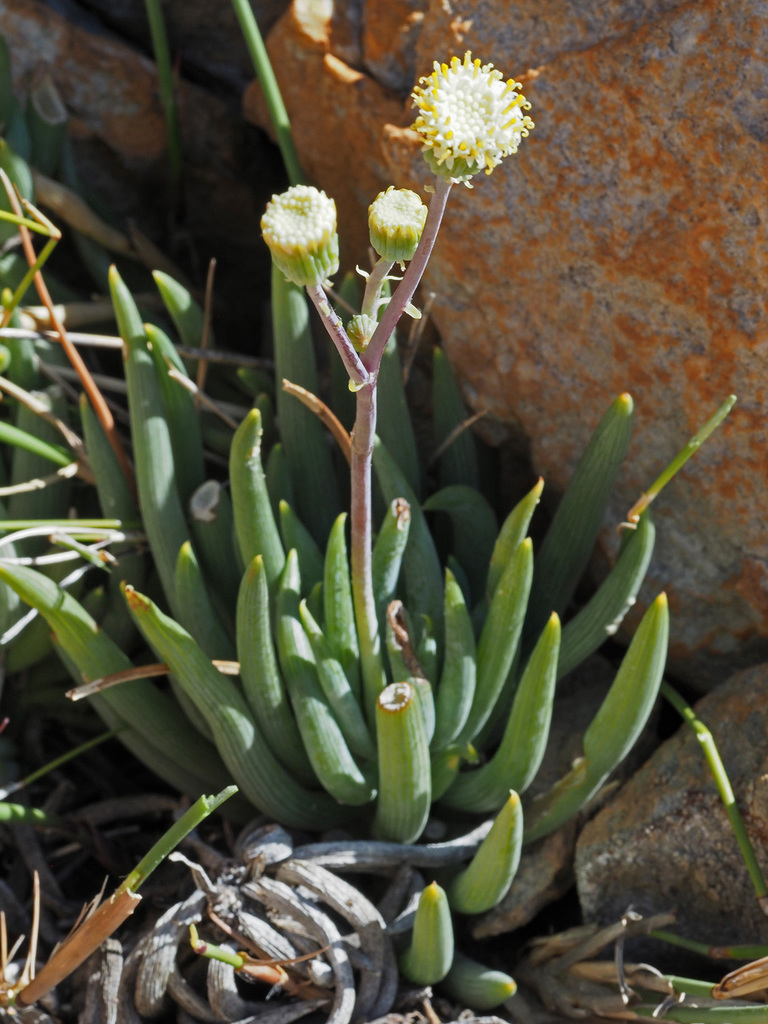
Bluestraws
Curio talinoides
Curio talinoides, syn. Senecio mandraliscae, also known as blue straws, blue chalksticks, dassieharpuis, or narrow-leaf chalk sticks, is a succulent plant of the family Asteraceae that is native to South Africa. The origin of this plant is dubious and it may be a hybrid.
From the article Curio talinoides on Wikipedia (CC BY-SA), quoted section by section
Description
The bluest of the curio plants, it is about 50 to 70 cm tall with 4.5-9.5 cm long leaves that are thickly and alternately arranged, jammed on the stems, and are set about 0.3-0.5 cm aside. The leaves are linear, rising, sickle shaped and would be narrow at both ends. Unlike the similar looking Curio repens, its leaves are much narrower and elongated. Curio repens is also easily distinguished by its shorter, often boat-shaped leaves. It is also easily confused with Curio ficoides, which has a similar growth habit. However, the leaves of C. talinoides are rounded-cylindrical in cross section. In contrast, the leaves of C. ficoides are usually somewhat knife-like, flattened laterally. A hybrid of this and 'repens', known as Senecio 'Trident Blue', exists.
Where it lives
Recorded sightings
—
geo-referenced records in GBIF, from museums, herbaria and field observers.
Drag the globe to turn it. Dots are where records exist, not a range map; darker means more records.
In the stacks
Searching the stacks…
Every page naming Curio talinoides in the Biodiversity Heritage Library →
This page is assembled live from iNaturalist, GBIF, Wikipedia, the Source Library and the Internet Archive. It is not yet part of the hand-edited codex. iNaturalist taxon 570734.