- Animals
- ›Chordates
- ›Vertebrates
- ›Mammals
- ›Therians
- ›Placental Mammals
- ›Ungulates, Carnivorans, and Allies
- ›Carnivorans
- ›Raccoons, Coatis, and Allies
- ›Bassaricyon
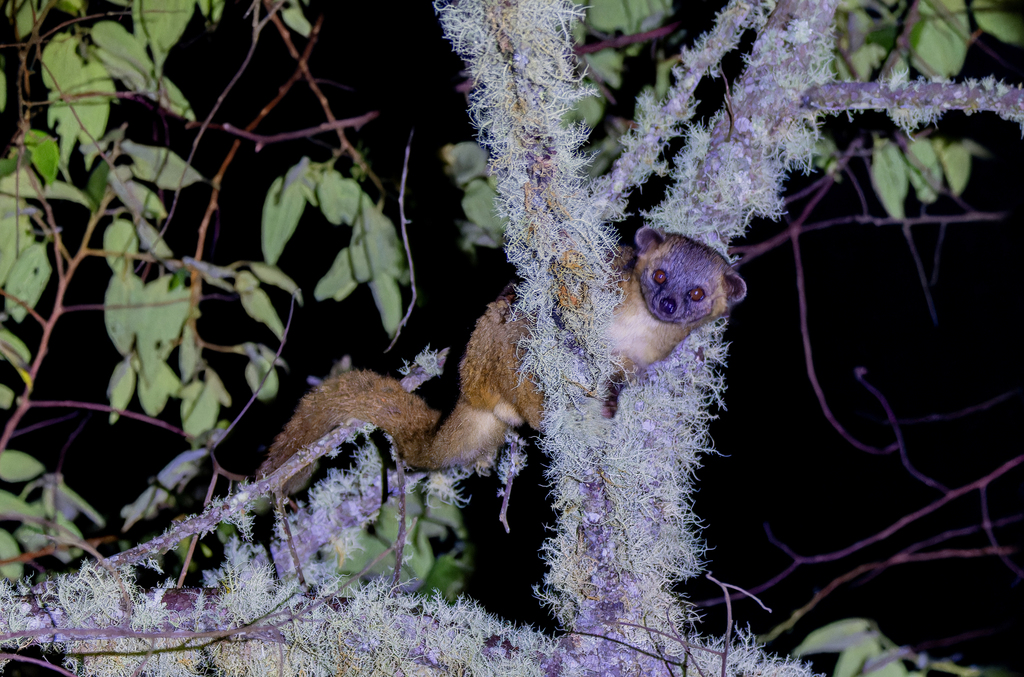
Eastern Lowland Olingo
Bassaricyon alleni
The eastern lowland olingo (Bassaricyon alleni) is a species of olingo from South America, where it is known from the lowlands east of the Andes in Bolivia, Brazil, Colombia, Ecuador, Guyana, Peru and Venezuela. It is the only olingo species found east of the Andes. The Latin species name honors Joel Asaph Allen, the American zoologist who first described the genus Bassaricyon.
From the article Eastern lowland olingo on Wikipedia (CC BY-SA), quoted section by section
Description
The eastern lowland olingo is smaller than the northern olingo, but is larger than the little olingo, the most montane member of the genus. It is larger than the western lowland olingo subspecies Bassaricyon medius medius from west of the Andes, but about the same size as the Bassaricyon medius orinomus subspecies from eastern Panama. The pelage is slightly darker than the western species. It has a head-body length of 30 to 45 centimetres (12 to 18 in), with a tail length of 40 to 53 centimetres (16 to 21 in), and weighs 1.1 to 1.5 kilograms (2.4 to 3.3 lb). It has large eyes adapted for nocturnal vision, and short, rounded ears. The fur is soft brownish-gray with the long tail aiding in balance and gripping during arboreal movement. The olingo is primarily nocturnal, and spend most of the day on tree tops or dens. They are omnivorous and consume fruits and flowers, insects and other small prey.
== References ==
Wikipedia: “Description and behavior”
Range & habitat
The olingo occurs across most of South America from the lowlands east of the Andes in Bolivia, Brazil, Colombia, Ecuador, Guyana, Peru and Venezuela. It is the only olingo species found east of the Andes. The closest relative of the eastern lowland olingo is the Western lowland olingo, from which it diverged about 1.3 million years ago. It is classified as Least Concern in the IUCN Red List.
Wikipedia: “Distribution and habitat”
Listen
Looking for field recordings…
Where it lives
Recorded sightings
—
geo-referenced records in GBIF, from museums, herbaria and field observers.
Drag the globe to turn it. Dots are where records exist, not a range map; darker means more records.
In the stacks
Searching the stacks…
Every page naming Bassaricyon alleni in the Biodiversity Heritage Library →
This page is assembled live from iNaturalist, GBIF, Wikipedia, the Source Library and the Internet Archive. It is not yet part of the hand-edited codex. iNaturalist taxon 569557.