- Animals
- ›Chordates
- ›Vertebrates
- ›Mammals
- ›Therians
- ›Placental Mammals
- ›Afromammals
- ›Proboscideans
- ›Elephants
- ›Loxodonta
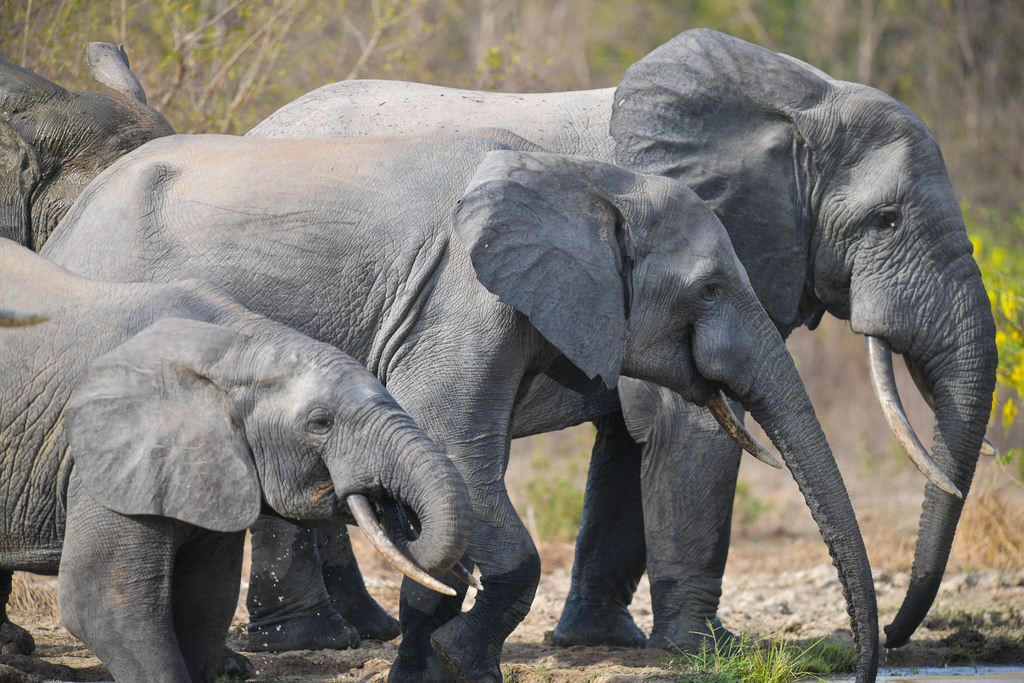
Savannah × Forest Elephant
Loxodonta africana × cyclotis
African elephants are members of the genus Loxodonta comprising two living elephant species, the African bush elephant (L. africana) and the smaller African forest elephant (L. cyclotis). Both are social herbivores with grey skin. However, they differ in the size and colour of their tusks as well as the shape and size of their ears and skulls.
Both species are at risk of extinction according to the IUCN Red List; as of 2021, the bush elephant is considered endangered while the forest elephant is considered critically endangered. They are threatened by habitat loss and fragmentation, along with poaching for the illegal ivory trade in several range countries.
From the article African elephant on Wikipedia (CC BY-SA), quoted section by section
Range & habitat
African elephants are distributed in Sub-Saharan Africa, where they inhabit Sahelian scrubland and arid regions, tropical rainforests, mopane and miombo woodlands. African forest elephant populations occur only in Central and West Africa.
Wikipedia: “Distribution and habitat”
What it does
African elephants are not strictly territorial but they display various types of patterns of space use which are influenced by social structure, seasonal and climate variation, and resource availability. Herds usually live in home ranges that vary from several hundred to several thousand square kilometers depending on the resource availability and habitat conditions; herds follow migratory routes and movement patters which connects protected areas and other suitable habitats that play an important role on maintaining population connectivity and access to critical resources such as vegetation and water. Additional factors such as social dominance and environmental factors like rainfall and vegetation productivity also influences spatial segregation among groups within the same region.
Aggression, fighting, and dominance. African elephants displays complex patterns of aggression accompanied with dominance, especially within adult males. Musth is a term which refers to physiological state where male African elephants exhibit massive surges of testosterone, heightened sexual activity, and increased aggression and is observed during male - male competition. During the period where male African elephant undergo musth, they display characteristic behavior which includes temporal gland secretion, urine dribbling, and certain postures which explains their condition to other individuals. …
Wikipedia: “Territorial behavior and space use”
In human culture
The name Loxodonta comes from the Ancient Greek words λοξός (loxós, "slanting", "crosswise") and ὀδούς (odoús, "tooth"), referring to the lozenge-shaped enamel of the molar teeth, which differs significantly from the rounded shape of the Asian elephant's molar enamel.
Wikipedia: “Etymology”
Listen
Looking for field recordings…
Where it lives
Recorded sightings
—
geo-referenced records in GBIF, from museums, herbaria and field observers.
Drag the globe to turn it. Dots are where records exist, not a range map; darker means more records.
In the stacks
This page is assembled live from iNaturalist, GBIF, Wikipedia, the Source Library and the Internet Archive. It is not yet part of the hand-edited codex. iNaturalist taxon 568907.