- Animals
- ›Chordates
- ›Vertebrates
- ›Birds
- ›Cranes, Rails, and Allies
- ›Rails, Gallinules, and Coots
- ›Aramidopsis
On eBird ↗
Snoring Rail
Live sightings near you, the range map, bar charts of when it is seen, and Macaulay Library photos and recordings.
Snoring Rail
Aramidopsis plateni
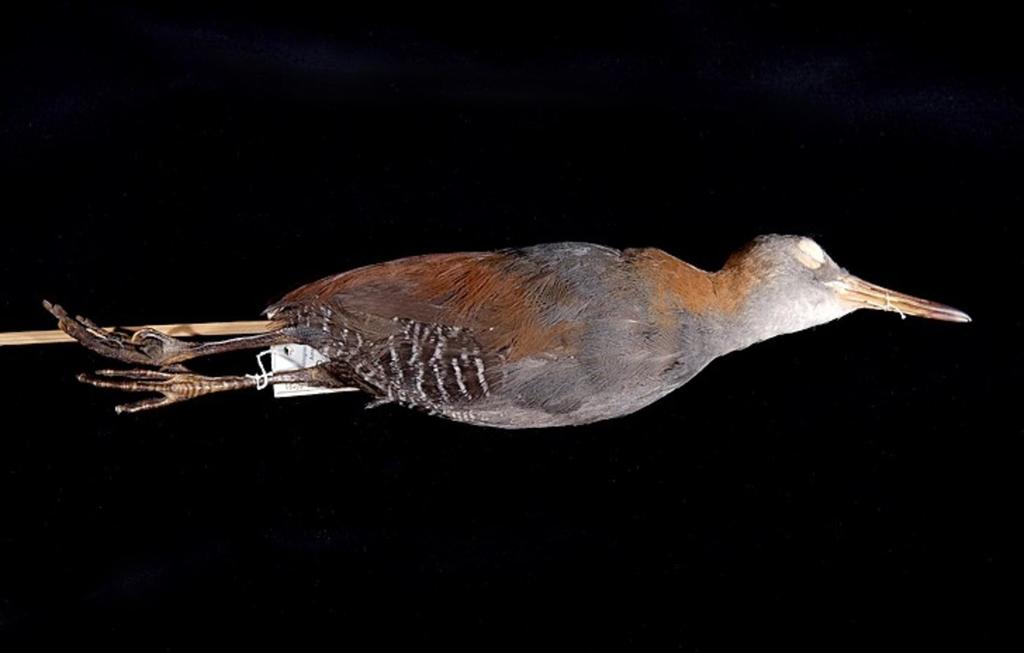
The snoring rail (Aramidopsis plateni), also known as the Celebes rail or Platen's rail, is a large flightless rail and the only member of the genus Aramidopsis. The species is endemic to Indonesia, and it is found exclusively in dense vegetation in wet areas of Sulawesi and nearby Buton. The rail has grey underparts, a white chin, brown wings and a rufous patch on the hind-neck. The sexes are similar, but the female has a brighter neck patch and a differently coloured bill and iris. The typical call is the snoring: ee-orrrr sound that gives the bird its English name.
Its inaccessible habitat and retiring nature mean that the snoring rail is rarely seen and as a result, little is known of its behaviour. Only the adult plumage has been described, and the breeding behaviour is unrecorded. It feeds on small crabs and probably other small prey such as lizards. Although protected under Indonesian law since 1972, the rail is threatened by habitat loss (even within nature reserves), hunting for food and predation by introduced species; it is therefore evaluated as vulnerable on the IUCN Red List.
From the article Snoring rail on Wikipedia (CC BY-SA), quoted section by section
Description
The snoring rail is 30 cm (12 in) long and weighs 143–160 g (5.0–5.6 oz). It is flightless, with short wings, a very short tail and strong legs and feet. The back and the underparts from the forecrown to the breast are grey, apart from a white chin, and the sides and rear of the neck are deep orange-red. Most of the rest of the upperparts are brown, and the belly, flanks, and undertail have white barring. The male has black legs, a yellow iris and a brown and greenish down-curved bill. The female is similar but has a brighter hindneck colour, less white on the chin, a red iris, a cream and reddish bill and blue-grey legs. Immature and juvenile plumages are undescribed. Visual confusion with sympatric rails is unlikely. The blue-faced rail is similar in size, but is chestnut above and black below, and the buff-banded rail has strongly marked upperparts, breast, and head. The slaty-breasted rail is smaller and has barred upperparts. The call, given frequently, is a short wheez followed by a distinctive snoring ee-orrrr. A deep hmmmm sound has also been recorded.
Range & habitat
The species is an uncommon Indonesian endemic of lowland and hill forests in northern, north central and southeastern Sulawesi. Another population was found on Buton island in 1995. The typical habitat of this species is dense vegetation in wet areas. This may include impenetrable bamboo and liana in forests, rattan in regrown forests, or elephant grass and bushes on the hillsides of Minahassa Peninsula. Claims of the species occurring in rice fields are believed to be due to confusion with the buff-banded rail. The snoring rail occurs from sea level to 1,300 m (4,300 ft).
Wikipedia: “Distribution and habitat”
What it does
Its inaccessible habitat and sparse distribution means that little is known about this species. A few birds were shot by Platen and another expedition led by Paul Sarasin and his second cousin, Fritz, between 1893 and 1898, but the rail was then not seen for more than thirty years until Heinrich found it almost at the end of a two-year survey of Sulawesi, then known as Celebes. He described it as "the most priceless catch that I have ever hunted or will hunt". More than a decade later, Dutch ornithologist Louis Coomans de Ruiter also took a year to find the rail, despite concentrating on known suitable habitat. There were then no documented sightings until birds were observed in 1983 and 1989. Sight records remain infrequent, and only about ten specimen corpses have been studied. The snoring rail catches crabs in highland streams, and these crustaceans may be a major dietary item. It also forages in muddy areas, and has been recorded as consuming lizards. Nothing is known of its breeding behaviour other than a report of an adult seen feeding with two chicks in August 1983, but the original report gives no details of the claimed sighting.
Wikipedia: “Behaviour”
Listen
Looking for field recordings…
Where it lives
Recorded sightings
—
geo-referenced records in GBIF, from museums, herbaria and field observers.
Drag the globe to turn it. Dots are where records exist, not a range map; darker means more records.
In the stacks
Searching the stacks…
Every page naming Aramidopsis plateni in the Biodiversity Heritage Library →
This page is assembled live from iNaturalist, GBIF, Wikipedia, the Source Library and the Internet Archive. It is not yet part of the hand-edited codex. iNaturalist taxon 565.